
BrandCook 👨🍳
Cook raw brandbooks into agent-ready skills.
BrandCook compiles guidelines, assets, and source material into a reusable brand system for AI agents.
Why it exists
Most brand guidance is written for people. AI agents can read it, but they often lose exact values, generalize from a single example, invent missing rules, or use assets without checking distribution rights. BrandCook turns that guidance into a small operational package that another agent can query reliably.
The generated skill separates:
- observed source facts from operational proposals;
- evidence from approval status;
- primitive values from stable semantic aliases;
- brand truth from presentation, website, image, and other production engines;
- package provenance from visible brand output.
- canonical Brand Core truth from operational creative direction;
- semantic content from transformable visual presentation;
- concept-ready work from genuinely production-ready output.
Modes
rules-onlycreates the original compact Brand Core for extraction, audit, lookup, and integration.production-readyadds scoped art direction, native metaphors, generation recipes, surface adapters, deterministic asset resolution, semantic diff, visual evals, and production-status checks.
Existing contract 1.0 brand skills remain valid. Version 2.0 adds modules without requiring old packages to migrate unless they need visual production guidance.
Demo gallery
These examples were made from brand guidelines and reference materials that were publicly accessible online at the time of the demo. BrandCook was not model-trained on these brands: it compiled the available guidance into local agent-ready skills, then used those skills to guide independent visual concepts for the same BrandCook brief.
The original brandbooks, proprietary fonts, and source asset libraries are not included in this repository. Public availability does not imply a right to redistribute the source documents. These screenshots are unofficial demonstrations, are not endorsed by or affiliated with the referenced brands, and all trademarks belong to their respective owners.
| Spotify reference | Apple reference |
|---|---|
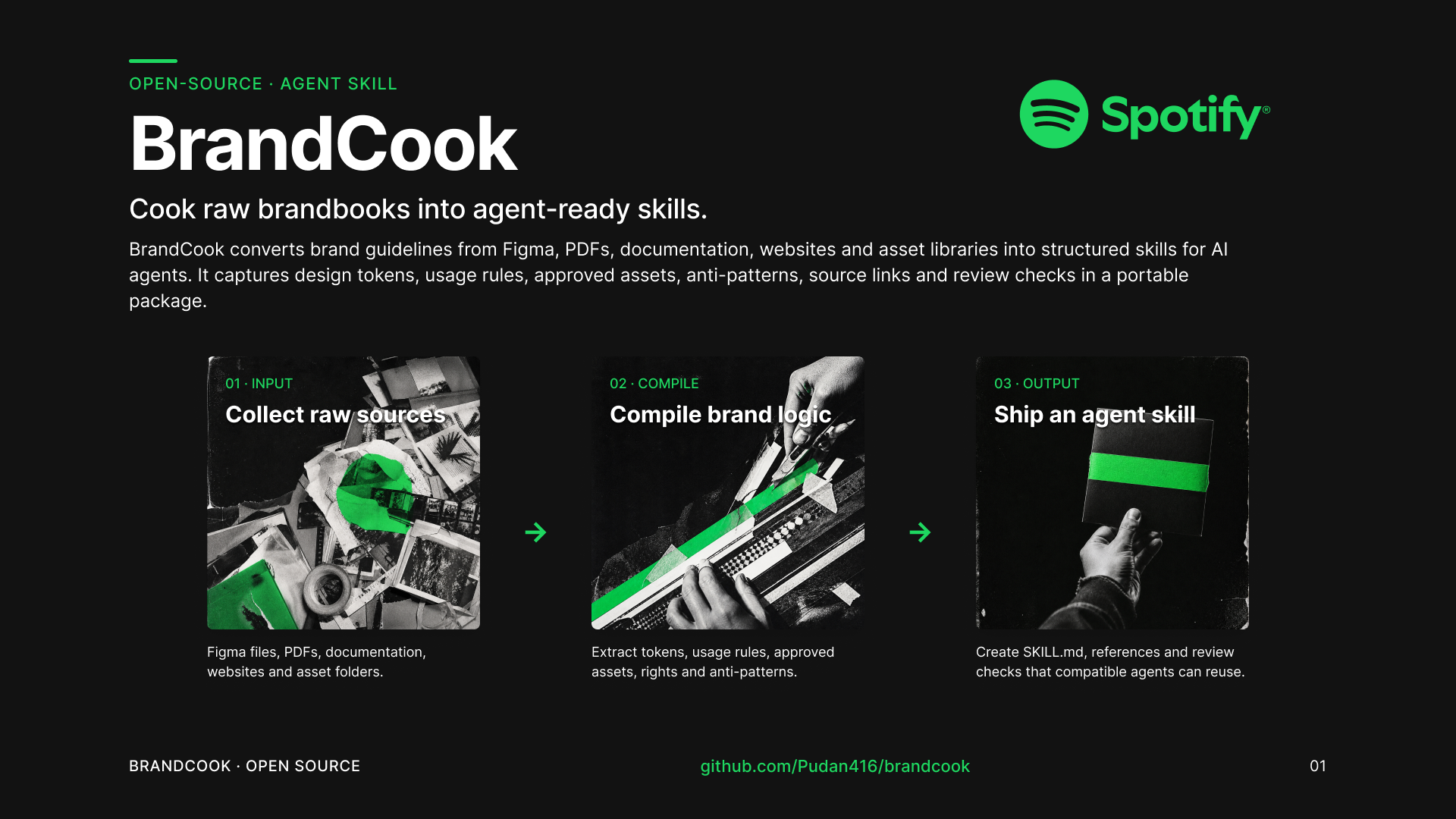 |
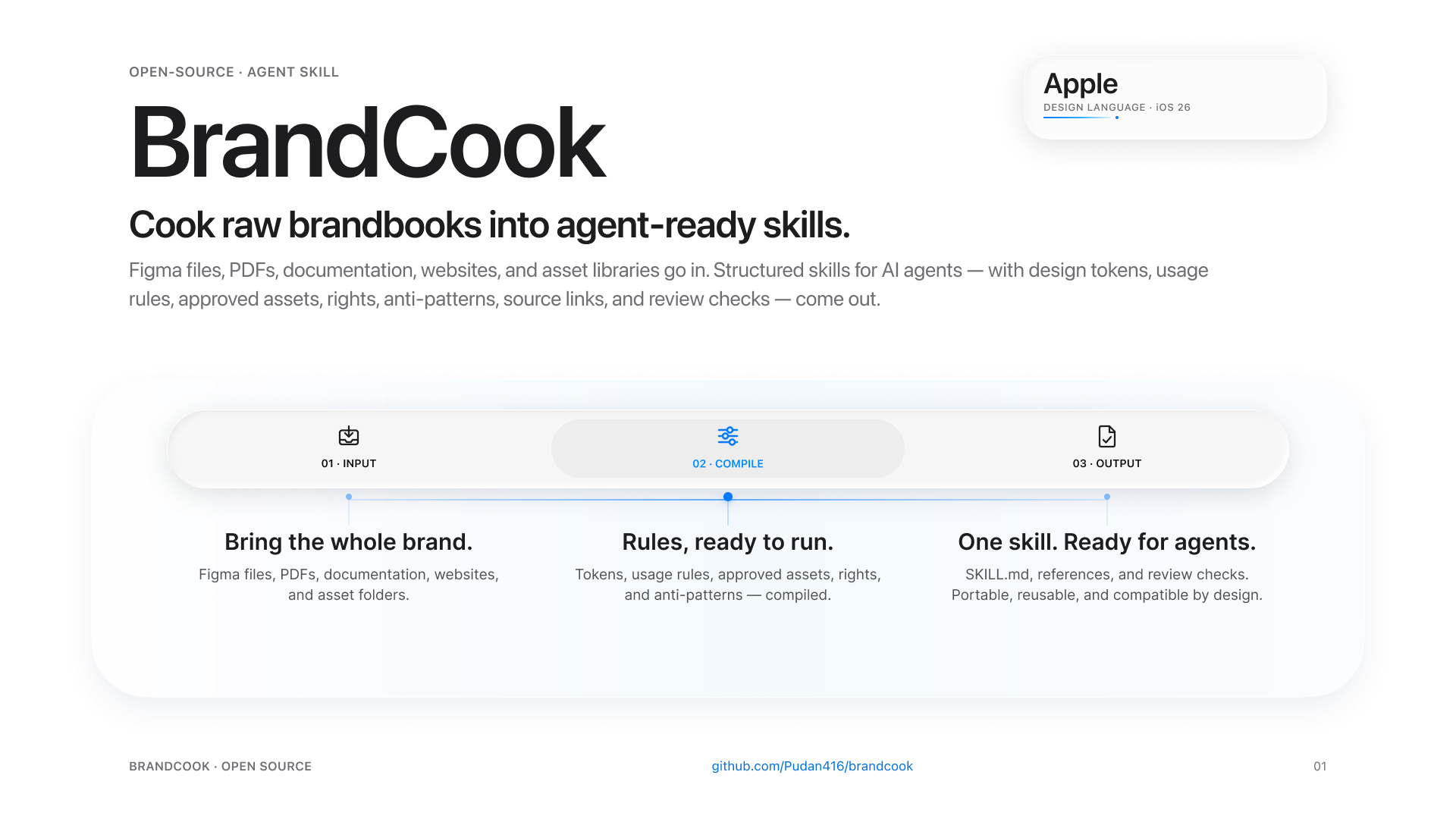 |
| McDonald’s reference | FIFA 2026 reference |
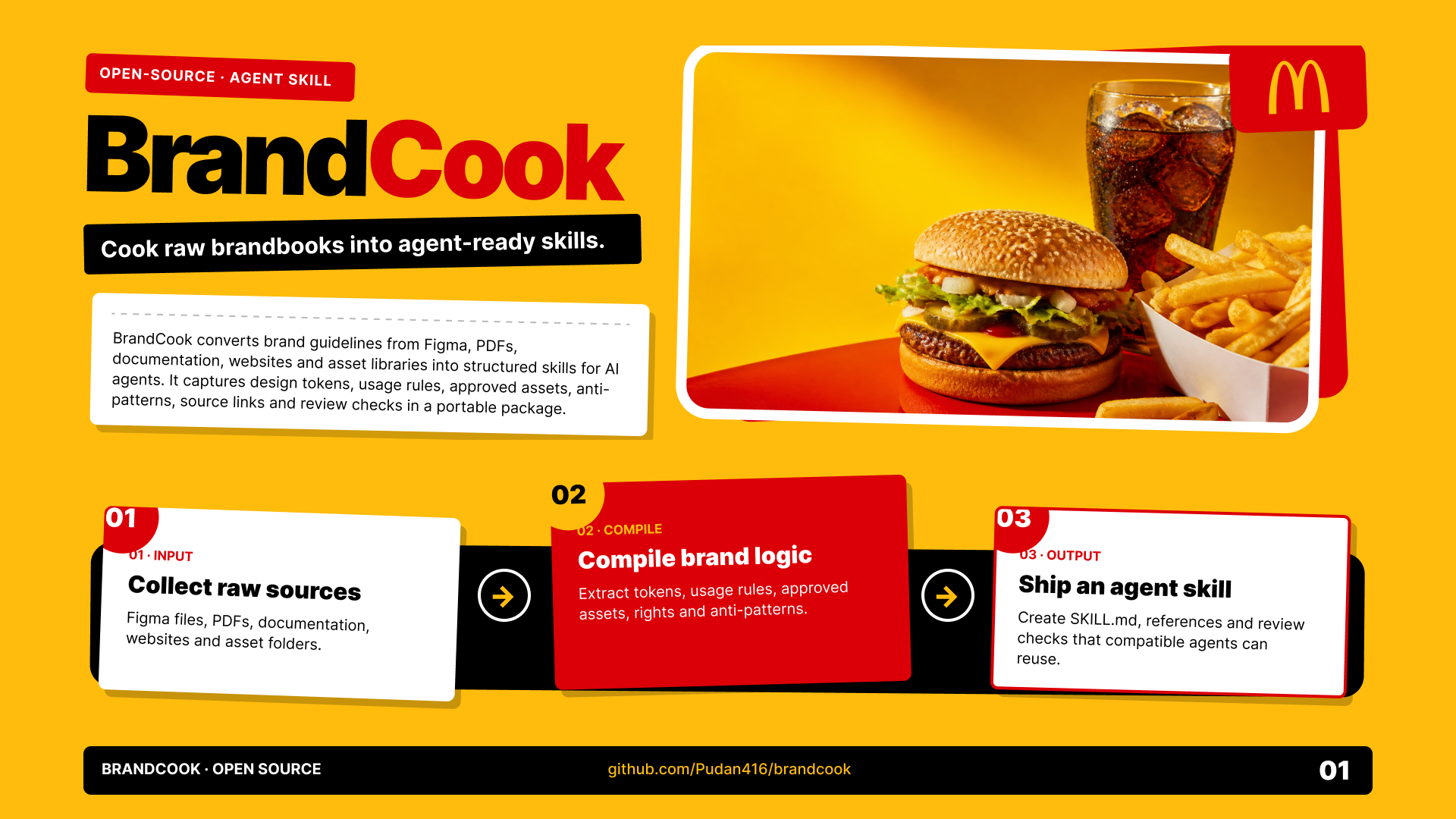 |
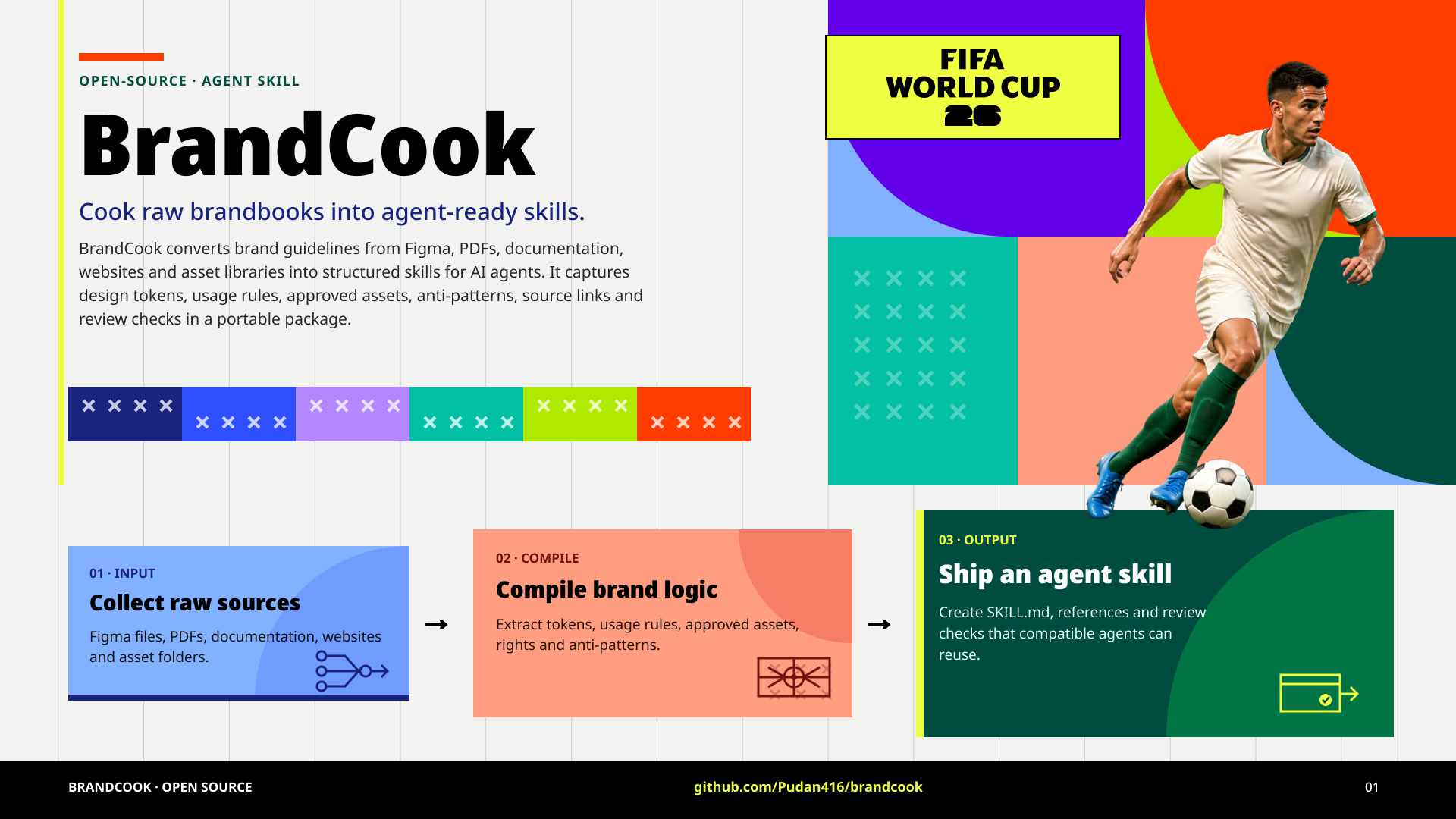 |
Repository layout
skills/brandcook/          Installable Agent Skill
examples/aurora-coffee/     Synthetic source material for a safe demo
docs/images/demo/            Static screenshots of public-source demos
scripts/                    Public-release audit
.github/workflows/          Cross-platform CI
Install
Codex
Ask the skill installer to install the GitHub directory:
$skill-installer install https://github.com/Pudan416/brandcook/tree/main/skills/brandcook
Restart Codex after installation.
Claude Code
Clone the repository and copy skills/brandcook to ~/.claude/skills/brandcook, then restart Claude Code.
Other Agent Skills clients
Copy skills/brandcook into the client's configured skills directory. The core package follows the open Agent Skills folder format; client-specific metadata is optional.
Quick start
Give your agent one or more brand sources and ask:
Turn these guidelines into a production-ready brand skill for presentations.
Preserve semantic content, keep approved facts separate from operational creative
direction, resolve assets safely, and include behavioral and visual evals.
You can also scaffold a package directly:
python3 skills/brandcook/scripts/init_brand_skill.py aurora-coffee \
  --brand "Aurora Coffee" \
  --output /tmp \
  --mode production-ready \
  --surfaces presentation,cover
Fork maintainers can override package provenance:
python3 skills/brandcook/scripts/init_brand_skill.py example-brand \
  --brand "Example Brand" \
  --output /tmp \
  --creator-name "Example Studio" \
  --creator-handle "example-studio" \
  --creator-url "https://github.com/example-studio/brandcook"
Then populate the scaffold from the inspected sources and validate it:
python3 skills/brandcook/scripts/validate_brand_skill.py \
  /tmp/aurora-coffee --strict
What a generated skill contains
brand-name/
├── SKILL.md
├── brand-constants.json
├── sources.json
├── decisions.json
├── provenance.json
├── content-policy.json              # production-ready only
├── assets/                          # manifest, masters, resolvers
├── art-direction/                   # production-ready only
├── generation/                      # production-ready only
├── applications/                    # declared surfaces only
├── references/
├── scripts/
├── examples/evaluated-directions.json
└── evals/
Production-ready output must pass content preservation, asset integrity, screenshot review, and the brand-transplant test: if another logo and palette can be substituted while leaving nearly the same design, the result is too generic.
Safety and rights
The bundled scripts are dependency-free and never upload brand sources. Master scaffolding, validation, and asset resolution run locally. URLs in an asset manifest are inert metadata: the bundled resolver performs no network requests. A remote asset must be downloaded by a separate environment-authorized tool with its own egress controls, then passed to the resolver with --source-file; the resolver verifies the declared SHA-256 before copying. Review the data policy of any external connector or download tool separately.
Do not publish a generated brand skill until every bundled font, logo, image, and source excerpt has redistribution rights. A private source being readable does not make it publishable.
Use only material you are authorized to process. For a safe first run, use the synthetic Aurora Coffee example.
Development
python3 -m unittest discover \
  -s skills/brandcook/scripts \
  -p 'test_*.py' -v

python3 scripts/audit_public_release.py .
Python 3.10 or newer is required for the bundled tools. See CONTRIBUTING.md for contribution rules and SECURITY.md for private vulnerability reporting.
Status
Use the release checklist before a tagged public release.
License
Apache License 2.0. See LICENSE.
Created and maintained by Pudan416.
No comments yet
Be the first to share your take.