
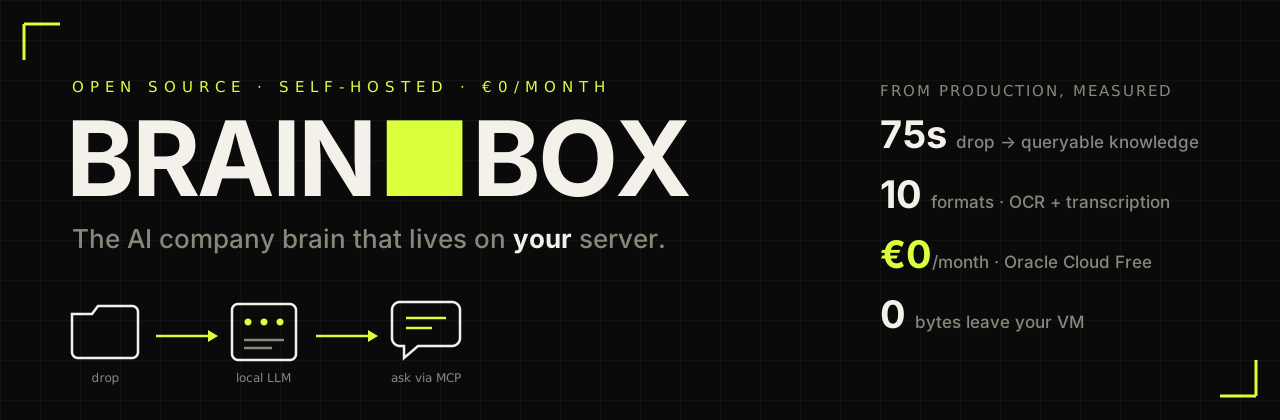
Brain Box — a self-hosted AI company brain that costs €0/month
Brain Box turns a free Oracle Cloud VM into a private, drag-and-drop company knowledge base your team queries in plain language from Claude Code, Codex or Gemini CLI — and no byte of your data ever leaves your server.
🌍 Website: getbrainbox.vercel.app · 🇮🇹 Guida rapida in italiano
Employees drop files (PDF, Word, Excel, scans, photos of invoices, audio, video) into a folder on their Desktop. ~75 seconds later the content is converted, versioned in git, embedded and queryable via MCP with cited answers. A local LLM (Gemma, via Ollama) extracts facts and reasons over your documents — on your hardware.
This is not a demo. It is the production template of a real company brain: ~8,250 chunks, 54 business books, 10 file formats, nightly self-testing, self-healing, verified backup restore — running 24/7 on Oracle Cloud's Always Free tier.
employee's Mac                        your VM (Ubuntu 24.04 + Docker + Tailscale)
─ Desktop/"Company Brain"/ ─watcher─▶ upload gate ─▶ ingest: convert → git → embed
─ Claude Code / Codex ───────MCP────▶ gbrain /mcp ◀──▶ Postgres + pgvector
                                      └─ Ollama: bge-m3 · gemma (chat) · glm-ocr
                     (all traffic inside your private Tailscale network)
Why would I self-host a company brain?
Because your contracts, financials and meeting notes should not train someone else's model — and because it can be free. Brain Box runs entirely on one VM: retrieval, embeddings, OCR, transcription and the reasoning LLM are all local. The Oracle Cloud Always Free ARM shape (4 OCPU / 24 GB RAM) runs the whole stack at €0/month, forever.
| SaaS knowledge base | Brain Box | |
|---|---|---|
| Monthly cost | €20–50 per seat | €0 (Oracle Free tier) |
| Your data | on their servers | on your VM, in git |
| LLM | theirs, cloud | local Gemma via Ollama |
| Access | web app | your AI agent, via MCP |
| Formats | usually text | 10 formats incl. scans, images, audio/video |
| Exit strategy | export and pray | brain/ is plain markdown in git |
How does it work?
One folder in, one connector out. The system of record is brain/<department>/ — plain markdown in git. Postgres+pgvector is a derived cache you can always rebuild.
- Drop — a launchd watcher uploads new files to the gate (bearer token per employee, department folders enforce access). Measured: drop → queryable in ~75s.
- Ingest — files convert to markdown (PyMuPDF, per-page OCR lane with glm-ocr for scans, faster-whisper for audio/video), get provenance frontmatter, git commit, embed with bge-m3.
- Query — agents connect via MCP (
/mcp, bearer auth). Hybrid search (vector + keyword), answers cite sources. Fact extraction with a local Gemma runs automatically after ingest (~23s/doc with the no-think patch). - Self-defense — nightly acceptance suite (6 end-to-end tests), a deterministic guardian (cron */15) that heals known failures, nightly backups with a restore script that has actually been drilled.
Quickstart — what do I need?
A free Oracle Cloud account, a free Tailscale account, and ~1 hour. Full click-by-click guide (VM shape, network, every parameter): docs/DEPLOY.md · 🇮🇹 Guida in italiano
# on the VM (Ubuntu 24.04 LTS — 24.04 exactly, see docs):
git clone https://github.com/uppifyagency/brain-box && cd brain-box/box
vi config.yml     # company name, departments, exposure, llm
./install.sh      # idempotent: secrets → containers → models → smoke test
Then register employees (client-kit/register-employee.sh), install the drop folder on their Mac (client-kit/drop-installer/), and add the MCP connector to their agent:
claude mcp add brain -s user --transport http "https://<your-box>/mcp" \
  --header "Authorization: Bearer <employee-token>"
What's in the box?
| Path | What it does |
|---|---|
box/ |
the deployable template (~25 KB): install.sh, compose, engine patches, gate, ingest pipeline, ops |
box/ops/ |
backup + drilled restore, guardian (self-healing), nightly acceptance runner, offline-bundle builder |
box/client-kit/ |
employee registration, Desktop drop-folder installer (macOS), connector recipes |
docs/DEPLOY.md |
deploy from zero on Oracle Cloud Free — every step, every parameter |
docs/ARCHITECTURE.md |
topology, data flows with measured latencies, every tunable, hard-won troubleshooting table |
landing/ |
the project's landing page (static, Vercel-ready) |
The engine is gbrain (MIT), pinned to a verified commit and patched in the Dockerfile for CPU-only operation (embedding batch caps, concurrency, optional no-think mode for reasoning models — each patch documented in docs/ARCHITECTURE.md). We have filed our findings upstream as issues #2552–#2557.
Frequently asked questions
Is it really free?
Yes — Oracle Cloud's Always Free tier includes an ARM VM (VM.Standard.A1.Flex, up to 4 OCPU / 24 GB / 200 GB disk) that never expires. Tailscale is free up to 100 devices. The models (bge-m3, Gemma, glm-ocr) are open weights running on your VM. Your only real cost is the hour it takes to deploy.
Is my data safe?
Your data lives in markdown in git on your VM, reachable only inside your private Tailscale network (the public SSH port gets closed during setup; the upload gate and MCP endpoint are tailnet-only by default). The local LLM means documents are never sent to a cloud model. Every access goes through a per-employee bearer token with department-level permissions.
What hardware does it need?
4 vCPU / 24 GB RAM / 60+ GB disk recommended — exactly the free Oracle ARM shape. It runs fine on CPU only: embeddings ~2.4s/chunk, OCR 6–9s/page warm, fact extraction ~23s/doc. Any Ubuntu 24.04 box (a Mac mini in the office, a Hetzner VM) works the same.
Which AI agents can query it?
Anything that speaks MCP over HTTP with bearer auth: Claude Code, claude.ai (with public exposure enabled), Codex CLI, Gemini CLI. Recipes in box/client-kit/CONNETTORI.md.
Italian comments in the code?
Yes — Brain Box was born inside Delera (Italian company) and this repo is the production template, not a cleaned-up copy. Runbooks and inline comments are in Italian; the docs in docs/ are English. Authenticity over polish.
No comments yet
Be the first to share your take.