
Better Thinking
Models don't get smarter when you ask them to think harder - they get better when you give them a better procedure to think with.
Structured reasoning (naming assumptions, weighing alternatives, checking evidence) reliably produces better answers than "think step by step" ever could, but Claude usually defaults to the first reasonable-sounding approach instead of the rigorous one for the situation.
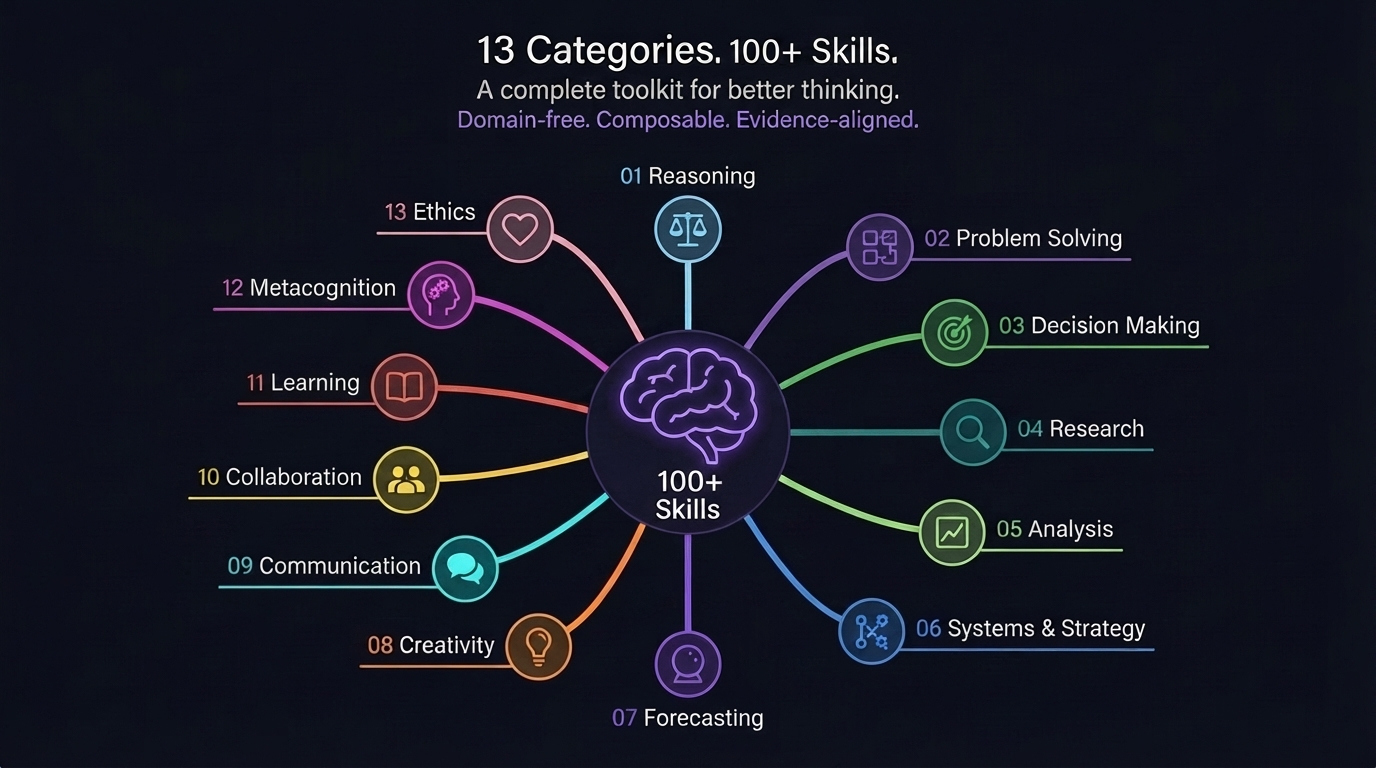
Better Thinking is a plugin that gives it a library of 135 explicit thinking procedures, e.g.:
- How to run a proper decision analysis.
- How to debug from symptoms to root cause.
- How to evaluate competing hypotheses.
Better Thinking has a dispatcher that picks the right method for the task in front of it, instead of you having to know which technique to ask for.
Think of it less like a persona ("act like an analyst") and more like a checklist a skilled analyst would actually follow.
How to activate it
Once installed (see below), just start any nontrivial task by typing:
/better-thinking
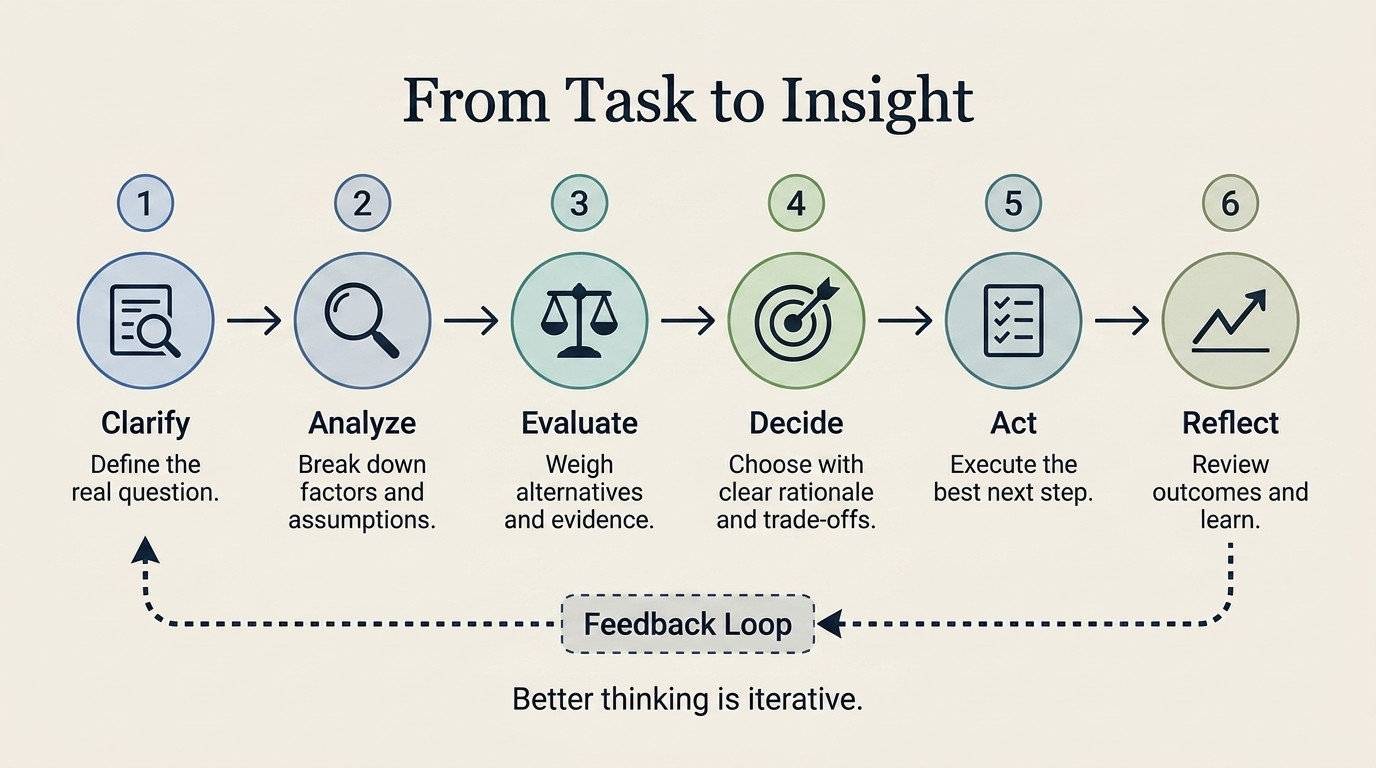
That's it. It looks at what you're asking, classifies the task (is this a decision? a diagnosis? a negotiation? research?) and how much is riding on it, then pulls in the right thinking skill(s) at the right depth automatically.
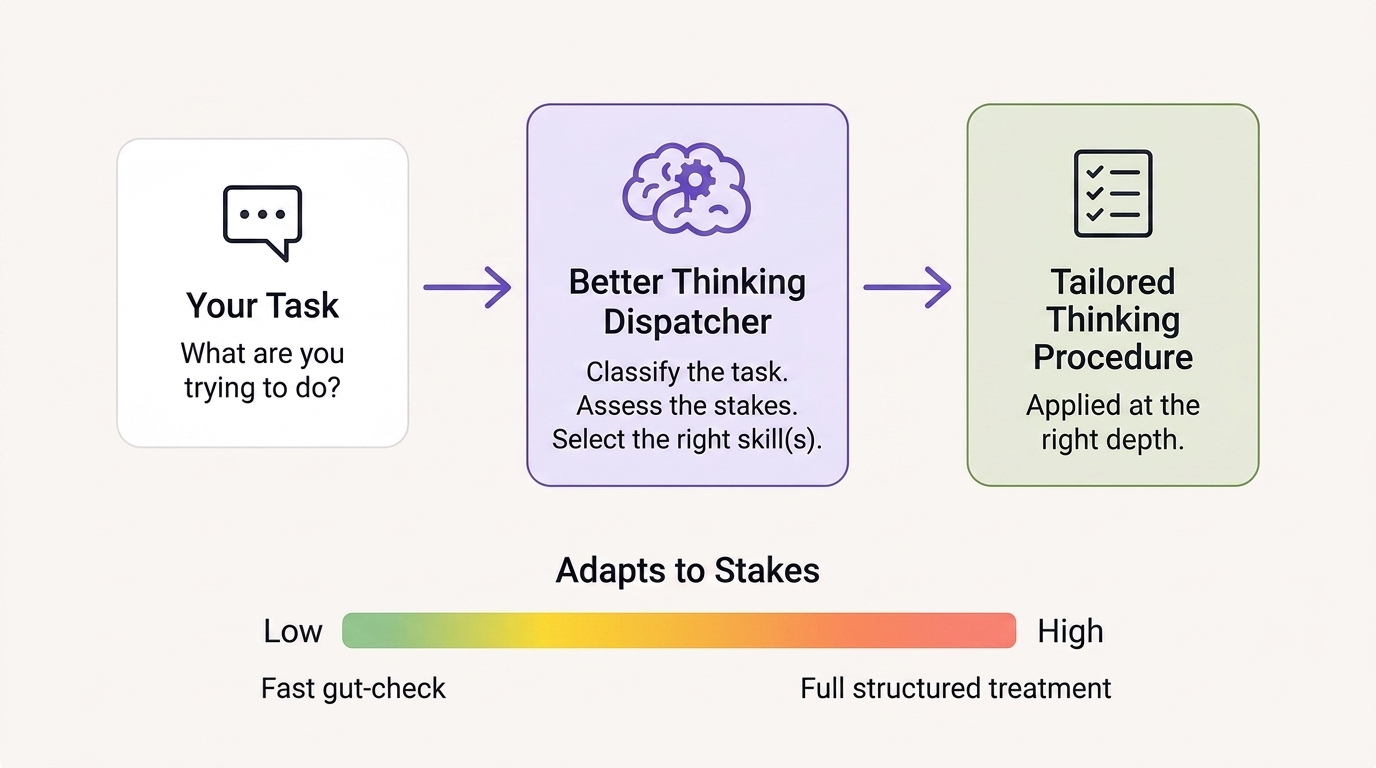
A quick, low-stakes question gets a fast gut-check; a costly, hard-to-reverse decision gets the full structured treatment.
You don't need to memorize any of the 135 skill names - /better-thinking reads the index and routes for you.
Installation
This repo is a Claude Code plugin. Install it directly from GitHub:
/plugin marketplace add skyf0xx/better-thinking
/plugin install better-thinking@better-thinking
Or from a local clone:
/plugin marketplace add /path/to/better-thinking
/plugin install better-thinking@better-thinking
This registers /better-thinking (plus /better-thinking-recipes for named frameworks) as slash commands. Every other skill is not independently invocable — /better-thinking reads skills/INDEX.json to select and apply the right one instead of surfacing a crowded name list.
To update an already-installed copy to the latest version:
claude plugin marketplace update better-thinking
claude plugin update better-thinking@better-thinking
Restart Claude Code (or start a new session) afterward — updates only take effect on the next session.
What a Skill is (and is not)
A Skill encodes a procedure, never a persona.
Bad: "Act like a scientist."
Good:
- Form hypotheses.
- Identify assumptions.
- Design experiments.
- Evaluate evidence quality.
- Attempt falsification.
- Update confidence.
- Report remaining uncertainty.
Excluded by design: programming languages, framework knowledge, APIs, professional personas, static reference material. If it isn't a transferable thinking process, it doesn't belong here.
Atomic vs. Composite
The collection is two-layered:
- Atomic skills implement a single cognitive algorithm — one move, done well. Examples:
bayesian-updating,steelmanning,premortem,active-listening. Atomic skills have no required dependencies (they may suggest related skills). - Composite skills orchestrate atomic skills into a larger workflow. Examples:
scientific-method,decision-analysis,competing-hypotheses,negotiation. Composite skills declare their dependencies in frontmatter, and their procedures read like pipelines: each step either does local work or invokes a named atomic skill.
This keeps the ecosystem modular: improving one atomic skill upgrades every composite that uses it, and new composites can be assembled without writing new cognition from scratch.
Repository layout
README.md               ← you are here
SKILL_TEMPLATE.md       ← canonical template every skill follows
catalog/                ← full specification of every skill, by category
  01-reasoning.md
  02-problem-solving.md
  03-decision-making.md
  04-research.md
  05-analysis.md
  06-systems-strategy.md
  07-forecasting.md
  08-creativity.md
  09-communication.md
  10-collaboration.md
  11-learning.md
  12-metacognition.md
  13-ethics.md
skills/
  better-thinking/SKILL.md         ← general dispatcher entry point (slash command)
  better-thinking-recipes/SKILL.md ← named-framework discovery + execution entry point (slash command)
  library/<name>.md                ← every other skill: reference content the dispatcher reads and applies, not an independent slash command
  INDEX.json                       ← machine-readable index; better-thinking reads this to route instead of relying on memorized recall
recipes/                ← named-framework mappings (design thinking, ...) onto skill sequences
Design principles
- Algorithm, not vibe. Every skill has a numbered procedure a model can actually execute. If a step can't fail, it isn't a step.
- Domain-free. A skill must work equally well on a medical question, a legal dispute, a product decision, and a debugging session. Domain examples illustrate; they never define.
- Composable. Atomic skills are single-responsibility. Composites declare dependencies and orchestrate; they never re-implement an atomic procedure inline.
- Explicit activation. Every skill states when to fire — trigger conditions a model can pattern-match against the task at hand, and anti-triggers for when it's overkill.
- Honest output contracts. Every skill states what it consumes and what it produces, so skills can be chained like functions.
- Failure-aware. Every skill lists its characteristic misuses, because a thinking tool applied wrong is worse than no tool.
- Token-budgeted. Every skill carries a footprint estimate so orchestrators can reason about the cost of loading it.
Recipes
Recipes map a named framework you already know — Design Thinking, Lean Startup — onto a sequence of skills from this collection, stage by stage. If you're looking for "what's the better-thinking equivalent of framework X," start at recipes/README.md rather than the skill index.
Difficulty & footprint conventions
- Difficulty (D1–D5): how hard the skill is to execute well. D1 = mechanical checklist; D3 = requires judgment at each step; D5 = requires orchestrating many judgment calls under uncertainty.
- Token footprint: estimated size of the final SKILL.md body. Atomic skills target 300–700 tokens; composites 800–1,500 (they lean on their dependencies for detail).
No comments yet
Be the first to share your take.