
Foundry IQ Live Knowledge Sources Accelerator
Platform teams connect a governed Fabric Ontology or remote HTTPS MCP tool, submit a natural-language question to a Foundry IQ Knowledge Base, and receive a grounded result with source evidence that can also be consumed through MCP.





Read the execution manual | Open the trace demo | Watch the KO/EN walkthrough
This public accelerator is designed for managed-organization evaluation, field demos, and implementation review. Start with a local proof, move to the smallest live profile that fits the tenant, and finish with source evidence plus cleanup evidence. It is not a production reference architecture.
First Success: No Cloud Required
From a fresh clone, inspect the complete answer-and-evidence contract before installing packages or configuring Azure:
git clone --depth 1 https://github.com/microsoft/azure-ai-search-foundry-iq-live-knowledge-sources.git
cd azure-ai-search-foundry-iq-live-knowledge-sources
./liveks try --evidence-out .deployment/first-run-evidence.json
Python 3.11 or newer is the only requirement for this first pass. Require Contract: PASS (4/4 assertions): the known synthetic fact, both required activity types, both required reference types, and both Knowledge Source names must be present. The ignored evidence capsule records the repository revision, runtime, fixture digest, source counts, and assertion statuses without the answer, query, raw response, or credentials.
The pull-request Validate workflow executes this same entry point and retains the capsule as the first-success-evidence artifact. This creates no cloud resources and proves the packaged response contract only, not a live source call.
Components At A Glance
| Component | What it does | Proof to inspect |
|---|---|---|
| MCP Server Knowledge Source | Calls an allowed tool on a remote HTTPS MCP server during Knowledge Base retrieval. | mcpServer activity or references and the invoked tool name. |
| Fabric Ontology Knowledge Source | Grounds a business question in governed Fabric entities and relationships. | fabricOntology activity or references plus Fabric source data. |
| Foundry IQ Knowledge Base | Plans retrieval across attached sources and produces one grounded result. | Answer content, activity, references, and sourceData. |
| Native Knowledge Base MCP endpoint | Exposes knowledge_base_retrieve to MCP-compatible clients. |
tools/list, tools/call, and a known-fact match when source grounding is claimed. |
| LiveKS CLI | Validates, plans, deploys, verifies, invokes MCP, and cleans up. | Stable status envelopes and nonzero failures. |
There are two distinct MCP directions:
Northbound: MCP client -> Knowledge Base MCP endpoint -> Foundry IQ -> Knowledge Source
Southbound: Foundry IQ -> MCP Server Knowledge Source -> remote HTTPS MCP tool
The representative managed-organization scenario uses the northbound client path with a native Fabric Ontology Knowledge Source. Fabric is not routed through the external MCP Server KS.
Run One Live Knowledge Source
Use byo-fabric when the organization already owns a Fabric workspace and ontology:
git clone --depth 1 https://github.com/microsoft/azure-ai-search-foundry-iq-live-knowledge-sources.git
cd azure-ai-search-foundry-iq-live-knowledge-sources
./liveks bootstrap
./liveks init --profile byo-fabric --env liveks-byo
Edit the ignored .liveks/liveks-byo.yaml ledger and add the existing identifiers:
version: 2
profile: byo-fabric
environment: liveks-byo
azure:
  location: eastus
fabric:
  workspace_id: 11111111-1111-1111-1111-111111111111
  ontology_id: 22222222-2222-2222-2222-222222222222
Then inspect before provisioning and deploy only after reviewing the resource and cost list:
az login --tenant <tenant-guid>
azd auth login
./liveks doctor --env liveks-byo
./liveks plan --env liveks-byo
./liveks up --env liveks-byo
plan is non-provisioning. up displays the Azure preview and requires create liveks-byo. Postprovision creates a Fabric-only Knowledge Base for isolated source validation and a combined Knowledge Base for planner-routing tests. Cleanup later deletes generated Azure resources and preserves the existing Fabric workspace and ontology.
No existing ontology? Use mcp-only for the fastest live path. Use full only with explicit approval because it creates a billable Fabric F2 capacity.
Confirm Foundry IQ Grounding
Do not treat a successful deployment message or final answer as routing proof:
./liveks verify --env liveks-byo --format json
For the checked-in synthetic Airline Ops contract, the verifier asks:
Which airlines have the highest customer-care exposure this month?
Require a live fabric-retrieve pass backed by fabricOntology activity or references. The sample ontology should rank Alpine Air first and return Fabric answer and raw grounding fields; another BYO ontology must use a question and expected fact from its own domain.
The verifier writes sanitized status and evidence summaries under ignored deployments/<environment>/. Raw responses, tokens, endpoints, and tenant-specific identifiers must stay out of git.
Follow Post-Deployment Tests for the exact trace-level pass/fail contract.
Call It Through MCP
After REST evidence proves the Knowledge Source independently, invoke the same Fabric-only Knowledge Base as an MCP server:
./liveks mcp \
  --env liveks-byo \
  --query "Which airlines have the highest customer-care exposure this month?" \
  --expect-term "Alpine Air"
Expected sanitized output:
LiveKS mcp: PASS
[PASS] tools-list: Knowledge Base publishes knowledge_base_retrieve.
[PASS] tools-call: knowledge_base_retrieve returned 1 text block(s).
[PASS] grounding-content: MCP content matched 1/1 expected term(s).
Use Alpine Air only when the connected ontology implements the checked-in synthetic contract. For another BYO ontology, use a non-sensitive fact that a known-answer question must return. Omitting --expect-term proves the MCP protocol surface only and produces a grounding warning.
The default sample path reads a Search admin key transiently through Azure CLI and never prints or persists it. Organization-managed identities with Search Index Data Reader can use --auth bearer.
For a controlled Fabric authorization failure:
./liveks mcp --env liveks-byo --omit-source-authorization --expect-failure
The command normalizes external failure text and stores no raw MCP content. The current MCP result returns result.content[], not the retrieve API's separate activity and references; the acceptance proof is therefore the pair of source-specific verify evidence and an mcp known-fact match.
Read Call the Knowledge Base Through MCP for authentication, evidence, and failure handling.
Configuration And Known Limitations
| Profile | Use when | Required configuration |
|---|---|---|
offline |
Learn the response and evidence contract without cloud resources. | None |
mcp-only |
Validate one live MCP Server KS without Fabric. | Azure sign-in; profile defaults are otherwise runnable. |
byo-fabric |
Connect an existing Fabric workspace and ontology. | fabric.workspace_id and fabric.ontology_id. |
full |
Rehearse a greenfield Fabric and Azure deployment. | Fabric quota and --accept-fabric-capacity. |
.liveks/<environment>.yaml is the canonical human-authored ledger. azd env is generated deployment state, and dotenv files are compatibility inputs for REST and notebook users. Secret fields use {env: VARIABLE_NAME} references; raw values never belong in YAML.
The Azure AI Search API is pinned to 2026-05-01-preview. Preview behavior has no production SLA and can change. Microsoft Learn is the source of truth for the current API, authentication, MCP response, and Fabric requirements.
Important boundaries:
- Fabric live retrieve requires a raw end-user Search token in
x-ms-query-source-authorization, without aBearerprefix. - MCP Server KS requires a reachable remote HTTPS endpoint; local stdio servers cannot be attached directly.
- The native MCP result alone does not identify source activity in separate arrays; use retrieve evidence first and a known-fact match before claiming grounded MCP content.
- The current
knowledge_base_retrieveMCP tool accepts onequeriesarray and cannot carry retrieve-onlyknowledgeSourceParams, includingalwaysQuerySource. - Browser code never receives Search admin keys or Azure OpenAI keys.
- Do not commit customer data, tenant IDs, workspace or ontology IDs, keys, tokens, raw live responses, or private screenshots.
See Configuration, Security and Governance, Troubleshooting, and Public Preview Limitations.
Inspect The Offline Trace
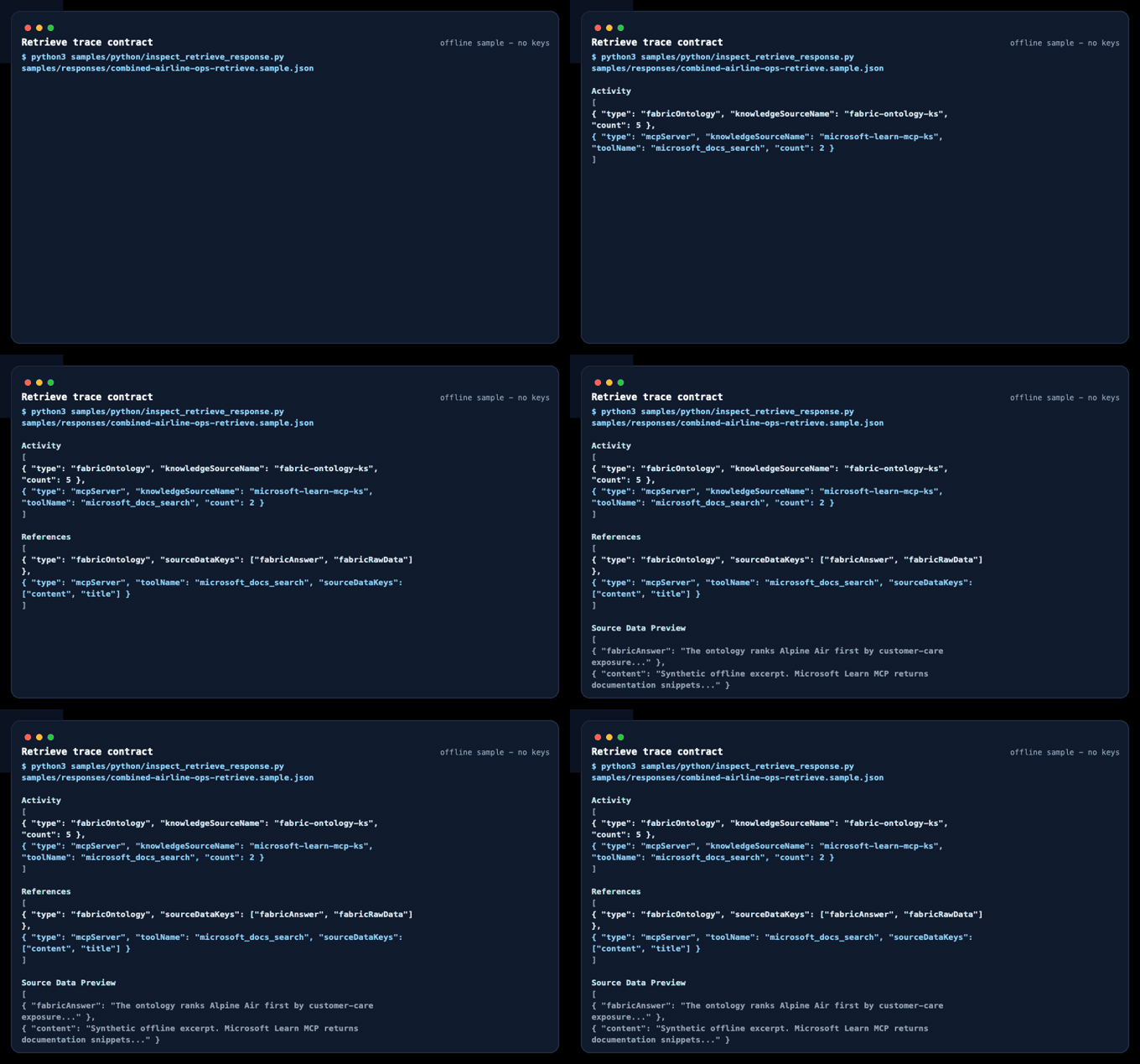
After the first pass, expand the checked-in trace or isolate the MCP replay without an Azure subscription, tenant, Fabric workspace, or key:
./liveks try --details
./liveks try --sample mcp --details
The answer is printed first, followed by MCP Server KS and Fabric Ontology KS evidence. This is offline replay only; it does not prove that a live source ran.
Verify And Clean Up
Before cleanup, open the App URL in deployments/<environment>/deployment-summary.md and complete the Guided Live Demo.
./liveks down --env liveks-byo
Require resource-group-absent. A full run that generated Fabric capacity must also report fabric-capacity-absent, plus either fabric-capacity-resource-group-absent for a generated group or fabric-capacity-resource-group-preserved for a pre-existing group.
A Fabric-only rehearsal must run scripts/fabric-e2e-test.sh --cleanup and end with fabric_release=PASS. Create mode proves the generated workspace and capacity are absent, and separately proves that the capacity group was deleted or preserved according to its ownership record. BYO mode proves the generated workspace is absent while preserving the existing capacity.
For a controlled end-to-end rehearsal:
./liveks e2e --env liveks-mcp --cleanup --yes
Use exactly one of --cleanup or --keep-resources. Prefer cleanup and record the owner whenever resources are retained.
Architecture
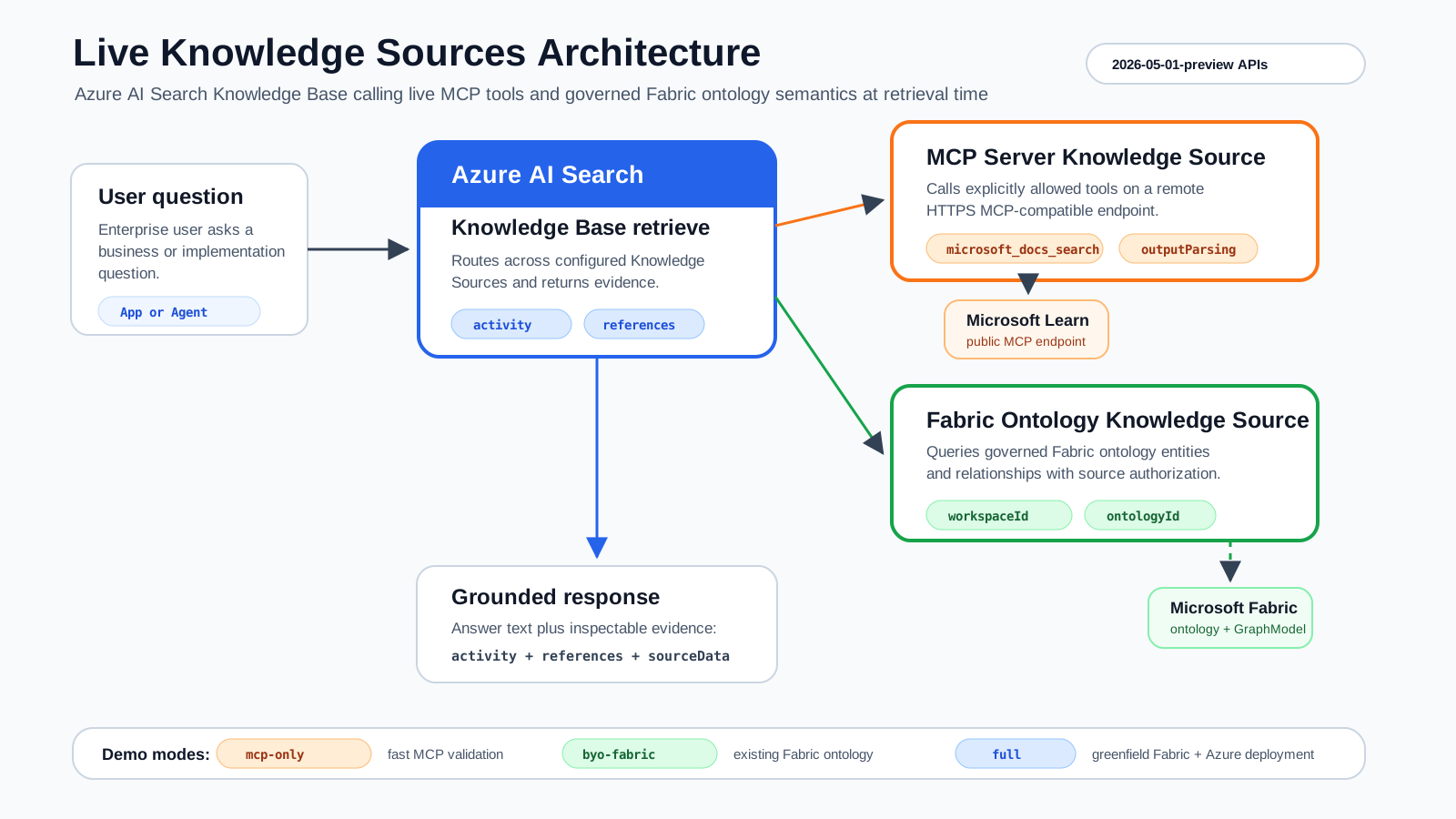
Question
  -> Foundry IQ Knowledge Base
    -> MCP Server KS: implementation guidance
    -> Fabric Ontology KS: governed business semantics
  -> grounded result + activity + references + sourceData
  -> native knowledge_base_retrieve MCP tool
The Airline Ops data is synthetic supporting material, not the main product surface. See the Airline Ops Ontology Contract.
Repository Map
liveks, liveks.ps1     Cross-platform lifecycle entry points
config/, profiles/    Canonical schema and executable profile defaults
src/liveks/            Configuration, planning, deploy, verify, MCP, and cleanup CLI
infra/                 Bicep for Azure AI Search, Azure OpenAI, Storage, and hosting
static-app/            Pages replay UI and Azure Static Web Apps managed API
samples/               REST, Python, responses, synthetic data, and ontology contract
notebooks/             Guided MCP and Fabric walkthroughs
docs/                  Execution manual, concepts, troubleshooting, and operations
Generated configuration, locks, deployment evidence, app builds, and logs stay under ignored .liveks/, .deployment/, deployments/, and build directories.
Local Validation
bash scripts/validate-local.sh
git diff --check
The gate checks configuration and CLI contracts, notebooks, links, sample and repository hygiene, secrets, the Pages demo build, Windows launcher behavior, and Bicep.
Official Microsoft Manuals
- Agentic retrieval overview
- What is a Knowledge Source?
- Create an MCP Server knowledge source
- Create a Fabric Ontology knowledge source
- Create a Knowledge Base
- Query a Knowledge Base using retrieve or MCP
- Microsoft Fabric Ontology overview
Issues and PRs are welcome. Read CONTRIBUTING.md, SECURITY.md, and SUPPORT.md. This project is licensed under the MIT License.
No comments yet
Be the first to share your take.