
AI Engineering Skills



ai-engineering-skills is the control layer for coding agents. It keeps Claude Code, Codex CLI, and similar agents bounded, verified, and resumable through lightweight workflow gates.
One human sets direction and boundaries; one agent executes inside them.
Start here
Use this repo when a coding task benefits from bounded scope and explicit proof, but is too small for a full PRD. Add durable handoff state only when another session or agent must continue the work.
The default durable loop is:
mini-spec -> scope-freeze -> build-one -> verify-contract -> handoff
That loop helps agents stop wandering, prove what changed, and leave enough state for the next session to continue safely.
When the right route is not obvious, start with ceremony-budget: a short
pre-flight that chooses the smallest workflow that still buys back enough
attention and safety.
Try it in 60 seconds
Clone the repo:
git clone https://github.com/tmusser/ai-engineering-skills.git
cd ai-engineering-skills
Then choose one install target.
Claude Code:
./install.sh --claude-user --only mini-spec,scope-freeze,build-one,verify-contract,handoff
Codex CLI:
./install.sh --codex-user --only mini-spec,scope-freeze,build-one,verify-contract,handoff
Prompt to give an agent for a durable slice:
Use mini-spec, scope-freeze, build-one, and verify-contract for this bug fix.
Add handoff only if another session must continue.
Or let the agent route first:
Use ceremony-budget first, then run only the smallest safe route.
A durable route can leave a SPEC.md or equivalent contract, a verification
record, and a HANDOFF.md when continuation state is actually needed.
Use test-mini as an optional add-on when the slice needs focused deterministic tests.
Use ceremony-budget as an optional front door when you are unsure whether the
task is a patch, one slice, a mini workflow, or a fuller guarded route.
Starter set
Recommended starter set:
mini-specscope-freezebuild-oneverify-contracthandoff
The starter set controls which skills are available. It does not require invoking all five for every task.
thin-plan is recommended when a slice needs more shape, but it is intentionally
not part of the absolute starter path.
ceremony-budget is also intentionally outside the absolute starter path. It is
an optional router that helps choose whether the starter set is even warranted.
For project-scoped installs, templates, and the raw Python installers, see Claude Code installation and Codex installation.
Those docs cover scripts/install_claude_code.py, scripts/install_codex.py,
AI_ENGINEERING_SKILLS_VERSION.json, --dry-run, --backup, --force, --only,
--uninstall, and --include-templates.
Agent support
| Agent | Support level | Notes |
|---|---|---|
| Claude Code | First-class / primary target | Dedicated install docs and workflow examples. |
| Codex CLI | First-class / supported docs | Dedicated install docs and workflow examples. |
| Other markdown-capable coding agents | Experimental / manual | Skills are plain Markdown folders, but validation may be partial. |
| IDE assistants | Manual artifact workflow | Use the same files and prompts by hand; no agent-specific install path is assumed. |
Skills are portable because they are plain Markdown, but validation is strongest where this repo has explicit install and docs coverage.
Complements sandboxing and observability
Runtime tools can help isolate where an agent runs and observe what it does. This repo sits one layer above that: it defines the task contract, scope boundary, verification evidence, and handoff state. Sandbox and observability tools can fit into that runtime layer, but they are not required for this workflow.
ai-engineering-skills is not a replacement for sandboxing, secret scanning, permissions, or runtime isolation. It is a workflow layer that helps agents stay bounded and resumable while those controls handle execution safety.
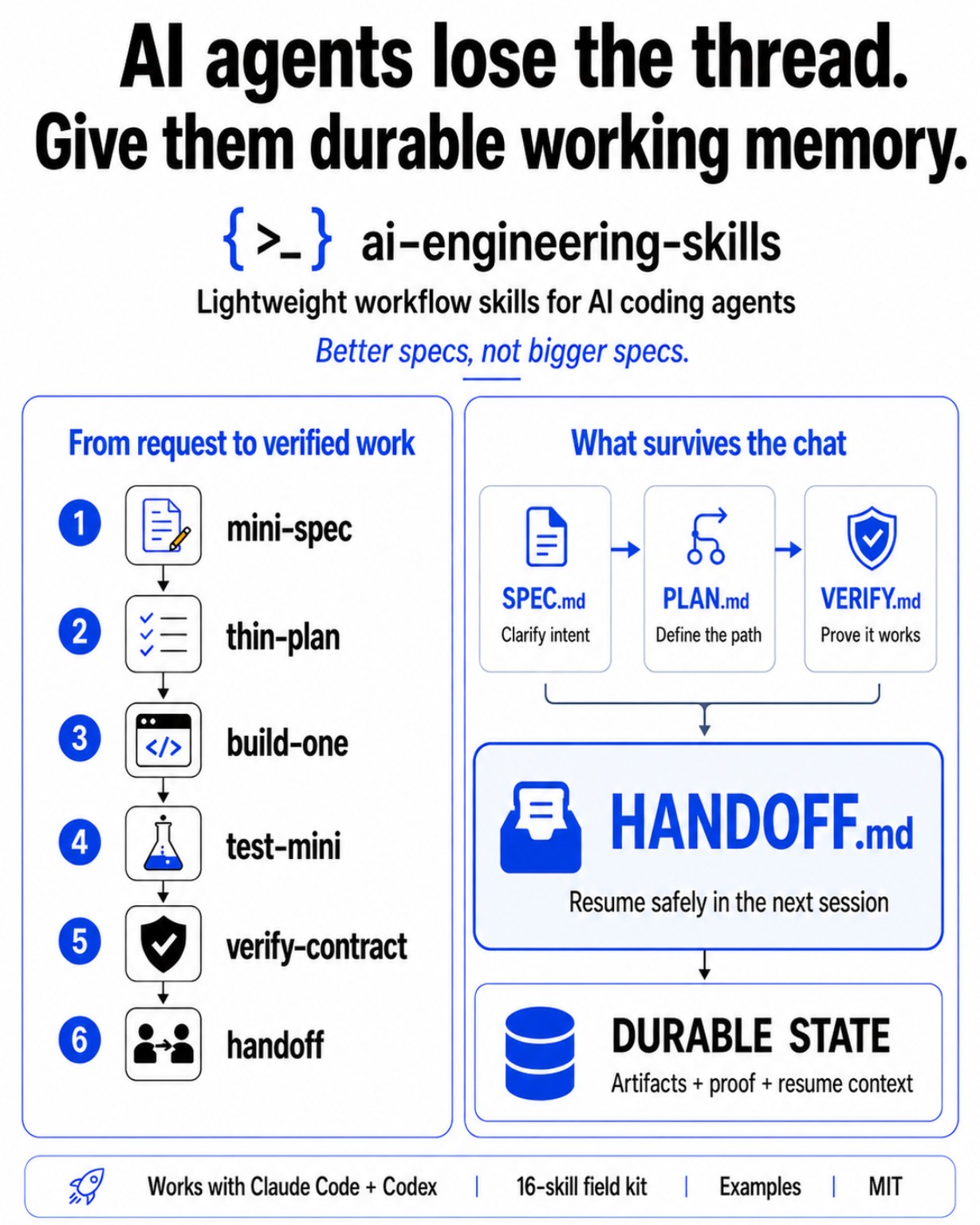
Durable artifacts
| Artifact | What it means |
|---|---|
SPEC.md |
Current contract |
PLAN.md |
Optional slice plan |
VERIFY.md |
Proof ledger / verify gate |
HANDOFF.md |
Fresh-session packet when continuation exists |
What you can do
Use the smallest route that fits.
| Need | Skill route |
|---|---|
| Turn a messy feature request into a safe coding task | grill-with-docs-lite -> mini-spec |
| Prevent unrelated edits | scope-freeze |
| Implement one vertical slice | build-one |
| Verify before calling done | test-mini -> verify-contract |
| Resume in a fresh session | handoff |
| Diagnose repeated agent loops | diagnose-loop |
| Capture bugs cleanly | bug-capture |
Why this exists
AI coding agents are powerful, but sessions still fail for predictable reasons:
- vague requests become plausible but wrong plans
- scope expands quietly
- weak verification gets accepted as completion
- long contexts hide the important constraint
- handoff state disappears between sessions
ai-engineering-skills gives the human and agent shared boundaries, checks, and
durable artifacts. It reduces risk, but it does not replace judgment.
| Common failure mode | Skill-pack response |
|---|---|
| Vague ask, hidden assumptions, or missing boundary | grill-with-docs-lite -> mini-spec |
| Scope expands while coding | scope-freeze |
| Change is treated as done without evidence | test-mini -> verify-contract |
| Fresh session loses the thread | handoff |
This is not just a prompt pack. Skills make behavior repeatable across sessions, templates preserve state, and verification records make claims auditable. See Why skills, not prompts.
Evidence
Proof artifact: this repo is evaluated by
agent-workflow-bench, a small
standalone benchmark for agent skills, verification artifacts, and fresh-session
resumability.
The benchmark asks a narrower question: when an agent completes messy technical work, does it leave enough verified context for another fresh session to trust, audit, and continue it?
| Task | What it shows |
|---|---|
| Task 4 — Impossible Churn Regression | Skill-routed runs can leave durable context for audit/resume. |
| Task 5 — Fake Data Campaign Lift Trust | Clearer audit trails help inspection, but do not guarantee correctness. |
| Task 7 — Dashboard Export Scope Pressure | Stronger settings saturated on behavior; weaker settings exposed compatibility and test-integrity failures. |
Supported claims:
- auditability
- verification discipline
- resumability
Not supported:
- broad pass-rate superiority
- guaranteed correctness
- universal behavior improvement
The Task 7 follow-up suggested the highest-leverage improvement was not heavier
skills, but sharper invalidation: compatibility probes, diff guards, and
REVIEW_REQUIRED states.
See docs/benchmark-findings.md for the fuller pilot notes.
Skill map
See docs/skill-map.md for the routing diagram, context-pressure layer, failure-mode diagram, and workflow recipes.
The failure mode this avoids
flowchart TD
  A["Vague request"] --> B["Many edits"]
  B --> C["Weak verification"]
  C --> D["Long context"]
  D --> E["Lost saliency"]
  E --> F["Buggy / bloated output"]

  G["Clarified request"] --> H["mini-spec"]
  H --> I["One vertical slice"]
  I --> J["scope-freeze"]
  J --> K["build-one"]
  K --> L["verify-contract"]
  L --> M["handoff"]
  M --> N["fresh context"]
This is the shape the repo is trying to prevent. For the full routing map, see docs/skill-map.md.
How this is different
- Raw prompting gives instructions. This repo leaves durable artifacts.
- Plan Mode approves a plan. This repo adds earlier and later gates.
- Chat scrollback disappears. Files survive the session.
Common objections
Isn't this just better prompting?
Better prompts help, but the artifact trail is the leverage: specs, scope boundaries, verification records, and handoff notes.
Is this process theater?
It can be if you use too much of it. Use ceremony-budget when the route is
unclear, use the durable starter for bounded work that needs artifacts, and skip
the workflow for tiny reversible edits.
Will agents ignore the skills?
Sometimes. Skills do not make agents obey. They make expected behavior explicit, inspectable, and easier to correct when the agent drifts. See Limitations for the honest failure modes.
Context-pressure control layer
Four skills form the backbone for resilient agent sessions:
scope-freeze— limits blast radius before workverify-contract— records evidence after workcontext-check— detects drift during workhandoff— preserves durable state between sessions
Together they support bounded execution and verifiable progress.
lean-mode is optional. It changes communication density, not the project workflow.
Use it when token budget matters, then switch back to full reasoning when ambiguity,
safety, or trade-offs require more explanation.
context-check is an optional passive guardrail. It watches for drift, compaction
pressure, and active-mode loss, then recommends the smallest corrective action.
For scheduled or delegated tool-using runs, see Agent-worker safety before giving a workflow write access.
Workflow recipes
See docs/recipes.md for the small-project, debug, ML/dashboard, analytical, and cross-functional recipes.
For the routing logic behind those recipes, see docs/ceremony-budget.md.
For an isolated git worktree task, see docs/worktree-agent-run.md.
Ceremony ladder
Use the smallest workflow that still feels safe.
ceremony-budget is the optional entry move before this ladder. It replaces a
larger route and should usually output no block when the route is already explicit.
Level 0 — Patch
Tiny reversible edit. Run one sanity check. Record the result.
Level 1 — Micro
One bounded slice. inline boundary -> build-one -> targeted verify -> stop.
Level 2 — Mini
Small vertical slice. compact mini-spec -> build-one -> targeted test -> verify-contract -> stop.
Analytical deliverables such as sizing memos or scenario tables often fit Level 2.
Level 3 — Full
User-facing, scheduled, autonomous, decision-impacting, data-sensitive, or
multi-slice work. grill-with-docs-lite -> mini-spec -> checklist-mini -> thin-plan -> scope-freeze -> analyze-mini -> build-one -> test-mini -> verify-contract -> ship-mini. Add handoff when another session or agent must continue.
Below Level 0 — Prompt primitives
Some tasks do not need a skill, artifact, or workflow gate. For quick steering moves like “Find the lie,” “Smallest safe diff,” or “Test the tests,” use prompt primitives instead. See docs/recipes.md#prompt-primitives.
Optional bundles
Use the smallest bundle that fits. Installing a bundle does not require invoking every included skill. See docs/bundles.md for copy-paste install sets for starter, bugfix, ML/data science, dashboard, agent-worker, and full governance workflows.
Demo

This sanitized terminal demo shows a bounded cycle using fake data and simulated
agent output. It is generated from demo/demo.tape using VHS, so it is reproducible
without private code, private data, or API calls.
Render it locally with:
scripts/render_demo.sh
Further reading
- Slash-style usage: see the install docs and skill command examples.
- anti-patterns: each skill documents common failure modes to avoid.
- Loop governance: see docs/loop-governance.md.
- Cross-functional infrastructure coordination: see docs/recipes.md.
Status
This is a practical workflow pack, not a guarantee that agents will behave. The best results still come from a human who can set boundaries, inspect evidence, and decide when to escalate ceremony.
The benchmark evidence supports auditability, verification discipline, and
resumability. It does not show broad pass-rate superiority, and ceremony-budget
should not be read as "always do more process." The point is to know when not to
use the heavier parts of this repo.
No comments yet
Be the first to share your take.