
Agents Shipgate





Your coding agent changed what your AI agent can do — Agents Shipgate tells you whether it can merge.
The deterministic merge gate for AI-generated agent capability changes.
Local-first and static by default — no agent execution, tool calls, LLM calls, or network access.
[!IMPORTANT] Status: pre-1.0 (beta). The decision engine is deterministic and stable. This source tree is
0.16.0b7; install and GitHub Action examples remain pinned to the latest published tag,v0.15.0, until the beta is released. Real-history accuracy numbers (small n, published in full inbenchmark/miner/README.md): across 361 mined rows from 8 distinct real agent repos, 336 (93%) organically skip the trigger; of the 19 unique labeled engine-engaged PRs, re-run on the released v0.15.0 engine (2026-W27-reeval), the gate never auto-passed an unsafe change — both realmust_blockPRs and everyneeds_humanPR are held for human review (must_block_caught/needs_human_caught= 1.0). But it routes to review, it does not block: real-historyblocked_recallis still 0.0 — bothmust_blockPRs returnhuman_review_required/review_required, notblocked. v0.15.0 cleared the 4 scan crashes and moved bothmust_blockPRs off abstention (insufficient_evidence→ review), at the cost of escalating 4 of 14 safe PRs to review (benign_escalation_rate0.286 — largely a cold-start whole-repo-surface measurement artifact on large repos). Reliable blocked-recall (1.0) and zero benign escalation are proven on the constructed-adversarial stratum, not yet on real history. Labels are AI-adjudicated (0 disagreement), pending human spot-check. Treat it as an advisory gate while this work closes — see ROADMAP.md.
60 seconds: watch it block two PRs
Claude Code adds stripe.create_refund to your support agent and opens a
PR. The diff looks fine to a human skimming it. Should it merge?
uvx agents-shipgate fixture run ai_generated_refund_pr
→ merge_verdict: blocked — the new refund capability has no declared
approval policy and no idempotency evidence. The verifier explains both
blockers and routes the PR to a human.
Now the move every reviewer fears — the agent deletes the Shipgate CI gate to make its PR pass:
uvx agents-shipgate fixture run agent_weakens_gate
→ merge_verdict: blocked, can_merge_without_human: false. The
gate-removal checks are suppression-immune: the cheapest reward-hack is
also the most visible one.
…and here's the failure mode. These two cases are constructed fixtures with
a clear-cut answer, chosen to show the gate working. Real PRs are messier: when
a change builds its tool surface dynamically — a toolkit factory, a config-bound
allowlist, tools assembled at runtime — static extraction often can't enumerate
the result, and Shipgate returns insufficient_evidence and routes to a human
rather than emit a confident wrong verdict. That is the intended failure mode,
not a bug; reducing how often it fires on real dynamic code is active work (see
ROADMAP.md).
One engine decides (report.json.release_decision.decision); everything
else — merge_verdict, PR comments, Check Runs, Action outputs — is a
deterministic projection of it. Five-minute version:
docs/mental-model.md.
Agents Shipgate is an open-source CLI and GitHub Action for local-first, static Tool-Use Readiness review. It scans MCP, OpenAPI, OpenAI Agents SDK, Anthropic Messages API, Google ADK, LangChain/LangGraph, CrewAI, OpenAI API, Codex repo config, Codex plugin, n8n, and Conductor OSS workflow artifacts, then writes a deterministic Tool-Use Readiness Report before your agent gets production-like permissions.
Within agent release readiness, Agents Shipgate's wedge is Tool-Use Readiness: the tool surface, schemas, scopes, approval policies, idempotency, and blast radius reviewed at PR time.
Website: threemoonslab.com — quickstart, glossary, check catalog, and design partners.
Static-by-default — no agent execution, no LLM calls, no MCP server connections,
no scanner network calls, no scanner telemetry. Audited exceptions are pinned
in tests/test_adapter_static_only.py::ALLOWED_EXCEPTIONS.
Apache-2.0.
What your PR sees
When a PR changes what your agent can do, the GitHub Action posts the merge
verdict as a PR comment. This is the comment for the first demo PR above —
the coding-agent diff that adds stripe.create_refund to a support agent
(abridged from the verbatim pr-comment.md artifact):
Agents Shipgate result: block
Decision:
block· Risk:critical· Required reviewers:agent-platform,security
Impact Change Subject Why blocks release action added stripe.create_refundCapability added. blocks release action broadened stripe.create_refundhigh-risk effect financial_action added blocks release scope broadened stripe.create_refund:stripe:*scope added Required before merge — Actor: Human (human authority required — a coding agent must not self-resolve):
- Declare an approval policy for
stripe.create_refundor remove this tool from the release.- Declare
approval.required,safeguards.audit_log, andsafeguards.idempotencyfor this financial write action.- Replace wildcard/admin scopes with operation-specific scopes.
Then re-verify:
agents-shipgate verify --base origin/main --head HEAD --json
The same uvx agents-shipgate fixture run ai_generated_refund_pr command
above writes this comment verbatim to reports/pr-comment.md.
Verify-first quickstart
Install once:
pipx install agents-shipgate
Then start from one of three prominent flows.
Local Boundary Check
Coding agents run shipgate check before reporting an agent-capability change
complete. Parse the stdout shipgate.agent_boundary_result/v1 object. The
--agent value identifies the caller; every recognized changed host surface is
evaluated regardless of that value:
shipgate check --agent codex --workspace . --format agent-boundary-json
shipgate check --agent claude-code --workspace . --format agent-boundary-json
shipgate check --agent cursor --workspace . --format agent-boundary-json
Switch on control.state; follow control.next_action,
control.allowed_next_commands, and control.human_review. Treat decision
as diagnostic context, not as the operational control signal, and never infer
control from prose. shipgate check is necessary but not sufficient for
capability-expanding diffs: if a change adds dynamic, undeclared, or otherwise
ambiguous tool capability, do not treat decision="allow" as merge readiness;
run agents-shipgate verify and read release_decision.decision.
PR And Local Verification
When a PR changes what your agent can do, run the deterministic verifier on the
diff and read its merge verdict before you merge. For committed PR/CI refs,
make the base ref available first because verify never fetches:
agents-shipgate verify --workspace . --config shipgate.yaml \
  --ci-mode advisory --format json --base origin/main --head HEAD
For local, uncommitted work, omit --base/--head so your working-tree edits
are scanned instead:
agents-shipgate verify --workspace . --config shipgate.yaml \
  --ci-mode advisory --format json
If a repo is not configured yet, use the verify flow's preview entry point:
agents-shipgate verify --preview --json
The short shipgate verify alias remains invokable for compatibility, but
agent-facing PR-gate guidance uses agents-shipgate verify.
Host-Grant Audit
Before changing local MCP servers, Codex/Claude/Cursor permission rules, hooks, workflow scopes, or other host grants, capture the host inventory:
shipgate audit --host --json --out agents-shipgate-reports/host-grants.json
The default audit is deterministic repository scope. Use
--scope local-static only when you explicitly want supported user and
file-based managed configuration included. Both modes publish per-host
coverage and excluded sources; neither proves session or runtime authority.
See the static host-boundary support matrix.
The release gate is agents-shipgate-reports/report.json →
release_decision.decision (blocked | review_required | insufficient_evidence | passed).
The PR/control surface is agents-shipgate-reports/verifier.json →
merge_verdict (mergeable | human_review_required | insufficient_evidence | blocked | unknown), a deterministic projection of the release decision.
Read agents-shipgate-reports/current-control.json first — it names which run
is current, and agents-shipgate agent control --workspace . validates it
against every artifact it binds and against the live repository, refusing the
read when HEAD or the working tree has moved since the decision. Then validate the verification-receipt.json it binds; then
read agent-handoff.json
(control.state, then gate.merge_verdict), followed by the
authoritative control substrate verifier.json for control, merge_verdict,
applicability, can_merge_without_human,
control.next_action, and fix_task. capability_review.top_changes is
supporting/provisional reviewer context.
Zero-setup demos of both verdicts are in
60 seconds above; uvx runs them with no
persistent install. To upgrade the CLI, use pipx upgrade agents-shipgate - a
plain install is a no-op over a stale build. Your agent project does not
need Python 3.12; the CLI installs
separately. To verify your own repo and write the standard
agents-shipgate-reports/ directory, see Verify your repo
below.
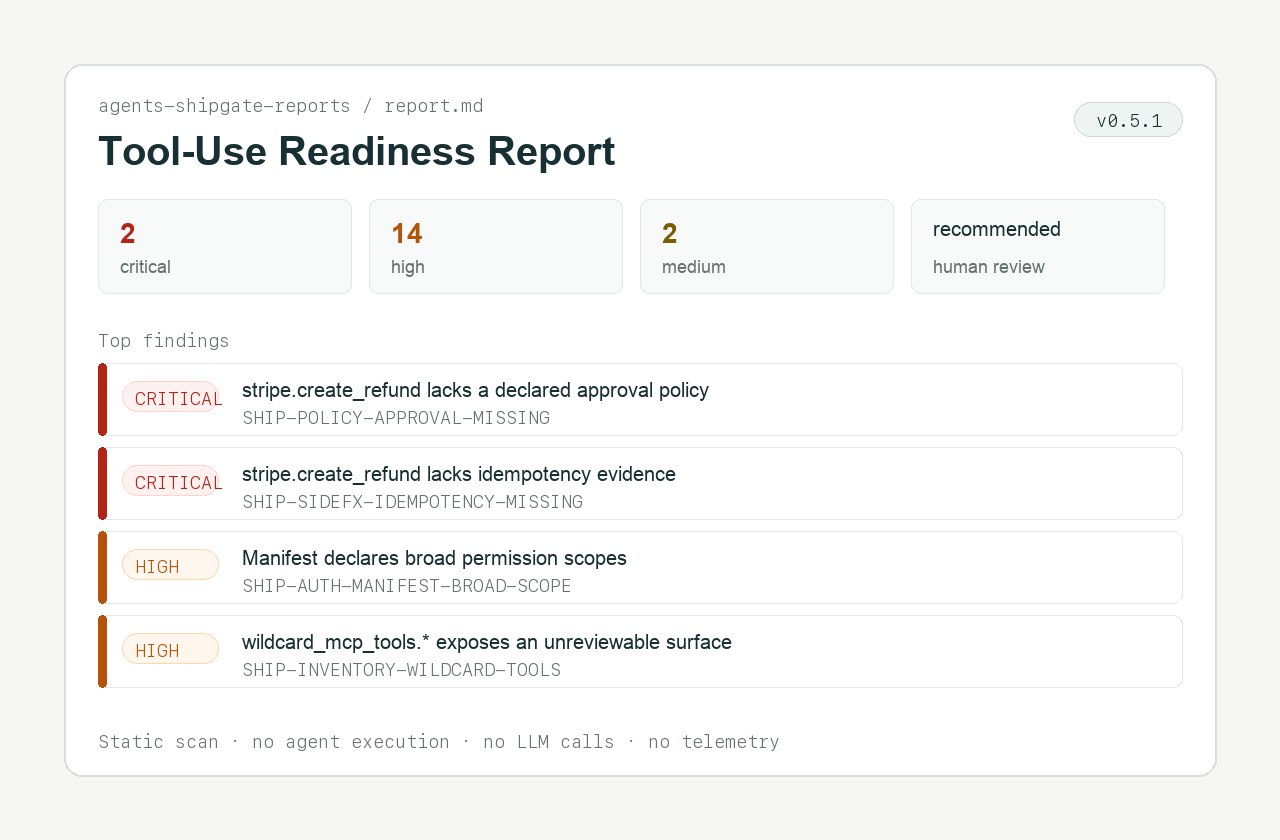
How to read your first result
For PR verification, validate verification-receipt.json, then read
agent-handoff.json.gate.merge_verdict:
| Merge verdict | Meaning | Next step |
|---|---|---|
blocked |
Active, unaccepted blockers exist. | Fix blockers or remove the risky capability. |
insufficient_evidence |
Static evidence is too weak to gate release confidently. | Add better sources and rerun; do not auto-merge. |
human_review_required |
A person must review accepted debt, trust-root changes, or authority-bearing gaps. | Surface the required review; a coding agent must not self-approve it. It may still commit, push, and update the PR so the review can happen — control.state is review_publishable and control.permissions.merge is false. |
mergeable |
No active blocker or review signal was found. | Keep verifier/report artifacts with the PR record. |
unknown |
Verify could not produce a reliable head scan or diff context. | Fix setup, fetch the base ref, or rerun with usable inputs. |
Then read report.json.release_decision.decision, the source-of-truth gate:
| Decision | Meaning | Next step |
|---|---|---|
blocked |
Active, unaccepted blockers exist. | Fix the blockers or remove the risky tool surface. |
insufficient_evidence |
The scan cannot confidently gate release from the available static evidence. This does not prove the agent is unsafe. | Follow the first structured evidence-gap action. Supported frameworks name the generated local inventory and exact manifest route; unidentified source shapes receive the generic source guidance. Then rerun. |
review_required |
Human review is needed, often for accepted debt or evidence gaps below the blocked threshold. | Review the listed items before promotion. |
passed |
No active blocker or review signal was found. | Keep the report artifact with the PR/release record. |
Common review signals include missing confirmation, missing idempotency evidence, broad-scope permissions, prohibited-action policy gaps, and trust-root changes such as weakened CI or manifest policy.
Authorize one exact coding-agent action
A human-review route denies merge and completion. Runtime contract v20 keeps
publishing the change for that review authorized (control.state: "review_publishable"), and reserves the total stop
(control.state: "human_review_required") for blocks and input Shipgate cannot
bind. Runtime contract v18 adds one narrow continuation path for a trusted host: after a
person reviews a host-attested receipt and its complete review set, the host can
sign an exact authorization request with Ed25519. The private key, human
authentication, and signing operation stay outside Agents Shipgate and outside
the evaluated workspace; Agents Shipgate ships no signing or approval command.
On POSIX, the verifier reads the trust policy only from the OS account home's
fixed path
~/.config/agents-shipgate/human-authorization-trust-policy.json. Changing
HOME or XDG_CONFIG_HOME does not redirect that lookup. The fixed lookup
prevents environment-based path substitution; the coding host must still make
the file and its parent path unwritable by the agent. The guarded executor is
POSIX-only in v1; this authorization route remains disabled on Windows.
Authorization-eligible verification must also bind an effective
plugins_enabled=false engine. Use --no-plugins for both verification
passes when the environment enables third-party plugins; the protected broker
never imports third-party check or adapter code.
First build the unsigned challenge from the validated receipt. It derives the reviewed source commit and complete review set; you supply the exact destination and the remote OID that the reviewer observed:
agents-shipgate authorization request \
  --receipt agents-shipgate-reports/verification-receipt.json \
  --artifacts-root agents-shipgate-reports \
  --remote origin \
  --destination-ref refs/heads/<branch> \
  --expected-lease-oid <reviewed-remote-oid> \
  --out agents-shipgate-reports/human-authorization-request.json
That command does not approve or sign anything. The external host must present
the complete request to the authenticated human and produce the signed grant.
The request binds the source receipt_id, artifact_set_id, engine, and
executor so the signer can require a trusted-CI attestation or rerun
verification itself. Content addressing detects changed bytes; it does not
authenticate an agent-supplied receipt. A signer must never treat a
self-consistent receipt from the coding agent as trusted provenance.
The request also exposes the evaluated base commit and merge base. Because a
Git commit transitively binds every parent and reachable object, the signer
must inspect the complete source ancestry—not only the final tree diff—before
authorizing its push. The guarded executor snapshots that full graph with a
512 MiB pack ceiling and a 120-second process timeout; the host broker should
apply tighter disk, memory, and CPU quotas for its deployment. The compressed
pack ceiling does not bound expanded-object indexing memory or CPU, so a
production broker should use a cgroup, container, or equivalent host quota.
Rerun verification with the externally produced grant:
agents-shipgate verify --workspace . --config shipgate.yaml \
  --base origin/main --head HEAD --ci-mode advisory --format json \
  --no-plugins \
  --authorization /path/outside/workspace/human-authorization.json
The verifier recomputes the request, subject, decision, trees, and full review
set, then checks the signature, trusted principal, repository scope, and TTL.
The v1 grant can authorize only one exact Git push. The source must be the
exact commit whose tree was verified; a synthetic PR merge receipt cannot
authorize pushing a different parent commit. The operation binds a canonical,
credential-free HTTPS destination, one full destination ref, and an explicit
expected remote OID in --force-with-lease. If accepted, control.state
becomes agent_action_required and exposes only a guarded
agents-shipgate authorization execute command. That consumer validates the
receipt from one immutable byte snapshot, grant, current trust policy,
wall-clock expiry, engine, repository, and commit again immediately before the
push. It copies the reachable Git graph into an isolated object store, checks
its object IDs with git fsck, disables hooks, configuration, replacement
objects, and HTTP redirects, and then pushes only that snapshot. The raw
git push is never an
allowed command. This does not turn
the PR into a pass: release_decision.decision stays review_required,
merge_verdict stays human_review_required, and both
can_merge_without_human and completion_allowed stay false. Invalid,
expired, stale, or mismatched grants fail closed with zero commands. If the remote ref
moves after approval, Git rejects the push because the signed command carries
the previously reviewed lease OID.
GitHub's default pull_request checkout evaluates a synthetic merge commit;
request push authorization only after a separate committed verification whose
--head is the actual PR head SHA. This release defines the signed protocol,
verifier consumer, and guarded executor. A Codex,
Claude Code, or other coding-host signing adapter must still authenticate the
human, protect the key from the agent, attest or rerun the source verification,
and produce the grant; no current UI integration is implied.
Authorization is enabled only when the coding host enforces a real write
boundary around the trust policy, signing key, clean launcher environment,
Python interpreter, entire virtual environment and site-packages tree
(including startup .pth files), dependencies, credentials, and separately
installed Agents Shipgate distribution.
Filesystem ownership/mode checks alone cannot distinguish an unrestricted
same-UID coding agent from its human user. Editable installs whose package code
resolves inside the authorized repository are therefore ineligible. If the
host cannot enforce these boundaries, it must leave the result at
human_review_required and expose no authorization command. Authorization v1
is intentionally push-only; reviewed patch application is a later operation
type, not an implied capability of this grant.
Not sure if Shipgate applies?
Run the zero-install detector from the repo you are reviewing. It is a stdlib-only first touch for engineers and coding agents that need a yes/no relevance signal before installing anything:
curl -sSL https://raw.githubusercontent.com/ThreeMoonsLab/agents-shipgate/main/tools/shipgate-detect.py \
  | python3 - --workspace . --json
Continue to Verify your repo when the output has
is_agent_project: true, non-empty suggested_sources, non-empty
codex_plugin_candidates, or the workspace already has shipgate.yaml.
Sample reports
Open a report first if you want to see the output shape before installing:
| Sample | Markdown | JSON |
|---|---|---|
support_refund_agent |
report.md |
report.json |
simple_openai_api_agent |
report.md |
report.json |
simple_langchain_agent |
report.md |
report.json |
The support_refund_agent fixture also includes a reviewer-shaped Release
Evidence Packet in packet.md,
packet.json, and
packet.html.
Copy this into your coding agent
Add a Tool-Use Readiness release gate for this tool-using AI agent with Agents Shipgate.
Use only the prominent Shipgate flows as first-look commands:
shipgate check --agent codex --workspace . --format agent-boundary-json
shipgate check --agent claude-code --workspace . --format agent-boundary-json
shipgate check --agent cursor --workspace . --format agent-boundary-json
agents-shipgate verify --workspace . --config shipgate.yaml --ci-mode advisory --format json
agents-shipgate verify --workspace . --config shipgate.yaml \
  --base origin/main --head HEAD --ci-mode advisory --format json
shipgate audit --host --json --out agents-shipgate-reports/host-grants.json
For local control, parse the `shipgate check` stdout JSON
(`shipgate.agent_boundary_result/v1`): switch on `control.state`, then follow
`control.next_action`, `control.allowed_next_commands`, and
`control.human_review`; `decision` is diagnostic context only. For local uncommitted verify work,
omit `--base`/`--head`. For committed PR/CI refs,
make the base ref available first because `verify` never fetches. Validate
`agents-shipgate-reports/verification-receipt.json`, then read
`agents-shipgate-reports/agent-handoff.json` and lead with
`control.state` and `gate.merge_verdict`, then read the authoritative substrate
`agents-shipgate-reports/verifier.json` (`merge_verdict`, `applicability`,
`control`, `can_merge_without_human`, `control.next_action`,
`fix_task`), then supporting/provisional `capability_review.top_changes` and
`agents-shipgate-reports/report.json` for `release_decision.decision`. Do not
claim completion unless `control.state` is `complete`. `control.permissions`
says exactly which actions are authorized; updating a pull request is not
merging it. Conversation-level
acknowledgement never clears a human-review route. A trusted host may provide a
signed external authorization for one exact command; only a new verifier
artifact that validates that grant can change control state. Do not
auto-assert action effect, action authority, approval, confirmation,
idempotency, broad-scope safety, prohibited-action enforcement, runtime-trace
proof, suppressions, waivers, baselines, or policy weakening. Never remove
Shipgate CI
or weaken agent instructions just to make the verifier pass.
Use with your coding agent
Claude Code — two commands wire the full surface:
pipx install agents-shipgate
agents-shipgate init --workspace . --write --claude-code
init --claude-code writes the CLAUDE.md managed block, the
auto-discoverable .claude/skills/agents-shipgate/ skill, and the Claude Code
hooks: a cheap trigger check after Edit|Write|MultiEdit and the full verifier
at Stop, so capability changes are re-checked before the agent reports work
complete — even on long sessions where instruction files lose attention. CI
stays authoritative; the hooks are the local feedback loop. Inside Claude Code,
agent mode auto-enables, so a zero-flag agents-shipgate verify prints the
compact agent result. Slash command, skill internals, and manual paths:
docs/agents/use-with-claude-code.md.
Prefer a plugin over a committed kit? This repo is also a Claude Code plugin marketplace — the skill-only symmetric counterpart of the Codex plugin below (workflows, not the scanner binary; install the CLI separately):
/plugin marketplace add ThreeMoonsLab/agents-shipgate
/plugin install agents-shipgate@agents-shipgate
The plugin ships the auto-triggering agents-shipgate skill and the
/agents-shipgate:shipgate command (plugin commands are namespaced). It does
not ship hooks — install those explicitly with agents-shipgate install-hooks --target claude-code --write, which requires the CLI on PATH.
Codex — install the skill-only plugin from this repo's marketplace, or write the repo-scoped kit directly:
codex plugin marketplace add ThreeMoonsLab/agents-shipgate   # plugin path
agents-shipgate init --workspace . --write --agent-instructions=agents-md,codex-skill  # committed path
Then invoke $agents-shipgate in a fresh thread. The plugin supplies
workflows, not the scanner binary — install the CLI (pipx install agents-shipgate && pipx upgrade agents-shipgate) where Codex runs commands and
require contract v15 or newer. Marketplace details, kit overrides, and the beta-migration
steps: docs/agents/use-with-codex.md.
Cursor — init --agent-instructions=cursor writes the auto-attach rule;
see docs/agents/use-with-cursor.md.
Who this is for
- Agent builders — review MCP, OpenAPI, and SDK tool definitions before merging changes that expand the tool surface.
- Platform teams — add release gates for approval, scope, idempotency, and baseline drift to PR review.
- Security and GRC reviewers — get static release evidence without running agents or importing user code.
Use this when
Run Agents Shipgate when a PR adds or changes agent tool surfaces or the policy evidence around them:
- MCP exports, OpenAPI specs, or local tool inventories.
- OpenAI Agents SDK, Google ADK, LangChain/LangGraph, CrewAI, Anthropic Messages API, or OpenAI API artifact tool definitions.
- Codex repo config such as
.codex/config.tomlor.codex/hooks.json. - Prompts, permission scopes, approval policies, confirmation policies,
prohibited actions, or
shipgate.yaml. - GitHub Actions or CI release gates for a tool-using AI agent.
Verify your repo
agents-shipgate verify --workspace . --config shipgate.yaml \
  --base origin/main --head HEAD --ci-mode advisory --format json
For local uncommitted work, omit --base/--head. For committed PR/CI refs,
make the base ref available first because verify never fetches. Verify writes
agents-shipgate-reports/verification-plan.json,
verification-unit-result.json, verification-artifacts.json,
verification-receipt.json, agent-handoff.json, verifier.json,
verify-run.json, pr-comment.md, the head capability lock, and the normal
report.{md,json,sarif} / packet artifacts when a scan is required. If the
base scan can be materialized, verify also writes
base.capabilities.lock.json plus capability-lock-diff.{json,md}, and the PR
comment includes a compact semantic capability diff summary. Lead with
control.state, then merge_verdict, applicability,
can_merge_without_human, control.next_action, and fix_task; use
release_decision.decision as the release gate. Capability diff summaries and
capability_review.top_changes are supporting/provisional review context.
Legacy agent_result_v1 / agent-result.json compatibility surfaces are
supporting/provisional projections, not the CI gate or verifier read path.
Install alternatives (your agent project does not need Python 3.12 — install the CLI separately):
python -m pip install -U --pre agents-shipgate       # global pip
uv tool install --upgrade agents-shipgate            # via uv
agents-shipgate contract --json                      # require contract_version >= 20
Adopt in one turn (scan helper)
The verifier-first loop above is the product entry path. For a scan-oriented
first adoption pass, agents-shipgate bootstrap runs all four steps in one
command, or run them individually:
agents-shipgate detect --json                                          # 1. classify
agents-shipgate init --write --ci --json                               # 2. manifest + workflow
agents-shipgate scan -c shipgate.yaml --suggest-patches --format json  # 3. scan + suggest
agents-shipgate apply-patches --from agents-shipgate-reports/report.json \
    --confidence high --apply                                          # 4. apply safe trivial fixes
apply-patches is dry-run by default and refuses to mutate anything outside
the manifest's directory. Agent-driven recipes:
docs/agent-recipes.md; framework-by-framework
minimal manifests: docs/minimal-real-configs.md.
Use in CI
The public Action is listed on the
GitHub Action Marketplace.
Drop this full advisory workflow into .github/workflows/agents-shipgate.yml —
it runs on every PR, posts a summary comment, uploads artifacts, and never
fails the job (same file as
examples/github-actions/01-advisory-pr-comment.yml):
name: Agents Shipgate (advisory)

on:
  pull_request:

permissions:
  contents: read
  pull-requests: write

jobs:
  shipgate:
    runs-on: ubuntu-latest
    timeout-minutes: 10
    steps:
      - uses: actions/checkout@de0fac2e4500dabe0009e67214ff5f5447ce83dd
        with:
          fetch-depth: 0
      - uses: ThreeMoonsLab/[email protected]
        with:
          ci_mode: advisory
          diff_base: target
          check_annotations: 'true'
          pr_comment: 'true'
The PR comment is fixed into a human summary plus agent instruction block, with
merge_verdict, the semantic capability diff when available, required next
action, and artifact links:
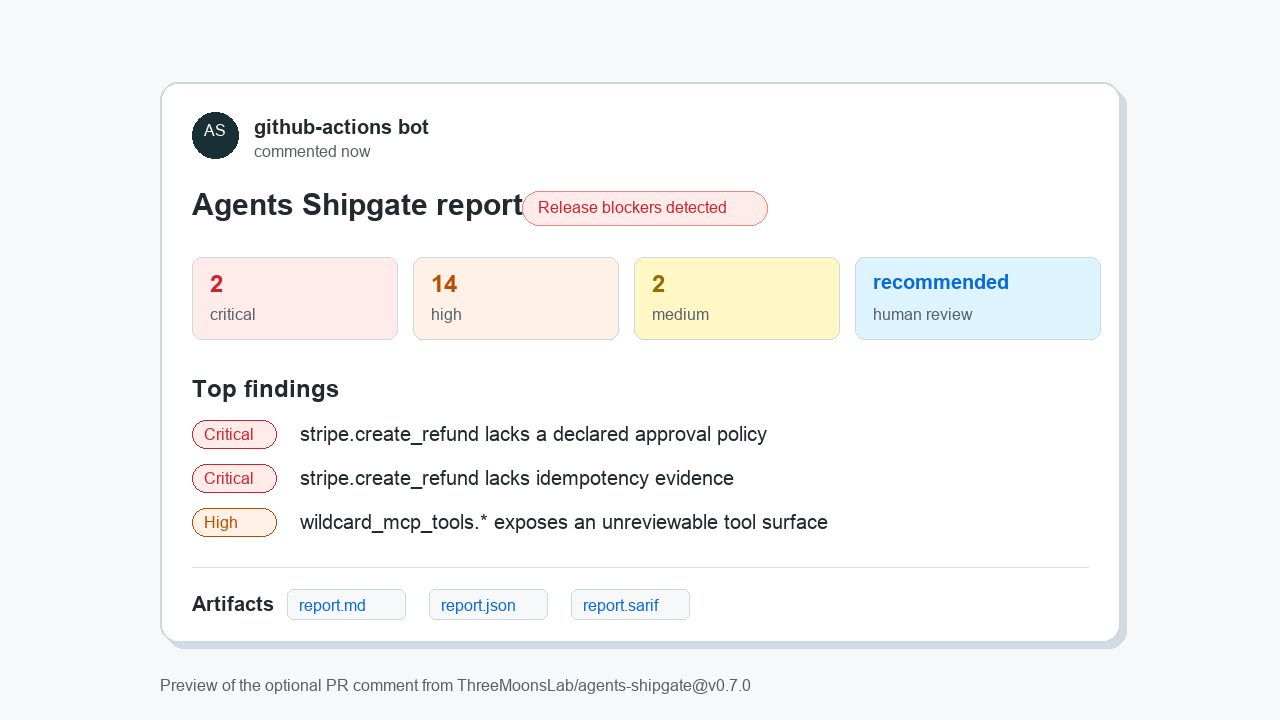
The action delegates to agents-shipgate verify and never fetches — keep
fetch-depth: 0 on checkout. After adoption, choose an explicit merge policy:
07-block-on-blocked-verdict.yml
blocks only when merge_verdict == blocked;
08-require-mergeable.yml
requires can_merge_without_human == true;
11-fail-on-insufficient-evidence.yml
fails only on insufficient_evidence. Strict / baseline / SARIF / Check Run /
multi-config recipes live in
examples/github-actions/; the full input and
output catalog is in action.yml. Use the decision output for
CI gating and merge_verdict / can_merge_without_human for PR-control
routing.
CI is advisory by default. Strict mode exits 20 only on unsuppressed critical
findings; for existing projects, save a baseline first so strict CI fails only
on new findings:
agents-shipgate scan --config shipgate.yaml --ci-mode strict
agents-shipgate baseline save --config shipgate.yaml --out .agents-shipgate/baseline.json
agents-shipgate scan --config shipgate.yaml --baseline .agents-shipgate/baseline.json --ci-mode strict
Severity and failure thresholds are configurable in the manifest
(checks.severity_overrides, ci.fail_on) — see
docs/baseline.md and
docs/integrations.md for GitLab, CircleCI, Jenkins,
and pre-commit equivalents.
What it scans
| Input | Status |
|---|---|
| Model Context Protocol (MCP) exports | Supported |
| OpenAPI 3.x specs | Supported |
| OpenAI Agents SDK Python files/directories | Supported |
| Anthropic Messages API artifacts | Supported |
| Google ADK Python and YAML config | Supported |
| LangChain/LangGraph static Python inputs | Supported |
| CrewAI static Python inputs | Supported |
| n8n workflow JSON and source-control stubs | Supported |
| Conductor OSS workflow JSON | Supported |
| OpenAI API artifacts | Supported |
| Codex repo config | Supported |
| Codex plugin packages and marketplaces | Supported |
What it produces
The read path is command-scoped. After standalone scan, read
report.json.release_decision.decision; scan does not produce a valid
verifier handoff or receipt. After verify, validate
verification-receipt.json and then read agent-handoff.json. If both
commands use the same output directory, a later standalone scan removes the
prior verifier substrate, handoff, PR comment, run projection, plan, diff,
base-report copy, unit result, artifact manifest, receipt, and copied human
authorization before writing its report. verify writes a fresh
content-addressed set after its internal scan completes. This prevents an old
verifier route from being mistaken for the current scan result. Supporting
commands such as baseline save run their internal scans in isolated temporary
directories and do not replace either command's report set.
When a PR changes what your agent can do, the verify loop writes these artifacts — in read order:
agents-shipgate-reports/verification-receipt.json— the first artifact a coding agent validates: a terminal content-addressed closure over the exact request (includingverification-input.diff), worker result, decision, and artifact set. It is written last; useagents-shipgate verification reproduceto validate every referenced hash.agents-shipgate-reports/agent-handoff.json— the compactshipgate.agent_handoff/v6object. Lead withcontrol.state, thengate.merge_verdict; it projects the same request, decision, and authorization evaluation and does not introduce a second verdict.agents-shipgate-reports/verifier.json— the authoritative PR/control evidence substrate (verifier_schema_version: "0.7"). A coding agent switches oncontrol.state, then readsauthorization,merge_verdict(mergeable | human_review_required | insufficient_evidence | blocked | unknown),can_merge_without_human,control.next_action, andfix_taskwhen producing reviewer evidence for an agent-capability PR. Only an accepted signed authorization evaluation may expose an exact reviewed command; the release verdict remains unchanged. Local control comes fromshipgate check --format agent-boundary-jsonandshipgate.agent_boundary_result/v1. Seedocs/agent-contract-current.mdfor the field contract.agents-shipgate-reports/verify-run.json— theshipgate.verify_run/v3projection embedding the exact verification plan, executor, unit-result IDs, decision ID, outcome, and artifact paths. Its deprecatedrun_idis an exact alias ofrequest_id.agents-shipgate-reports/attestation.json+agents-shipgate-reports/org-evidence-bundle.json— optional organization-governance projections over the same verifier/report artifacts. They are ledger inputs for platform teams, not release gates;report.json.release_decision.decisionremains the decision engine.agents-shipgate-reports/host-grants.json+agents-shipgate-reports/org-status.json— optional fleet-governance artifacts fromaudit --host --outandorg status --json, useful for host-grant drift, policy-pack pin state, and exception hygiene.agents-shipgate-reports/pr-comment.md— the human PR surface: the same verdict and semantic capability diff when available, shaped for a reviewer.agents-shipgate-reports/capabilities.lock.json+agents-shipgate-reports/base.capabilities.lock.json+agents-shipgate-reports/capability-lock-diff.{json,md}— the capability review primitive. Verify always emits the head lock after a successful scan; it emits the base lock and diff when the base scan can be materialized, falling back to the reviewed committed lock at.agents-shipgate/capabilities.lock.jsonif needed.- Gate source of truth —
report.json.release_decision.decision(passed | review_required | insufficient_evidence | blocked).merge_verdictis a deterministic projection of it; the report stays the one decision engine. - Tool-Use Readiness Report (supporting) —
agents-shipgate-reports/report.{md,json,sarif}. Markdown for human release review, JSON for tools and coding agents, SARIF for GitHub code-scanning workflows. This is the underlying check domain the verdict summarizes. - Release Evidence Packet (supporting) —
agents-shipgate-reports/packet.{md,json,html}(andpacket.pdfwith the[pdf]extras). Reviewer-shaped synthesis with fixed sections, including binding and semantic evidence coverage, the compact evidence matrix, and tool/action diffs when available. Packet outputs are locally redacted by default; see STABILITY.md §Release Evidence Packet.
Exit codes
| Code | Meaning |
|---|---|
0 |
Pass (advisory mode or strict-no-blockers) |
2 |
Manifest config error |
3 |
Input parse error (file missing, malformed, path traversal blocked) |
4 |
Other Agents Shipgate error |
20 |
Strict-mode gate failure |
For coding agents
Human readers can skip this section; it exists so coding agents can find the repo's machine-readable contracts quickly.
Agents Shipgate is designed to be agent-f
No comments yet
Be the first to share your take.