
AgentRisk


Risk guardrails for AI trading agents. Your agent proposes; your policy decides.
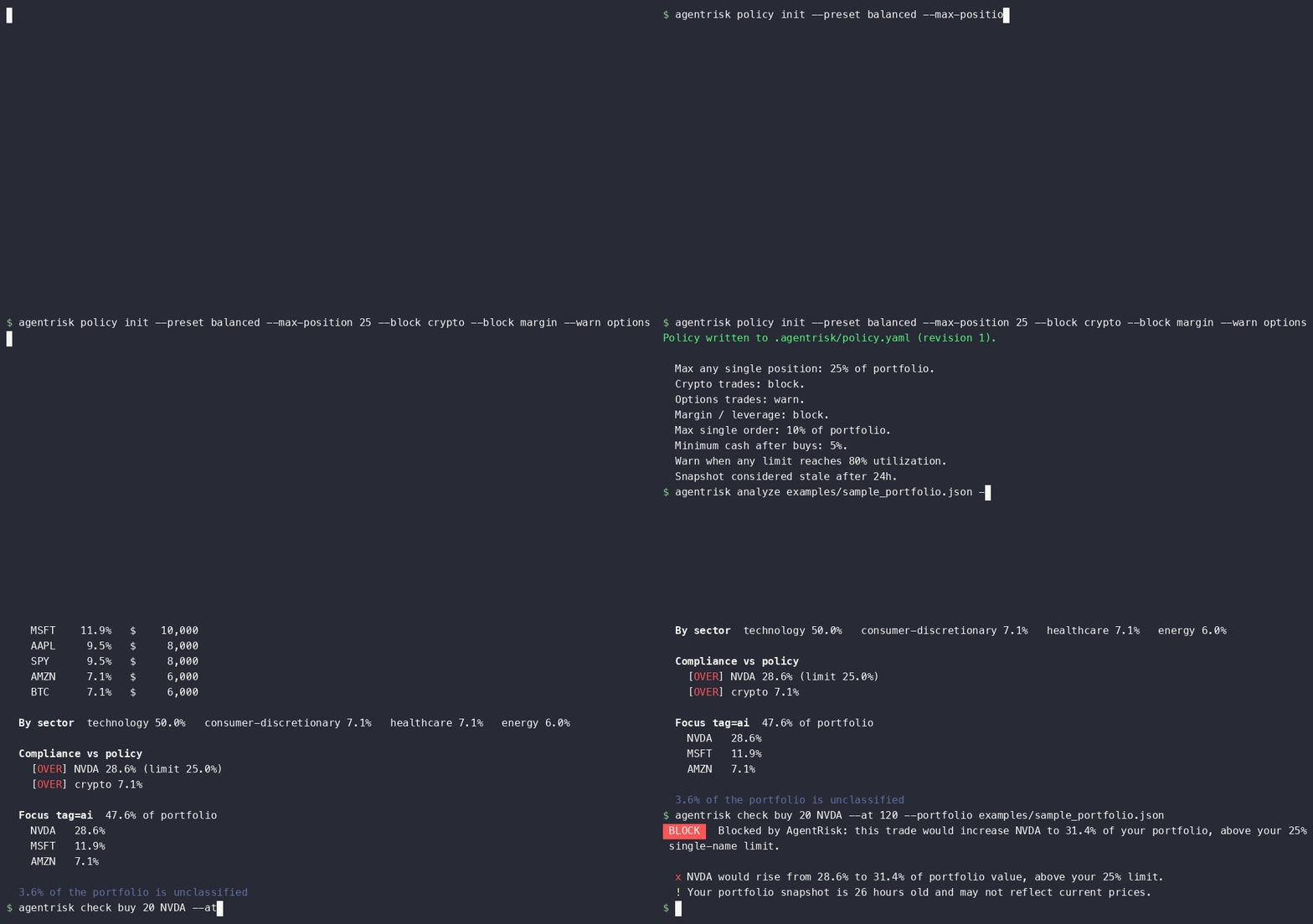
AgentRisk sits in front of trade execution: it analyzes portfolio risk, checks each proposed trade against a policy you write, and manages that policy. The core is deterministic (same inputs, same verdict), transparent (policies are plain YAML you can read and edit), and fail-closed (invalid input or a missing policy blocks, never a silent pass).
AgentRisk never recommends trades and never executes them. A
PASSmeans a trade did not break the rules you wrote, not that it is safe or profitable. See DISCLAIMER.md.
Quickstart
The fastest path for a Claude agent is the Claude Code plugin. It installs the Agent
Skill and registers the MCP server in one step
(via uvx, so there is nothing else to install):
/plugin marketplace add trycoin-ai/agentrisk
/plugin install agentrisk@agentrisk
For any other MCP client, register the server yourself:
{
  "mcpServers": {
    "agentrisk": {
      "command": "uvx",
      "args": ["--from", "agentrisk[mcp]", "agentrisk-mcp"]
    }
  }
}
Then ask questions in plain English and the agent translates them into three tool calls:
| Tool | Question it answers | Returns |
|---|---|---|
analyze_portfolio_risk |
What risk am I holding? | Concentration, exposure, and policy-compliance report |
check_trade_risk |
Should this trade go through? | PASS / WARN / BLOCK with a one-line reason |
generate_risk_policy |
What are my rules? | A human-readable YAML policy (create, update, show) |
The plugin path needs uv for uvx. See
examples/claude_desktop.md for a two-minute Claude
Desktop setup.
Agent Skill
For Claude agents, AgentRisk ships an optional Agent Skill that encodes the
discipline the guardrail depends on: before any order reaches a broker, classify the
trade, call check_trade_risk, respect the verdict, and record the result, in that
order. The plugin above installs it with the server. To install just the skill:
- Claude Code or Claude Desktop: copy
skills/agentrisk/into~/.claude/skills/. - claude.ai: upload
skills/agentrisk/SKILL.mdas a skill.
The enforcement contract
AgentRisk returns advice. It cannot physically stop an order, so your integration must gate execution on the verdict:
result = check_trade_risk(portfolio, trade)
if not result.proceed:
    refuse(result.summary)              # BLOCK: never call the broker
elif result.acknowledgements_required:
    confirm_with_user(result)           # WARN: surface warnings first
else:
    execute(trade)                      # PASS
If you call the broker regardless of the verdict, you have a logger, not a guardrail. See the integration guide.
Using the library directly
The three tools are also a pure Python library, with no network calls and no LLM in the core:
pip install agentrisk
Every parameter, return field, and error case is in the tool reference.
What it checks
- Concentration caps on single names, sectors, themes, and asset classes, evaluated on the simulated post-trade portfolio.
- Asset-class rules (allow, warn, or block) for crypto, options, and margin.
- Order sanity: max order size, minimum cash floor, insufficient-funds detection.
- Restricted symbols and data quality (stale snapshots warn, invalid ones block).
The policy reference covers every field and the safety behaviors: fail closed, exits are never trapped, only breach-worsening trades block, and the one-time bypass.
Documentation
| Doc | Contents |
|---|---|
| Concepts | The mental model and the agent/AgentRisk division of labor |
| Architecture | The module layout and how a call flows through the core |
| Policy reference | Every policy field and the check behavior it drives |
| Tool reference | Parameters, outputs, and error cases for all three tools |
| CLI reference | The agentrisk command: policy, check, analyze |
| Integration guide | The enforcement contract, broker MCP pairing, audit log |
| Threat model | What AgentRisk can and cannot protect against |
| Classification data | The open taxonomy and how to contribute corrections |
Roadmap
Next is deterministic stress scenarios, ETF look-through, and behavioral limits (v0.2), then options analytics, broker snapshot adapters, short positions, and multi-currency (v0.3). Trade recommendations, signals, execution, and telemetry are permanently out of scope. See the milestones.
Contributing
Classification-data corrections and new deterministic checks are especially welcome. See CONTRIBUTING.md, and keep the core pure: no network, no LLM calls, no hidden state.
License
MIT. See LICENSE.
No comments yet
Be the first to share your take.