
AgentDesk
A local visual debugger for AI agent runs: replay the failure, inspect every prompt/tool/result, and export redacted evidence before you wire in live tools.


AgentDesk answers the 10-second question: what actually happened inside this agent run, and can I replay or share the evidence?
- Replay a failed agent run instead of reading raw logs.
- Click from trace event to graph node and inspect prompt/tool/result/artifacts.
- Export a redacted replay session you can share in an issue, PR, or handoff.
Live demo | Launch page | GitHub repo | Wiki
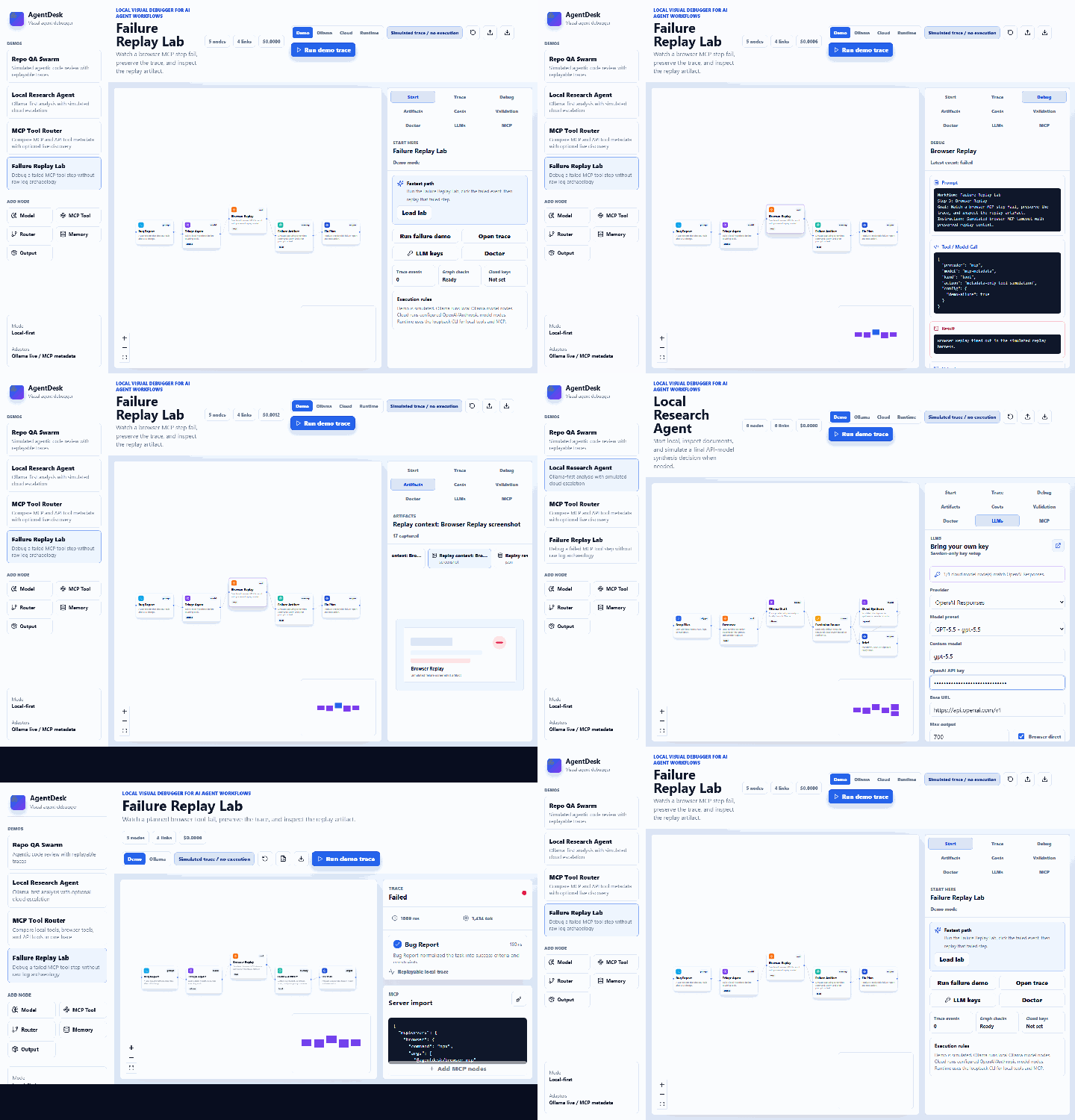
Failed MCP step -> prompt/tool/result -> artifacts -> cost -> replay -> redacted evidence export.
Documentation Wiki
The AgentDesk Wiki is the detailed operating manual for users and contributors. It is the best place to understand setup, run modes, MCP/runtime behavior, BYOK LLM configuration, exports, troubleshooting, security boundaries, and launch/contribution workflows.
| Wiki page | Use it for |
|---|---|
| Getting Started | Install paths, first run, and the 30-second failure replay demo. |
| Core Concepts | Workflows, nodes, edges, traces, artifacts, costs, validation, and replay. |
| Run Modes | Demo, Ollama, Cloud BYOK, and Runtime mode behavior. |
| MCP and Runtime | MCP import, live discovery, local command nodes, official SDK adapter, and runtime safety boundaries. |
| LLM Configuration | OpenAI/Anthropic BYOK setup, model presets, and browser-direct caveats. |
| Replay Sessions and Exports | Replay-session JSON, trace bundle ZIP, redaction, and framework starter exports. |
| Troubleshooting | Common local setup, Ollama, BYOK, MCP, and Runtime mode failures. |
| Security Model | What AgentDesk redacts, what it does not promise, and how to handle secrets. |
| Contributing Guide | Repo workflow, verification commands, code areas, and contribution expectations. |
| Launch and Promotion | Launch positioning, assets, community threads, and promotion checklist. |
See The Failure Replay In 30 Seconds
- Open the live demo.
- Click
Run failure demo. - Click the failed
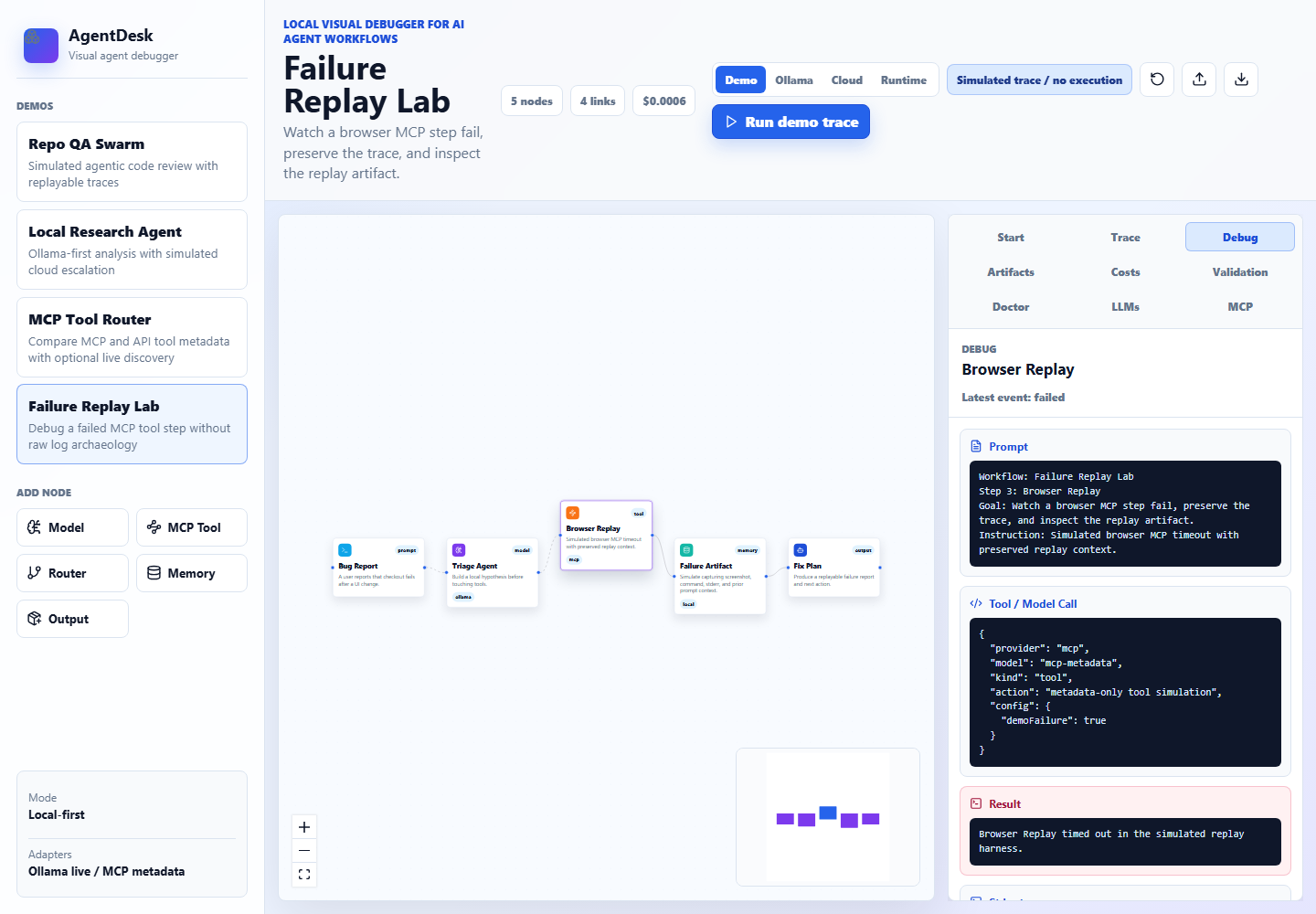
Browser Replaytrace event to highlight the graph node. - Inspect the exact prompt, tool call, result, stderr, screenshot, JSON, markdown, and cost.
- Click
Replay failed step, then export the.agentdesk-session.jsonevidence bundle.
Want to inspect the export format directly? Open docs/examples/failure-replay.agentdesk-session.json.
Why It Exists
Most workflow builders optimize for wiring boxes together and shipping automation. AgentDesk optimizes for the debugging loop before that: replay a run, click from trace to graph, inspect the exact prompt/tool/result payloads, review artifacts and cost, check graph health, and export redacted evidence.
Use it when you need to explain or reproduce an agent run locally. Use a workflow builder when you need production scheduling, hosted secrets, queues, branching operations, or live third-party tool execution.
| Need | Use |
|---|---|
| Replay and explain a failed local agent run | AgentDesk |
| Production scheduling, queues, hosted secrets, and cron jobs | Workflow builders |
| Hosted tracing/evals across deployed applications | Observability platforms |
| Framework-specific authoring and debugging | Framework studios |
Why Star This Repo
- It is a debugger-first agent tool, not another orchestration canvas.
- It gives immediate value in Demo mode without accounts, keys, or hosted infrastructure.
- It can graduate from demo evidence to live local execution through Ollama, BYOK model nodes, and loopback Runtime mode.
- It treats safety as a product feature: explicit execution modes, local runtime boundaries, secret redaction, and exportable evidence.
- It is small enough to understand, fork, and adapt for a team's own agent runtime.
Launch Install Paths
Fastest path:
npx --yes --package=@papaplus/agentdesk agentdesk --port 5173
The executable is still agentdesk, so global installs work as expected:
npm install -g @papaplus/agentdesk
agentdesk --port 5173
Source install:
git clone https://github.com/karurikwao/agentdesk.git
cd agentdesk
npm install
npm run dev
For the packaged local runtime:
npm run build
node ./bin/agentdesk.mjs --port 5173
What Works Today
- Visual workflow canvas with four launch demos: Repo QA Swarm, Local Research Agent, MCP Tool Router, and Failure Replay Lab.
- Demo trace runner with active-node highlighting, trace-to-node selection, node-to-latest-event inspection, graph validation, cost/token summaries, simulated failures, whole-run replay, and failed-step replay.
- Debugger inspector tabs for Start, Trace, Debug, Artifacts, Costs, Validation, Doctor, LLMs, and MCP import.
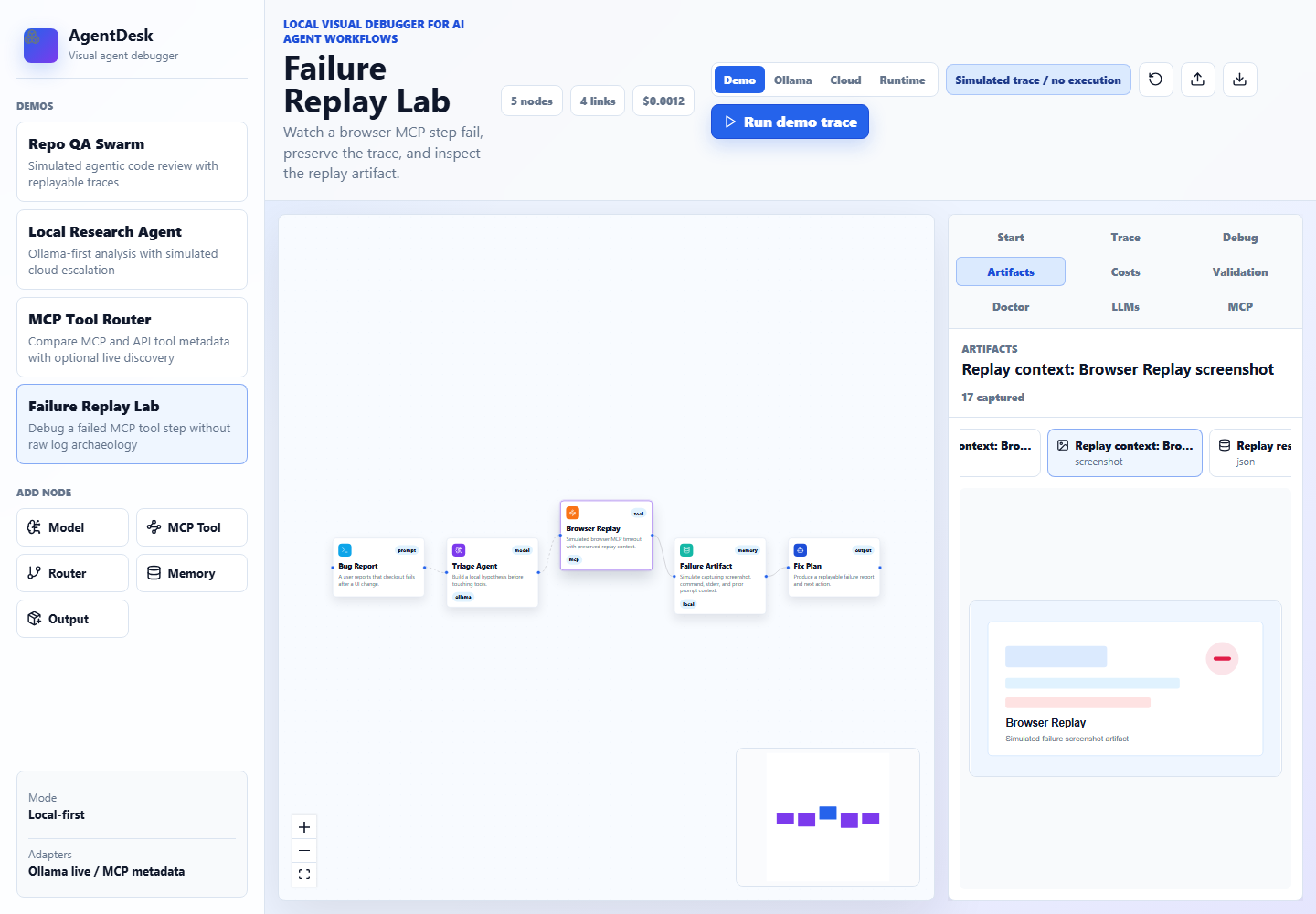
- Artifact viewer for JSON, markdown, simulated screenshot SVG previews, stdout, and stderr captured from trace events.
- Graph health UI for cycles, missing endpoints, duplicate IDs, missing edges, unreachable outputs, and non-output dead ends.
- Live local Ollama mode for
provider: "ollama"model nodes. - Cloud BYOK mode for configured
provider: "openai"andprovider: "anthropic"model nodes, with API keys held in browser session state only. - Runtime mode through the packaged loopback CLI for local command nodes, MCP 2025-11-25 stdio initialize/paginated tools-list/call-tool, and remote Streamable HTTP probing.
- Provider/model dropdown presets for OpenAI Responses and Anthropic Messages, plus editable base URL and model fields.
- MCP config import for Claude-style
mcpServers, VS Code-styleservers, nestedmcp.servers, remote server URLs, and single-server JSON. - MCP readiness, risk flags, inferred/live tool hints, and env/header key names without secret values.
- Replay-session import/export with
portableWorkflow,traceSummary, trace bundle manifest, LangGraph/CrewAI starter exports, full trace data, artifacts, costs, validation issues, selected evidence, imported MCP metadata, and secret/path redaction. - Packaged static CLI via
agentdeskafternpm run build.
Static hosted demos do not execute local processes. Live local command and MCP execution is available only when you run the packaged CLI on loopback and switch to Runtime mode.
Screenshots
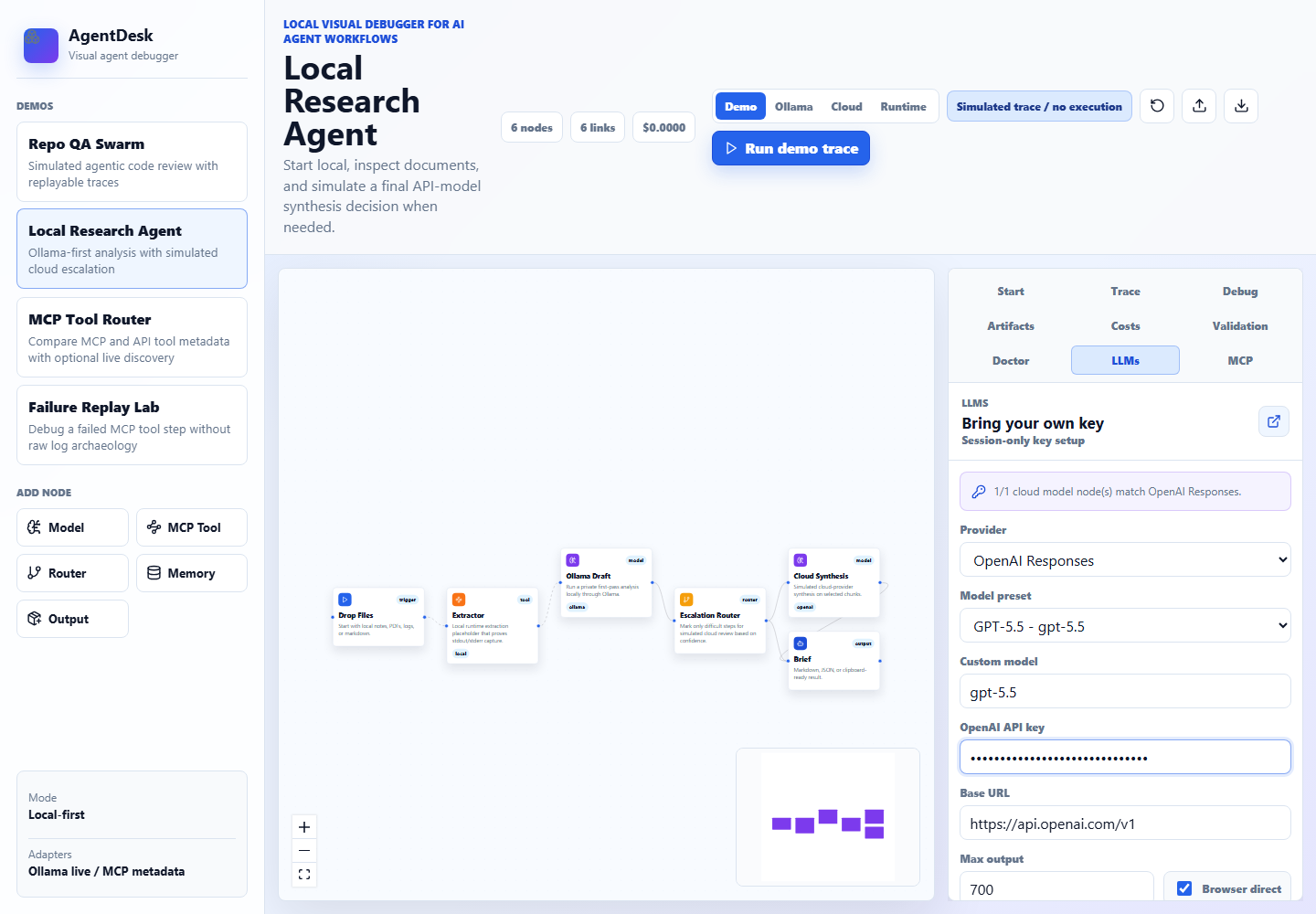
| Failure Debugger | Artifacts | BYOK LLMs |
|---|---|---|
 |
 |
 |
Quick Start
Prerequisite: Node.js 20.19.0 or newer.
npm install
npm run dev
Open http://127.0.0.1:5173.
The app opens on Start, which gives the shortest path into the Failure Replay Lab, trace inspector, Doctor, and LLM key setup.
Guided Demo
- Start on the
Starttab and clickLoad lab. - Click
Run demo trace. - Click the failed
Browser Replaytrace event to highlight its node and inspect prompt/tool/result. - Click
Replay failed step, then openArtifactsandCosts. - Use
LLM keysorDoctorfromStartwhen you want setup checks. - Paste an example MCP config from
docs/examples. - Export the
.agentdesk-session.jsonreplay session and import it again to restore the evidence.
Optional Local Ollama Run
- Start Ollama locally on
127.0.0.1:11434. - Pull the demo model, for example
ollama pull llama3.2. - Pick
Local Research Agent. - Switch run mode from
DemotoOllama. - Click
Run local Ollama.
Only Ollama model nodes are executed. All MCP and local tool nodes remain simulated metadata steps. Cloud-provider model nodes remain simulated too, with trace entries marked as simulated during Ollama mode.
Optional Cloud BYOK Run
- Pick
Local Research Agentfor the OpenAI path (Cloud Synthesis) orRepo QA Swarmfor an Anthropic planning path. - Open the
LLMstab. - Pick
OpenAI ResponsesforLocal Research AgentorAnthropic Messagesfor Anthropic model nodes. - Choose a model preset or type a custom model ID.
- Paste your API key, then click
Use Cloud mode. - Click
Apply to nodesif you want matching model nodes updated to the selected model. - Click
Run BYOK cloud.
Only configured OpenAI/Anthropic model nodes execute in Cloud mode. API keys stay in this browser tab's React state and are not saved to localStorage, replay sessions, workflow exports, or debug payloads. Cloud BYOK calls are browser-direct: provider CORS, browser policy, or organization settings may block direct requests, and production apps should use a backend proxy or hosted secret boundary.
Optional Runtime Mode
- Build and start the packaged CLI:
npm run build
node ./bin/agentdesk.mjs --port 5173
- Open
http://127.0.0.1:5173. - Click
Doctor, thenCheck runtime. - Switch run mode to
Runtime. - Run workflows with configured
provider: "local"command nodes, or import an MCP config and clickDiscoveron an MCP server.
Runtime mode uses loopback-only API routes, JSON-only requests, no shell by default, fixed timeouts, stdout/stderr caps, and redacted trace artifacts. MCP stdio servers are initialized through JSON-RPC, paginated tools/list results are captured as evidence, and tools/call is available when a node supplies toolName and optional toolInputJson in config. AgentDesk negotiates MCP protocol version 2025-11-25, preserves discovered tool descriptor metadata such as outputSchema and execution, and treats isError: true tool-call results as failed trace events. Remote MCP Streamable HTTP endpoints are probed only after explicit discovery.
MCP Import Examples
Secrets in env values, headers, URLs, args, private user path prefixes, and common token formats are redacted before display/export.
Scripts
npm run dev        # start local Vite app on 127.0.0.1:5173
npm run build      # typecheck and build
npm run preview    # preview production build
npm run test       # run unit tests
npm run test:e2e:install # install Playwright Chromium
npm run test:e2e   # build and run browser regressions
npm run check:release # verify launch/release docs and version metadata
npm run screenshots:launch # refresh GitHub Pages launch screenshots
npm run smoke:package # pack, install, and serve the CLI in a clean temp project
npm run lint       # run TypeScript checks
npm run verify     # typecheck, test, build, audit
npm pack --dry-run # verify package contents
Packaged CLI
npm run build
node ./bin/agentdesk.mjs --port 5173
The CLI serves the built dist app from localhost with conservative static-server headers.
Current Limits
- Ollama calls happen from the browser to
127.0.0.1:11434; CORS settings may need adjustment in some local Ollama setups. - Cloud BYOK calls happen directly from the browser tab; provider CORS may block some endpoints, and production apps should use a backend proxy or hosted secret boundary instead.
- Runtime mode requires the packaged CLI; static Cloudflare and GitHub Pages builds cannot spawn local processes.
- Shell commands are blocked unless
AGENTDESK_ALLOW_SHELL=1is set before starting the CLI. - BYOK prompts and responses become trace/debug/artifact evidence, even though API keys are excluded from exports.
- Workflow execution is still linear/topological; advanced branching and joins are schema-ready but not fully interactive.
- Project storage is replay-session import/export only for now; there is no persistent workspace database.
- The README uses a current screenshot; an optional short GIF can replace it in a later promo pass.
Recently Completed
- Official MCP SDK stdio adapter with an explicit legacy JSON-RPC fallback.
- Persistent local runtime profiles for approved MCP configs and local command adapters.
- ZIP export for the current trace bundle manifest and artifact files.
- Keyboard trace inspection plus LangGraph and CrewAI example workflows.
Roadmap
- Persistent workspace database for saved projects and trace history.
- Deeper framework imports for LangGraph, CrewAI, OpenAI Agents SDK traces, and Vercel AI SDK examples.
- Three polished launch videos for README, Product Hunt, and Hacker News.
Launch Assets
- Release notes:
docs/RELEASE_v0.7.0.md - Good first issues: live issue queue and
docs/GOOD_FIRST_ISSUES.md - Killer demo:
docs/KILLER_DEMO.md - NPM publish runbook:
docs/NPM_PUBLISH.md - Launch details:
docs/PROJECT_LAUNCH.md - Launch plan:
docs/LAUNCH_PLAN.md
Security Notes
AgentDesk treats imported MCP configs and replay sessions as untrusted. Runtime mode can execute local commands and MCP servers only through the loopback CLI after explicit UI action. Exports redact common secrets and private paths, but local UI display is not a secret vault. BYOK API keys are session-only and excluded from replay exports, but direct browser calls still expose the supplied key to the local tab runtime and provider endpoint. Do not paste real secrets into node labels, prompts, stdout/stderr, artifacts, screenshots, or model responses. See SECURITY.md.
License
MIT
No comments yet
Be the first to share your take.