
AgentSpan gives AI agents persistent, scalable, cached access to 52 internet platforms through one REST API, an SSE event stream, a native MCP server (91 tools), 9 language SDKs, a CLI, and a React dashboard — all on an async Rust core.
The channels also heal themselves — a background monitor auto-switches failing backends, reinstalls broken CLI tools, and alerts on sustained outages — and the gateway learns from its own traffic, suggesting cache-TTL tweaks, faster backends, and platforms worth adding next.
Why AgentSpan?
Agent Reach proved the "capability layer" model (install → diagnose → route) for agent web access. AgentSpan takes that model and turns it into a real gateway — it does the reading itself, behind one API.
| Capability | Agent Reach | AgentSpan |
|---|---|---|
| Architecture | Python installer (agent calls tools) | Async Rust gateway |
| Channels | 13 | 52 |
| Caching | ❌ | ✅ L1/L2/L3 |
| REST API | ❌ (CLI only) | ✅ + SSE + OpenAPI |
| MCP tools | 1 | 91 |
| SDKs | 0 | 9 (Py, JS/TS, Rust, Go, Ruby, Java, PHP, C#, Swift) |
| Multi-tenant / RBAC / audit | ❌ | ✅ |
| Web dashboard | ❌ | ✅ React |
| Docker | ❌ | ✅ |
| Cookie auth · transcription · installer · SKILL.md | ✅ | ✅ |
What AgentSpan is not
- Not a browser-automation agent (can't click, log in, fill forms). Use Browser-Use or Playwright for that.
- Not a generic crawler competing with Firecrawl on arbitrary-site quality. AgentSpan is optimized for the 52 platforms it knows.
- Not a hosted SaaS. It's a self-hosted binary you run on your own infra.
"Why not MCP servers / OpenRouter / Composio / SearXNG / LangChain / a browser agent?" — each gets a concrete answer in docs/why-agentspan.md. Performance claims are CI-verified on every PR: BENCHMARKS.md.
Website
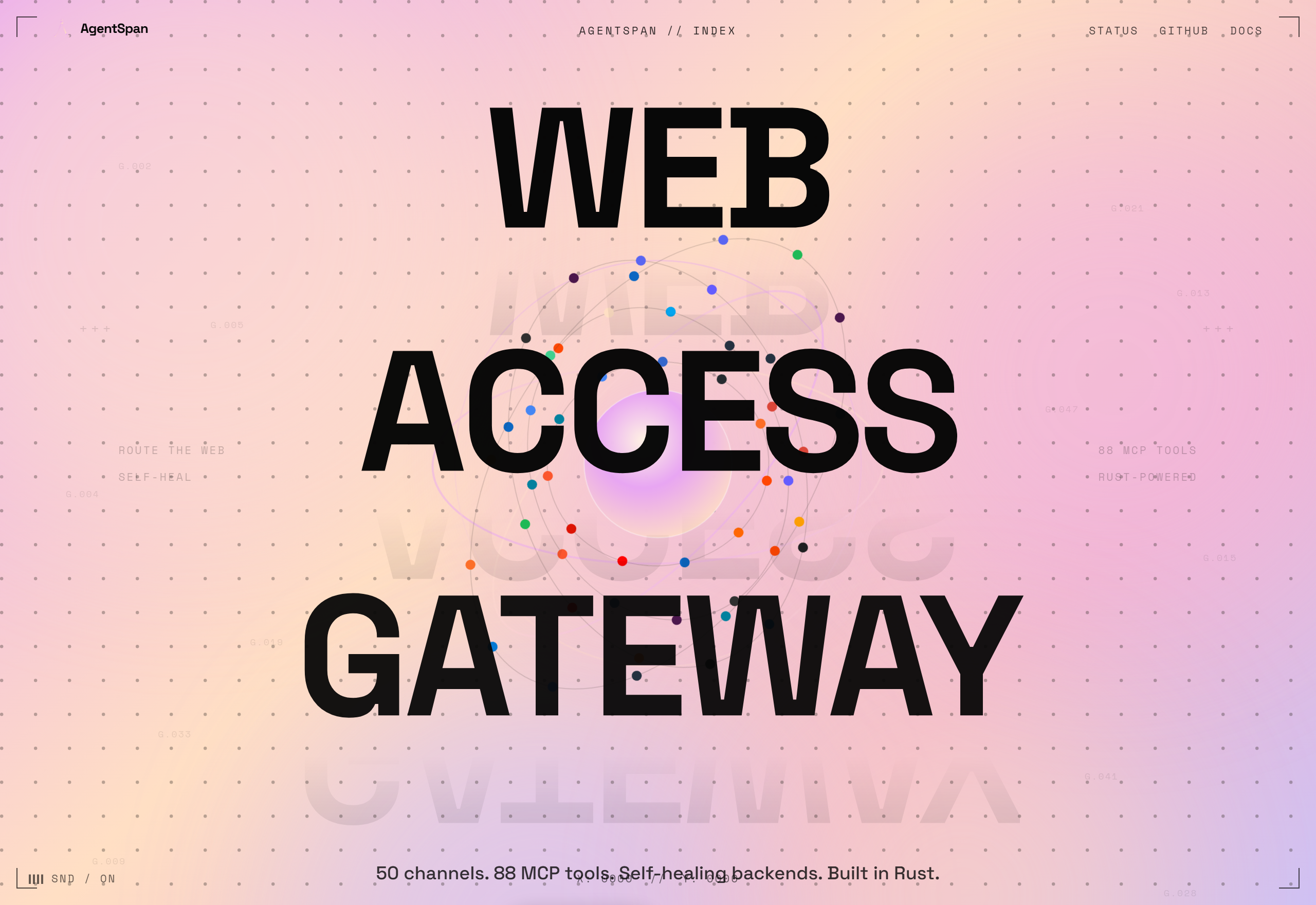
Two surfaces, one design system — built with React 18 + TypeScript + Vite + GSAP (ScrollTrigger) + Lenis, pure CSS (no Tailwind/Bootstrap):
- Home (
/) — the marketing page; the whole scroll is the landing experience. - Status (
/status) — a live, read-only gateway dashboard.
Home (/)
A section-based editorial / futuristic-HUD clone reverse-engineered from a reference design and filled with real AgentSpan content:
| # | Section | What it shows |
|---|---|---|
| 0 | Preloader | gradient gateway orb with pulsing rings, 0→100 boot counter, terminal readouts (<91 MCP TOOLS>, // 2026) |
| 1 | Hero | Web Access Gateway display headline over a distortion-shaded coral gateway figure (its head an open ring routing a request through the sky), pink cloud-sky background, scattered coordinate tags, flank labels, EXPLORE / GITHUB pills |
| 2 | Channels | circular portal with the orb spinning inside + 52 CHANNELS + 4 numbered category cards |
| 3 | Network | Network grid — all 52 channels as brand-colored silhouette avatars, each wearing the platform's real logo (or a hand-drawn glyph where no logo exists), with a live status dot + category |
| 4 | Architecture | pink orbital-ring diagram + the 9 Rust crates — pinned on scroll |
| 5 | Features | the 6 killer capabilities on the pink panel |
| 6 | Showcase | the AGENTSPAN waveform wordmark, stats, and the install snippet |
| 7 | Footer | links, MIT, version |
Signature chrome: corner-frame brackets, a live mouse-coordinate HUD, a sound toggle, dot-grid section texture, animated chevron pill CTAs, a 1s per-section background cross-fade, and GSAP scroll-reveal on every section.
Status dashboard (/status)
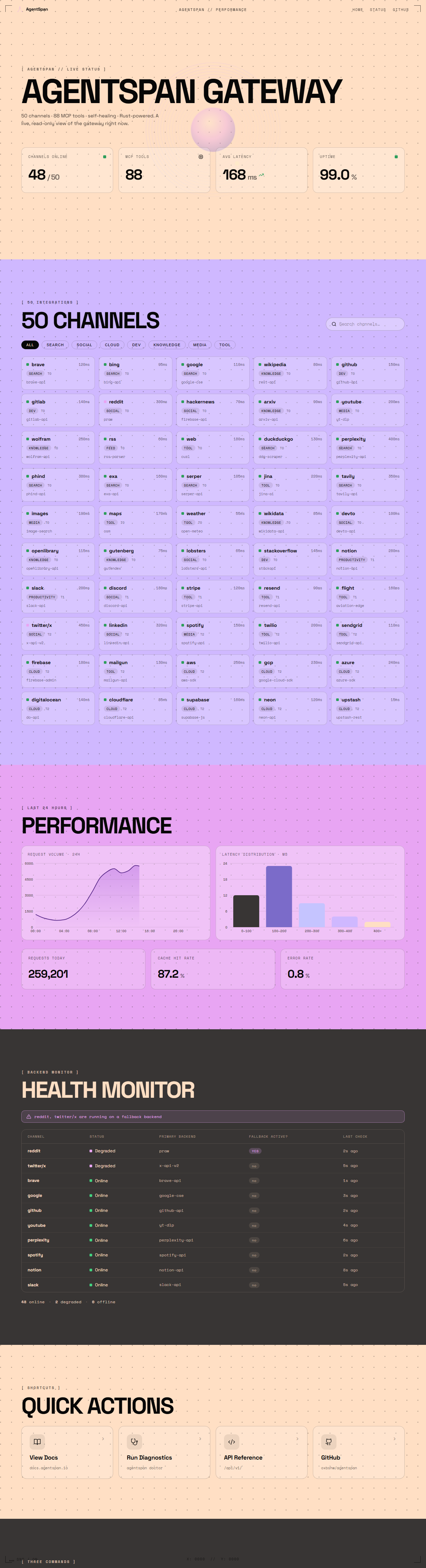
A read-only at-a-glance view of the gateway, sharing the home page's chrome, fonts, colors and animations: gateway status header (count-up stat cards), a searchable/filterable grid of all 52 channels, performance charts (request volume + latency, recharts), a health monitor table with fallback status, quick actions, and a copy-to-clipboard install snippet.
Launch: cd web && npm install && npm run dev → / and /status.
(?static renders without the preloader/smooth-scroll, handy for screenshots.)
Architecture
flowchart TD
    subgraph Clients
      SDKs["9 SDKs (Py/JS/Rust/Go/Ruby/Java/PHP/C#/Swift)"]
      CLI["agentspan CLI"]
      Dash["React Dashboard"]
      MCP["MCP clients (Claude/Cursor/...)"]
    end
    subgraph Gateway["AgentSpan Core (Rust, async)"]
      API["REST API + SSE"]
      MCPS["MCP Server (91 tools)"]
      Router["Router: probe · select · retry · circuit-break"]
      Cache["3-tier Cache (L1/L2/L3)"]
      Auth["Auth: keys · tenants · RBAC · rate-limit · audit"]
    end
    Backends["Backends: HTTP APIs · CLI tools · Jina Reader"]
    Clients --> API & MCPS
    API --> Router --> Backends
    Router --> Cache
    API --> Auth
Quick start (3 commands)
cargo run --bin agentspan -- serve            # 1. start the gateway on :8080
curl "localhost:8080/api/v1/read?url=https://example.com"   # 2. read any page
curl "localhost:8080/api/v1/channels/hackernews/search?q=rust"  # 3. search
Or with Docker:
docker compose up --build # API + UI + Redis + PostgreSQL + Prometheus + Grafana
Use with AI agents (Claude Code, Cursor, Windsurf)
# One command — writes the MCP config to the right file automatically:
agentspan mcp install --client claude-code    # or: cursor, windsurf, cline

# Or print the config and paste it yourself:
agentspan mcp print-config --client cursor

# See all 91 tools:
agentspan mcp tools
See the full guides: Claude Code · Cursor · Windsurf.
Use an SDK
# Once published to PyPI:
# pip install agentspan
# Until then, install from source:
pip install -e sdk/python
from agentspan import AgentSpanClient
client = AgentSpanClient(base_url="http://localhost:8080")
print((await client.read("https://example.com")).body)
See sdk/README.md for all 9 languages and docs/api-reference.md for the full API.
Channels (52)
| Tier 0 (zero-config) | Tier 1 (needs key/cookie) |
|---|---|
| web, github, youtube, tiktok, rss, hackernews, v2ex, exa, wikipedia, arxiv, quora, pinterest, npm, crates, pypi, gitlab, dockerhub, wayback, maps, weather, coinbase, duckduckgo, gnews, statuspage, huggingface, devto, openlibrary, gutenberg, lobsters, wikidata | twitter, reddit, bilibili, xiaohongshu, instagram, linkedin, xueqiu, xiaoyuzhou, discord, telegram, spotify, twitch, scholar, podcasts, openai, anthropic, brave, bing, google, notion, slack, flight |
Every channel implements read and/or search, runs through a health-checked
backend router, and reduces tokens via format_for_llm. Run agentspan doctor
to see which backend is serving each channel right now.
CLI
agentspan serve | doctor | watch | format | benchmark | transcribe | tunnel
         | plugin | install | uninstall | setup | config | skill | mcp | completions | update
Highlights: benchmark (cache-hit vs backend p50/p99), tunnel (public URL via
cloudflared), plugin (community channels), transcribe (Whisper), format
(per-channel token-reduction rules), completions <shell> (bash/zsh/fish/
powershell/elvish), and config backup/config restore.
Observability & operations
GET /metrics— Prometheus text exposition (request counts, errors, shed requests, latency, channel gauge). Public, so scrapers need no API key.- Request tracing — every request/response carries an
x-trace-id(an inboundx-trace-id/x-request-idis honoured); the id is attached to audit events for correlation. - Resource limits — a 2 MiB request-body cap plus a global in-flight
concurrency limit that sheds excess load with
503instead of unbounded queueing. - Graceful shutdown —
agentspan servedrains in-flight requests on Ctrl-C and (on Unix)SIGTERM.
Smart routing & content
- Adaptive routing — opt in with
BackendRouter::with_adaptive_routing(). The router learns each backend's EWMA latency and success rate from live traffic and prefers the better performer within a health tier. Unknown backends stay optimistic so they still get tried. - Content intelligence — fetched pages are classified (article / forum /
code / docs) with key facts (URLs, dates, code blocks), reading stats
(word/sentence count, reading time), and an extractive summary (the most
salient sentences) pulled out and attached as metadata;
smart_truncatetrims on sentence boundaries, not mid-word. All dependency-free heuristics — no model calls. - Conditional revalidation — the direct-HTTP path remembers
ETag/Last-Modifiedand revalidates withIf-None-Match/If-Modified-Since, so unchanged pages come back as a cheap304instead of a full re-download. - Federated search —
POST /api/v1/search/federatedqueries many channels at once, de-duplicates by URL (merging which channels found each result), and ranks cross-source hits first. One channel failing doesn't sink the query. Pass"rerank": trueto instead order results by a dependency-free lexical relevance score (title-weighted TF with a phrase bonus), and"collapse": trueto merge near-duplicate hits (the same story re-syndicated under different URLs) by title similarity. - Request coalescing —
with_request_coalescing()collapses a dogpile of concurrent identical reads into a single upstream fetch (single-flight), so five agents asking for the same URL in the same second hit upstream once.
Agent memory
A namespaced key/value scratchpad so agents can persist small state — cursors, seen-sets, notes — across requests without standing up their own store:
curl -X PUT localhost:8080/api/v1/memory/agent1/cursor \
  -H 'content-type: application/json' -d '{"value":{"page":3},"ttl_secs":3600}'
curl localhost:8080/api/v1/memory/agent1/cursor      # -> {"value":{"page":3},...}
curl localhost:8080/api/v1/memory/agent1             # -> {"keys":["cursor"]}
In-memory and process-local (survives requests, not a restart); entries take an
optional TTL and are swept lazily. GET/PUT/DELETE on
/api/v1/memory/{namespace}/{key}, GET on /api/v1/memory/{namespace}.
AI-native content primitives
Dependency-free, deterministic building blocks in agentspan-channels that make
reads cheaper and more useful for agents — no model calls, no extra services:
- Token-budget compiler (
budget::fit_to_budget) — "give me this page in ≤ 2 000 tokens." Fits any text to a hard token ceiling, degrading gracefully from extractive summary to boundary-aware truncation, and reports which strategy it used. The estimate is a safe upper bound, so the ceiling holds. - Content fingerprinting (
fingerprint) — an exact FNV-1a hash plus a 64-bit SimHash, so an agent can ask "did this page meaningfully change since I last read it, and by how much?" without diffing bodies. Complements ETag revalidation (which only says the bytes differ). - Structured extraction (
extract) — pull typed fields (title, links, dates, emails, prices, summary) into JSON and project just the keys you asked for, so a channel can answer in a fixed schema with zero LLM-extraction spend.
These ship as library primitives; REST/MCP surfacing is the next wave.
Project structure
crates/         Rust workspace (core, probe, router, cache, auth, channels, mcp, api, cli)
sdk/            9 SDKs (python, js, rust, go, ruby, java, php, csharp, swift)
web/            React marketing site + admin dashboard (Vite + GSAP + Lenis)
integrations/   MCP client configs, VS Code/JetBrains/Nvim plugins, GitHub Action
plugins/        Community channel registry
docs/           API reference, guides, mdbook site, i18n
tests/          Integration + load test suites
See KNOWN_ISSUES.md for current rough edges and build quirks.
Community
- Issues — bugs and feature requests
- Discussions — questions and show & tell
- CONTRIBUTING.md — how to add a channel or MCP tool
Security
- Binds to
127.0.0.1by default; the Docker image sets0.0.0.0. - Single-user mode (default): admin routes return
403. Setauth.require_api_key=trueto enable scoped API keys. - API keys stored as SHA-256 hashes;
~/.agentspan/config.yamlis0600and secrets are masked in output/logs. See SECURITY.md.
License
MIT — see LICENSE.
No comments yet
Be the first to share your take.