
agent-prod
English | 简体中文 | Design | MCP Integration | Usage
Quality gates for production AI agents. agent-prod wraps any agent run or release in an 8-gate safety pipeline — permission, budget, trace integrity, regression, gray release, audit, answer quality, and execution consistency. Like tests for code, but for agent behavior.
from agent_prod import trace

result = trace(
    agent="my-agent",
    session_id="session-001",
    current_metrics={"final_response": "Paris", "success_rate": 0.99},
)
print(result["status"])  # "production" | "rejected"
Pipeline
Agent run ──▶ Gate0 ──▶ Gate1 ──▶ Gate2 ──▶ Gate3 ──▶ Gate4 ──▶ Gate5 ──▶ Gate6 ──▶ Gate7 ──▶ Approve?
              │         │          │          │          │          │          │          │
             risk     budget    trace     regress.   gray      audit     answer    exec.
             ACL      check     DAG       compare   rollout   policy    quality   consistency
| Gate | What it checks | When it blocks |
|---|---|---|
| Gate0 Permission | Tool ACL, risky arg inspection, declared-tools enforcement | Undeclared or dangerous tool calls |
| Gate1 Budget | Token & time budgets per agent type, circuit breaker | Budget exceeded or LLM endpoint degraded |
| Gate2 Trace Integrity | LLM → tool DAG completeness, no orphan tool calls | Missing or unmapped LLM calls |
| Gate3 Regression | Latency/success-rate/quality drift vs. evolving baseline | Significant performance or quality drop |
| Gate4 Gray Release | Progressive rollout stages (1% → 10% → 50% → 100%) | Error-rate or latency spike per stage |
| Gate5 Release Audit | Policy-as-code rules: prior gates, rollback plan, human approval | Critical policy violation |
| Gate6 Answer Quality | Checklist evaluator (12 binary checks) or LLM-as-judge | Score below per-agent threshold |
| Gate7 Execution Consistency | Plan-to-output alignment, goal fulfillment | Off-plan or hallucinated execution |
How this differs from eval frameworks: Eval frameworks score a single dimension (answer correctness) in isolation. agent-prod closes the loop — permission → budget → trace → regression → release → audit → quality → consistency — and rejects the run at the first failure. This is the difference between "this answer scores 0.85" and "this agent run is not safe for production." See design philosophy →
Quick Start
# Install
pip install agent-prod

# Evaluate one trace — no server needed
python -c "
from agent_prod import trace
result = trace(
    agent='demo',
    session_id='demo-1',
    decisions=[{
        'decision_id': 'd1',
        'model': 'gpt-4',
        'prompt_tokens': 100,
        'completion_tokens': 50,
        'tool_calls': [
            {'tool_name': 'web_search', 'arguments': {'q': 'weather'}, 'success': True},
        ],
    }],
    current_metrics={'final_response': 'Sunny, 22°C', 'success_rate': 1.0},
    human_approver='demo',
)
print(f'Passed: {result[\"status\"]}')
"

# Or start the server
agent-prod configure
agent-prod serve
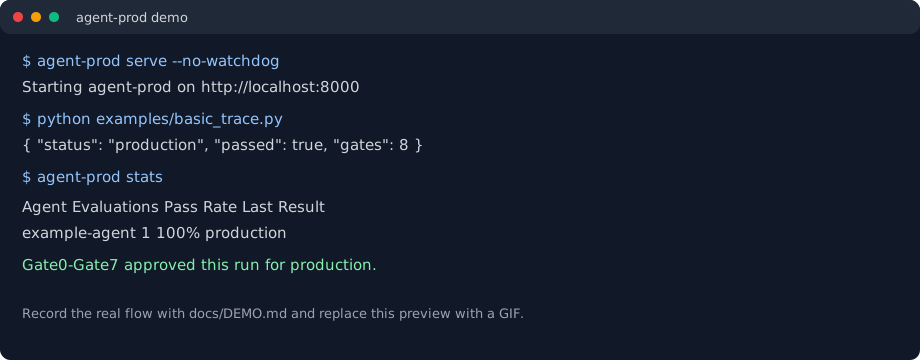
python examples/basic_trace.py
agent-prod stats
MCP Server — Use From Any Agent
agent-prod exposes all 8 gates as MCP tools. Claude Desktop, Cursor, Cline — any MCP client can call quality-gate evaluations directly.
pip install "agent-prod[mcp]"
agent-prod-mcp
// claude_desktop_config.json
{ "mcpServers": { "agent-prod": { "command": "agent-prod-mcp" } } }
| MCP Tool | Purpose |
|---|---|
evaluate_trace |
Full Gate0–Gate7 pipeline for an agent trace |
check_tool_safety |
Single tool-call Gate0 preflight |
get_gate_stats |
Historical evaluation stats |
health_check |
Engine and repository health |
MCP Registry — Publish, Search, Install
# Publish your MCP server
agent-prod registry publish my-server \
    --command "uvx my-server" \
    --description "Search and index documentation" \
    --tags "search,docs"

# Search for servers
agent-prod registry search mcp

# List local registry
agent-prod registry list
Agent Observability — OpenTelemetry Spans
Wrap pipeline evaluations with OpenTelemetry spans. Each gate becomes a span under an agent-run trace, exportable to any OTLP-compatible backend (Grafana, Honeycomb, SigNoz).
from agent_prod.observability.otel import AgentSpanExporter

exporter = AgentSpanExporter(endpoint="http://localhost:4317")
exporter.export_pipeline(improvement, agent_type="hermes")
# → Gate0–Gate7 spans exported to your observability backend
Zero hard dependency — works without opentelemetry installed. Activate with
pip install opentelemetry-api opentelemetry-sdk opentelemetry-exporter-otlp.
A2A — Agent-to-Agent Delegation
Delegate tasks between agents via a lightweight protocol with capability negotiation, partial-success semantics, and error chain attribution.
from agent_prod.a2a import A2AAgent, A2ATask, A2ADelegator

class SearchAgent(A2AAgent):
    capabilities = ["web_search", "news"]

    def execute(self, task: A2ATask):
        results = search(task.input["q"])
        return {"results": results}

delegator = A2ADelegator()
delegator.register(SearchAgent())

task = A2ATask(name="search", input={"q": "weather"}, required_capabilities=["web_search"])
result = delegator.delegate(task)
Comes with a LangChain adapter (create_langchain_tool) to plug into existing
agent pipelines.
Multi-Agent Trust Chain — Phase 5
When a parent agent delegates to a child, the child inherits a subset of the
parent's authority — never more. TrustChainValidator enforces this at Gate0:
from agent_prod.gates.trust_chain import TrustChainValidator, TaskACL, TrustLevel

tc = TrustChainValidator()
tc.register_task(TaskACL(
    task_id="task-001",
    parent_agent="qclaw",
    child_agent="code-reviewer",
    trust_level=TrustLevel.RESTRICTED,
    allowed_tools={"Read", "Grep"},          # child can only call these
    allowed_domains={"finance"},             # child can only operate in this domain
    expires_at=datetime.now(UTC) + timedelta(hours=1),
))

# Gate0 now blocks any tool call from `child_agent=code-reviewer`
# outside the ACL — even if it's declared in declared_tools.
| Trust level | Behavior |
|---|---|
RESTRICTED (default) |
Child can only use tools in allowed_tools |
FULL |
Child inherits parent's full tool palette — no restriction |
SANDBOX |
Read-only / benign tools only; auto-expires |
Without a registered ACL, the validator stays out of the way — Gate0 falls back to its standard declared-tools + auth-grant checks. So trust-chain enforcement is opt-in per delegation relationship.
Async Approval Workflow — Phase 3
Gate5 can emit a pending_approval state instead of binary pass/fail. The
pipeline halts, the improvement is persisted, and the pipeline resumes on
external decision — via HTTP callback, CLI, or webhook.
# Pipeline reaches Gate5 with only "Human approval" missing
# → status: pending_approval, improvement persisted

# Approve via HTTP
curl -X POST http://localhost:8080/v1/approvals/$APPROVAL_ID/decide \
  -H "Content-Type: application/json" \
  -d '{"approved": true, "approver": "alice", "reason": "looks good"}'
# → runs Gate6, Gate7, promotes to PRODUCTION

# Or reject
curl -X POST http://localhost:8080/v1/approvals/$APPROVAL_ID/decide \
  -d '{"approved": false, "approver": "bob", "reason": "rollback plan missing"}'
# → status: rejected, fail_gate: gate5_approval
| Endpoint | Purpose |
|---|---|
GET /v1/approvals |
List approval records (filter by agent, status) |
GET /v1/approvals/{id} |
Fetch a single record |
POST /v1/approvals/{id}/decide |
Approve or reject; resumes pipeline |
POST /v1/approvals/{id}/approve |
Convenience: approve + resume |
POST /v1/approvals/{id}/reject |
Convenience: reject |
Approval records are idempotent — deciding twice raises ValueError. Records
auto-expire after a configurable TTL (default 24h).
CLI
agent-prod approval list                       # list pending approvals
agent-prod approval list --agent qclaw         # filter by agent
agent-prod approval list --status pending      # filter by status
agent-prod approval approve <id> --approver alice --reason "LGTM"
agent-prod approval reject <id> --approver bob
Server-restart rehydration
The in-memory ApprovalQueue is lost on server restart, but Improvement
records with status=PENDING_APPROVAL persist in the repository. On startup,
the server scans the repository for pending approvals and re-registers them in
the queue — so callbacks received after a restart still resume the pipeline.
Domain Policy Engine — Phase 2
Industry-specific risk escalation at Gate0. The base tool risk is only escalated, never downgraded when an agent operates in a regulated domain.
# config.yaml
gates:
  domain_policy:
    enabled: true
    domains:
      finance:
        risk_overrides:
          web_search: elevated   # benign → elevated in finance context
        required_compliance: [sox, pci_dss]
      medical:
        risk_overrides:
          read_file: elevated
        required_compliance: [hipaa]
from agent_prod.gates.domain_policy import DomainPolicyEngine

engine = DomainPolicyEngine(config)
result = engine.get_effective_risk("web_search", "my-agent", domain="finance")
# RiskLevel.ELEVATED  (was BENIGN in vanilla Gate0)

# Compliance claims are enforced: missing HIPAA claim in medical domain → block
cr = engine.validate_compliance_claims(
    tool="read_file", domain="medical",
    compliance_claims={},  # missing HIPAA
    agent_type="my-agent",
)
assert cr.violation  # ViolationType.MISSING_COMPLIANCE
Observability — Prometheus + Grafana — Phase 4
# Spin up the full monitoring stack
docker compose --profile observability up -d
# → Prometheus on :9090, Grafana on :3001
Pre-built dashboard (deploy/grafana/dashboards/agent_prod_overview.json)
auto-provisions with panels for: pipeline outcomes, per-gate rejection rates,
gate1 circuit breaker state, domain-policy escalations, and approval queue
depth. The dashboard is provisioned automatically on first Grafana boot —
no manual import required.
Key Prometheus metrics exposed on :8080/metrics:
| Metric | Type | Labels |
|---|---|---|
agent_prod_pipeline_total |
counter | status, agent |
agent_prod_gate_duration_ms |
histogram | — |
agent_prod_rejections_total |
counter | gate |
agent_prod_gate1_degraded |
gauge | — |
agent_prod_domain_escalations_total |
counter | domain, tool, agent |
agent_prod_domain_compliance_blocks_total |
counter | domain, violation_type |
GatePlugin Interface — Extend With One Class
Every gate is a plug-in. Write your own gate in ~30 lines:
from agent_prod.gates.interface import GatePlugin, register_gate
from agent_prod.gates.models import GateName, GateResult, Improvement

class MyCustomGate(GatePlugin):
    name = GateName("my_custom_gate")
    rollback_level = RollbackLevel.L1

    def verify(self, improvement: Improvement) -> GateResult:
        if improvement.candidate_output.get("my_field", 0) >= 90:
            return GateResult(gate_name=self.name, passed=True, reason="OK")
        return GateResult(gate_name=self.name, passed=False, reason="my_field < 90")

    def rollback(self, improvement: Improvement) -> None:
        pass

    @classmethod
    def from_config(cls, config, name):
        return cls()

register_gate(GateName("my_custom_gate"), MyCustomGate)
The engine discovers gates through the GatePlugin ABC — no monkey-patching,
no framework fork. Add a gate, register it, and from_yaml() picks it up.
→ Full interface design →
Proof Points
| Signal | Evidence |
|---|---|
| 217 real agent sessions | Validated against Hermes traces |
| 4,345 tool calls | Exercised tool-risk and trace-integrity paths |
| 221 tests | CI passes without warnings |
| Dogfood report | docs/DOGFOOD_REPORT.md — self-evaluation with 70% pass rate |
Why Not Just an Eval Framework?
| Eval frameworks | agent-prod | |
|---|---|---|
| Scope | Score one answer | Gate the whole run (8 dimensions) |
| Flow | Submit → score → report | Gate0 → Gate1 → … → reject early |
| Persistence | Stateless | Full state machine: candidate → production → rejected → rolled back |
| Complexity | One metric | Policy, audit trail, gray release, auto-rollback |
| Integration | Standalone | SDK + MCP server + config-as-code |
Eval frameworks answer "how good is this output". agent-prod answers "is this agent run safe for production".
Deployment
# One command — Postgres + agent-prod + MCP
docker compose up -d
See docker-compose.yml and .env.example.
Start Here
- Design document — architecture decisions, GatePlugin ABC, and pipeline topology
- MCP Integration guide — Claude Desktop, Cursor, Cline, Hermes setup
- MCP Registry — publish, search, and install MCP servers
- A2A Protocol — agent-to-agent delegation
- Observability — OpenTelemetry spans for agent runs
- Examples — runnable traces and release scenarios
- Usage guide — CLI, configuration, Gate0–Gate7 details
- Dogfood report — we ate our own dog food
- Calibration guide — tuning Gate5/Gate6 for your agents
- Roadmap — production validation plan and next proof points
License
MIT License. See LICENSE.
No comments yet
Be the first to share your take.