
@cardor/agent-harness-kit
A provider-agnostic scaffolding kit for running structured multi-agent workflows in your codebase.




Instead of letting AI agents roam freely through your project with no memory, no coordination, and no audit trail, agent-harness-kit gives them a shared structure: a task backlog, a defined workflow, a persistent log of every action taken, and a health gate that must be green before any work begins.
You stay in control. The agents stay on track.
Visit the website to view a full explanation, examples, and other tools!
npx ahk init
Table of Contents
- @cardor/agent-harness-kit
- Table of Contents
- Why this exists
- How it works
- Features
- Requirements
- Installation
- MCP command per package manager
- Commands
- Files created by
ahk init - Tasks schema
- What you can customize
- MCP tools (for agents)
- Agent roles
- What to commit
- Runtime compatibility
- Contributing & local development
- Security Policy
- Roadmap
Why this exists
If you don't know what is Agent Harness, you can check this blog post: Introducing Agent Harness.
Most AI coding tools give you a single agent with a chat window. That works for small tasks. It breaks down when:
- You want multiple specialized agents working in sequence (plan → explore → build → review)
- You need to track what changed, what was tried, and what was blocked — across sessions
- You switch between AI providers (Claude Code today, OpenCode tomorrow) and don't want to re-setup everything
- You want a health check that agents must pass before touching code
agent-harness-kit solves all of this with a thin layer of scaffolding and a local MCP server that any MCP-compatible AI tool can connect to.
How it works
ahk init
  └── creates config, agent definitions, task backlog, health check

AI tool opens your project
  └── reads .claude/mcp.json, opencode.json, .codex/config.toml, or .grok/config.toml
  └── spawns: ahk serve (stdio MCP server)
      via your package manager (npx/pnpm exec/yarn run/bunx) when the
      package is a local dependency, or the bare binary when it isn't

Agent starts working
  └── tasks.get()         → picks a task from the backlog
  └── tasks.claim(id)     → atomically claims it (no double-work)
  └── actions.start()     → registers its action
  └── actions.write()     → logs sections: result, files, blockers…
  └── actions.complete()  → closes the action

Lead → Explorer → Builder → Reviewer
  └── each role has its own agent definition with clear responsibilities
  └── the harness DB records the full history
Everything is stored locally in a SQLite database (.harness/harness.db). No cloud, no external services, no API keys required beyond what your AI tool already uses.
Features
- Provider-agnostic — works with Claude Code, OpenCode, Codex CLI, Grok Build, or any MCP-compatible AI tool. Switch providers without losing your task history or reconfiguring your workflow.
Note: "Grok Build" here refers to xAI's official Grok Build CLI (
provider: 'grok-cli') — it is unrelated to the unofficial, community-maintainedgrok-cli/grok-devnpm packages.
- Structured 5-agent workflow — Lead, Explorer, Consultant, Builder, and Reviewer each have defined responsibilities and can only act within their role.
- Atomic task claiming — agents use
tasks.claim()which uses a SQLite transaction to prevent two agents from picking up the same task at the same time. - Full audit trail — every action, file touched, tool used, and section written is stored in SQLite and queryable.
- Health gate — agents must run
health.shand get a green exit before starting or closing any task. You define what "healthy" means. - Markdown fallback —
current.mdis always regenerated so agents can understand the session state even without the MCP server. - Docs search — agents can call
docs.search(query)to find relevant content in your project's docs folder before writing code. - Multi-database support — SQLite by default (uses
better-sqlite3on Node ≥ 22 orbun:sqliteon Bun). Switch to PostgreSQL or MySQL with a single config line — same schema, same MCP tools, same workflow. - Incremental scaffold —
ahk initpreserves files you've already customized (agent definitions you've edited are kept). A hand-written.harness/feature_list.jsonbacklog is merged, never overwritten — existing tasks survive and any first task you add during init is folded in (deduplicated by slug).ahk buildalso creates missing agent files and never touches existing ones. Useahk build --forceto regenerate them from the latest templates, discarding your edits (a backup is written first). - Global installation —
ahk initcan scaffold the harness into your home directory (~/.claudeor~/.config/opencode) to share it across all projects. - Input validation — CLI prompts validate all inputs (name length, path format, task title, etc.) and retry with the error message instead of silently accepting bad values.
Requirements
- Node.js ≥ 22.5 or Bun (any recent version)
- npm ≥ 9
Installation
# Install in your project as a dev dependency (recommended)
npm install --save-dev @cardor/agent-harness-kit
Then run the interactive setup inside your project:
npx ahk init
The config file format depends on whether the package is installed locally.
ahk initchecks that first, before anything else:
Local install Generated config Why Not installed (global-only CLI) agent-harness-kit.config.jsonYour project cannot resolve @cardor/agent-harness-kit, so a TypeScript config'simport typewould red-underline in your editor and failtsc --noEmiton a package that isn't there. JSON has no imports and no types — nothing to resolve, zero editor errors.Installed ( npm install --save-dev @cardor/agent-harness-kit).ts,.mjsor.cjsThe package resolves, so you get the full typed config with editor autocompletion. Which of the three is picked is unchanged: .tswhen atsconfig.jsonis present, otherwise.mjs/.cjsbased onpackage.jsontype.The trade-off is autocompletion: a JSON config has no type information behind it, so your editor cannot suggest fields. Installing the package locally and switching to a
.tsconfig gets that back. There is no$schemakey in the generated JSON — no JSON Schema forHarnessConfigis published yet, and pointing at a URL that doesn't resolve would only swap a type error for a fetch error.Existing projects are never converted. If a config of any extension already exists, it keeps working and keeps its format — installing or removing the package locally will not silently rewrite it.
loadConfig()reads all five formats, andahk initstops when it finds any of them.A local install is still recommended even though it is no longer required: it pins the CLI version so behavior stays reproducible across your team and CI instead of drifting with whatever is installed globally on each machine. On a global-only install
ahkprints a non-blocking warning suggesting it — the command runs and exits normally either way.This check also works with Yarn Berry (PnP) projects, which never create a
node_modulesfolder —ahkdetects.pnp.cjs/.pnp.loader.mjsand falls back to checking that the package is declared inpackage.jsoninstead of requiring anode_modulesentry.
MCP command per package manager
ahk init and ahk build detect which package manager your project uses and generate the MCP server launch command (.mcp.json, opencode.json, .codex/config.toml, or .grok/config.toml) accordingly, instead of hardcoding npx:
| Package manager | Detected via | Generated command |
|---|---|---|
| npm | packageManager field, package-lock.json, or fallback |
npx --no ahk serve --port <port> |
| pnpm | packageManager field or pnpm-lock.yaml |
pnpm exec ahk serve --port <port> |
| yarn classic (v1) | packageManager field (major 1) or yarn.lock without .yarnrc.yml |
yarn run ahk serve --port <port> |
| yarn berry (v2+, PnP or node-modules) | packageManager field (major ≥ 2) or yarn.lock + .yarnrc.yml |
yarn run ahk serve --port <port> |
| bun | packageManager field or bun.lockb/bun.lock |
bunx --no-install ahk serve --port <port> |
| any — no local install | @cardor/agent-harness-kit is not a dependency of your project |
ahk serve --port <port> |
Detection order: the packageManager field in your package.json (e.g. "packageManager": "[email protected]") takes priority when present; otherwise ahk falls back to lockfile heuristics; if nothing is detected, it defaults to npm.
Global installs bypass the package manager entirely. Every command in the table above asks your package manager to resolve a locally installed ahk binary — npx --no deliberately refuses to download one, and pnpm exec/yarn run/bunx --no-install have nothing to point at. If you installed the CLI globally and never added it to the project, all five of those commands fail. So ahk checks for a real local install first and, when there is none, generates the bare ahk serve --port <port> — resolved from your PATH like any other global binary. The package-manager-specific commands are used only when a local install actually exists. If, on that global-install path, ahk is not resolvable on your PATH at generation time, ahk prints a non-blocking warning (the command still succeeds) pointing you at npm i -g @cardor/agent-harness-kit or a local install — moving the "binary not found" failure earlier instead of surfacing it later when the MCP server is spawned.
Working inside the agent-harness-kit repository itself does not count as a local install for this decision: there is no real node_modules/@cardor/agent-harness-kit entry for a package manager to resolve, so self-dev generates the bare global ahk serve --port <port> form, same as any other project with no local install. This is a narrower check than the one deciding your config file format, above (ahk init's .ts/.mjs/.cjs vs. .json choice) — that check still treats self-dev as satisfied, since it only cares whether the package is resolvable for type-checking purposes, not whether a package manager can mediate a spawned command.
Existing projects: if you initialized your project before this change, your .mcp.json/opencode.json/.codex/config.toml/.grok/config.toml may still have a hardcoded npx command. No migration step is needed — ahk build always regenerates (merges) these files from scratch on every run, so the command self-corrects the next time you run ahk build (or ahk build --sync), including if you've since switched package managers.
Commands
ahk init
Interactive scaffold. Asks for your project name, description, AI provider, docs path, storage scope, task adapter, and an optional first task. Creates all harness files in the current directory.
Claude Code only, init asks you to pick a model for each of the 5 core roles (lead, explorer, consultant, builder, reviewer) one at a time: inherit (default), haiku, sonnet, opus, or fable. Each choice is written straight into that role's generated .claude/agents/<role>.md frontmatter as a model: line at scaffold time — it is never persisted to the config file. Picking inherit (the default) emits no model: line at all, leaving Claude Code to apply its own default. Agent files are user-owned once generated (see Agent files are yours below), so after init the model can be changed three ways: hand-editing the model: frontmatter line directly, running ahk models to re-prompt and regenerate just the 5 agent files, or running ahk build --force (which re-prompts too, then regenerates everything --force regenerates).
Codex CLI only, init asks you to pick a model and a reasoning effort for each of the 5 core roles, one role at a time: model choices are gpt-5.6-sol, gpt-5.6-terra (default), gpt-5.6-luna, gpt-5.5, gpt-5.4, gpt-5.4-mini, gpt-5.3-codex-spark; effort choices are minimal, low, medium (default), high, xhigh. Not every model supports every effort level — Codex applies its own per-model behavior for an unsupported combination, so pick deliberately rather than assuming universal compatibility. Both choices are written straight into that role's generated .codex/agents/<role>.toml as model = "..." / model_reasoning_effort = "..." lines at scaffold time — never persisted to config.toml. Agent files are user-owned once generated, so after init the model/effort can only be changed by hand-editing the TOML directly (there is no Codex equivalent of ahk models yet) or running ahk build --force (which re-prompts, then regenerates everything --force regenerates).
Separately, .codex/config.toml always gets a project-wide top-level default — model = "gpt-5.6-terra" and model_reasoning_effort = "medium" — written once and preserved across every subsequent ahk build/ahk init --force: if you hand-edit either value in config.toml, your edit is never overwritten. Per-role model/model_reasoning_effort lines in .codex/agents/<role>.toml (above) act as overrides of this baseline for that one role.
OpenCode and Grok Build are unaffected by either prompt — it never appears for those providers, since neither has a closed model enum to prompt against.
Storage scope — where the harness DB (and its current.md fallback) physically lives:
local(default) —.harness/harness.db, inside the project.global—~/.harness/dbs/<projectId>/harness.db, outside the project tree (useful to keep the DB out of version control entirely, or to centralize storage for many projects).<projectId>is a UUID generated once at init and persisted inagent-harness-kit.config.ts— it's never regenerated on subsequent runs.
Regardless of scope, .harness/storage-state.json is always written to the project — it records the actual current storage state (scope, projectId, dbType, migratedAt), separate from the desired state declared in the config file.
Agent and skill files always live in the project tree, regardless of storage scope — --storage-scope only affects where the harness DB lives.
ahk init

# Skip prompts with flags
ahk init --name "my-app" --provider claude-code --docs ./docs --tasks local --storage-scope local
ahk init --name "my-app" --provider codex-cli   --docs ./docs --tasks local --storage-scope global
ahk init --name "my-app" --provider grok-cli    --docs ./docs --tasks local --storage-scope local
Run this once per project. If the project is already initialized, the command prints an 'already initialized' message with suggested next-step commands (ahk build, ahk build --sync, ahk reset, ahk serve) and exits without overwriting anything.
The config file extension is chosen automatically: .ts if a tsconfig.json is present, .mjs for ESM-only projects ("type": "module" in package.json), or .mjs otherwise.
ahk build
Regenerates AGENTS.md and provider-specific files from your agent-harness-kit.config.ts. Use this after changing config values.
ahk build
ahk build --watch    # watch mode: rebuilds automatically on config changes
ahk build --force    # DESTRUCTIVE: regenerate agent files, discarding your edits
ahk build --sync     # kept for backwards compatibility — now a no-op on every provider
Agent files are yours
ahk build creates agent files that are missing and never modifies ones that already exist. Edit .claude/agents/<role>.md (or .opencode/agents/<role>.md, .codex/agents/<role>.toml, or .grok/agents/<role>.md) freely — change the role prompt, set a model: line, adjust the restriction fields. Rebuilding will not revert your work. ahk doctor does not report hand-edited files either; it checks existence only.
Everything else build writes — MCP config and skills — is derived from your config and is regenerated on every run.
AGENTS.md and CLAUDE.md — derived, but your edits are safe
AGENTS.md (all providers) and CLAUDE.md (Claude Code only) are generated from your config, so a config change should flow into them — but they are also files people hand-edit. build reconciles both concerns with a provenance marker: every generated file ends with a comment holding a checksum of the exact bytes we wrote, e.g.
<!-- ahk:generated 3f7a…c1 -->
On each build the marker lets build tell its own untouched output apart from a human edit, byte-for-byte:
- Untouched since we wrote it, config changed → the file is regenerated so your config propagates. No prompt, no backup — it was provably our own output.
- Already up to date → no-op.
- You edited the body (the checksum no longer matches) or the file has no marker (written by an older version, e.g. a
CLAUDE.mdyou customized before upgrading) → left untouched, andbuildprints a loud notice naming the file and telling you to run--forceif you actually want it regenerated.
Because the checksum is over the exact bytes, any change — even one space — counts as an edit and is preserved. The behavior is identical with or without a terminal (there is no prompt), so it is safe in scripts and CI. Leave the marker comment in place; deleting it just makes build treat the file as hand-edited (preserve it) on the next run.
If you use OpenCode or Codex CLI, your agent files may be out of date right now. Those two providers have always preserved existing agent files on build, which means they have never picked up template improvements shipped in newer versions of this package. Claude Code, by contrast, used to overwrite them on every build — that inconsistency was a bug, and it is now fixed in favour of preserving your edits. To pull in the current templates, run
ahk build --force(read the warning below first).
--force
Because build no longer overwrites agent files on any provider, --force is the only way to regenerate them from the packaged templates. It is destructive:
ahk build --force
- It discards your customizations. Every agent file is rewritten from the template. Prompt edits,
model:lines, and restriction tweaks are all lost. - It backs up first. Before overwriting anything, the current content of every affected file is copied under
.harness/backups/— agent files toagents-<timestamp>/, hand-editedAGENTS.md/CLAUDE.mdtoderived-<timestamp>/. If that backup cannot be written, the command aborts and no file is modified — the same fail-safe asahk migrate storage --force. - It names what it touched. The command prints every file it overwrote and the backup location, so you can diff or restore.
- Claude Code and Codex CLI also re-prompt for models. Before regenerating,
ahk build --forceruns the same per-role prompt asahk initfor the current provider — the model prompt on Claude Code, or the model and reasoning-effort prompt on Codex CLI (see above) — and injects the fresh choices into the regenerated frontmatter/TOML. OpenCode and Grok Build are unaffected — no prompt appears for them, since neither has a closed model enum to prompt against.
--force also regenerates a hand-edited AGENTS.md or CLAUDE.md (backing it up first) — the only time you need it for those files, since an unedited one already re-generates on its own when config changes.
--watch never forces, even if you pass both flags: an automatic rebuild triggered by a file change must not destroy your edits in the background.
--sync used to rewrite the tools: frontmatter of agent files so it matched a canonical allowlist. Agent files no longer declare an allowlist at all — they inherit every tool and declare only restrictions — so there is nothing left to synchronise. Use ahk build --force to regenerate agent files.
ahk models
Claude Code only. Re-runs ahk init's per-role model prompt and regenerates ONLY the 5 .claude/agents/*.md files with the chosen models — nothing else (not AGENTS.md, CLAUDE.md, .mcp.json, .claude/settings.json, your config file, docs path, storage scope, or task adapter).
ahk models
- Prompts once per role (lead, explorer, consultant, builder, reviewer):
inherit(default),haiku,sonnet,opus, orfable— same prompt asahk init. - Always regenerates all 5 agent files, backing up the previous content first under
.harness/backups/agents-<timestamp>/— the same fail-safe--forceuses. - On a non-Claude-Code project, it prints a one-line no-op message and exits — no prompt.
- If no
agent-harness-kit.configis found, it prints a message pointing atahk initand exits — no prompt, no stack trace.
ahk dashboard
Opens a local web dashboard to visualize everything stored in the harness database — tasks, agent actions, file operations, tool usage, and live timelines. Updates in real time via WebSocket as agents work.
ahk dashboard                  # opens http://localhost:4242 in your browser
ahk dashboard --port 8080      # custom port
ahk dashboard --no-open        # start server without opening browser
--port must be an integer between 1 and 65535; an invalid value (e.g. ahk dashboard --port abc or --port 99999) is rejected at the CLI with a clear error naming the flag and the valid range, rather than silently failing.
If the requested port (default 4242) is already in use, ahk dashboard automatically tries up to 10 sequential ports (e.g. 4242 → 4243 → … → 4251), printing Port 4242 in use, using 4243. The actual port opened is printed to the console. If all 10 ports are exhausted, the command exits with a clear error message showing which port range was attempted.
Port availability is checked against the same network interface the dashboard actually binds to, so an already-running ahk dashboard — or any other server holding that port — is reliably detected. The success banner is printed only after the server has genuinely bound; if the bind fails (for example, the port was claimed by another process in the moment between the check and the bind), the command reports an actionable error instead of crashing.
The dashboard includes:
| View | What it shows |
|---|---|
| Overview | Status counts, active tasks with acceptance progress, recent agent activity |
| Tasks | Full task list, filterable by status, with acceptance progress bars |
| Task detail | Acceptance criteria, action timeline per agent, files touched, tools used |
| Agents | Per-role breakdown: actions, tasks worked, files touched, completion rate |
| Tools | Top tools bar chart + full log of recent tool calls with args and results |
| Files | Most-touched files with operation breakdown + recent file operation log |
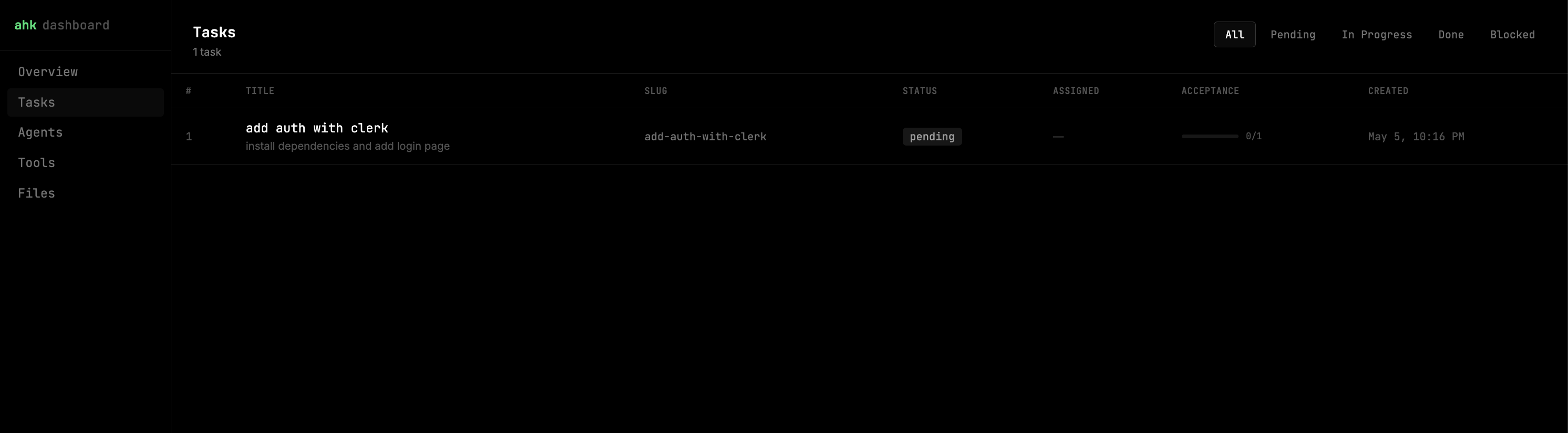
ahk status
Shows the current task table and any active agent actions in the terminal.
ahk status
ahk status --json    # machine-readable output
ahk health
Runs health.sh and reports the result. Exit 0 = healthy, exit 1 = something is wrong.
ahk health
ahk doctor
Checks the installed lib version, that every agent file is present, and that the harness skills are in sync.
ahk doctor
Reports three categories:
- lib version — compares installed version against the latest on npm. Shows
[✓]if up to date,[!]if an update is available, or[~]if the registry could not be reached. - agent files — checks only that a definition file exists for every role. Reports
[!]with the file name if one is missing. The contents are never read, so editing an agent file by hand is a fully supported state and is never reported — customise the body, the description, or the restrictions freely andahk doctorstays green. - harness skills — checks that
ahk-ask,ahk-consultant,ahk-triage, andahk-reviewskills exist and match the bundled source. Reports[!]if missing or outdated.
Run ahk build to fix any reported issues.
ahk sync
Syncs .harness/feature_list.json ↔ SQLite. Tasks already in the DB are skipped by slug. Use this to seed the backlog from the JSON file without duplicating existing tasks.
ahk sync                         # both directions (default)
ahk sync --direction in          # JSON → SQLite only
ahk sync --direction out         # SQLite → JSON only
ahk sync --dry-run               # preview changes without applying them
ahk sync --dry-run --direction in
ahk serve
Starts the MCP server on stdio. You never need to call this manually. After ahk init, the generated .claude/mcp.json (Claude Code) or opencode.json (OpenCode) tells the AI tool to spawn it automatically when you open the project.
ahk serve
ahk serve --port 3456    # store a port hint in config (stdio transport only)
--port must be an integer between 1 and 65535; an invalid value is rejected at the CLI with a clear error.
ahk task add
Interactively adds a new task to the backlog (SQLite + feature_list.json).
ahk task add
ahk task list
Lists all tasks. Optionally filter by status.
ahk task list
ahk task list --status pending
ahk task list --status in_progress
ahk task list --status done
ahk task list --status blocked
ahk task list --json             # machine-readable output
ahk task done <id|slug>
Marks a task as done. Runs the health check first if health is required — if it fails, the task is not closed.
ahk task done 3
ahk task done add-auth-flow
ahk reset
Clears harness data interactively. Only SQLite databases are managed by this command — remote Postgres/MySQL databases are intentionally skipped.
ahk reset                          # interactive — asks before deleting each item
ahk reset --force                  # skip all confirmation prompts
ahk reset --provider claude-code   # also delete agent files for this provider
ahk reset --provider opencode
ahk reset --provider codex-cli
ahk reset --provider grok-cli
What it can reset:
- The SQLite
.dbfile (plus WAL and SHM files if present) .harness/feature_list.json- Agent definition files in
.claude/agents/,.opencode/agents/,.codex/agents/, or.grok/agents/
After a reset, run ahk init to scaffold a fresh harness.
ahk migrate
ahk migrate has two subcommands: provider (migrate scaffold files to a different AI provider) and storage (migrate the harness database between storage backends). ahk migrate --to <provider> (no subcommand) is kept as a backward-compatible alias for ahk migrate provider --to <provider> — existing scripts/CI using the old form keep working unchanged.
ahk migrate provider
Migrates provider-specific files from one AI provider to another. Useful when switching from Claude Code to OpenCode or vice versa.
ahk migrate provider --to opencode
ahk migrate provider --to claude-code
ahk migrate provider --to codex-cli
ahk migrate provider --to grok-cli

# Backward-compatible alias (identical behavior):
ahk migrate --to opencode
Migrating always regenerates the target provider's agent files from scratch, so — same as ahk init and ahk build --force — it also runs that target's per-role prompt first, before anything is written: the model prompt when migrating to Claude Code, or the model and reasoning-effort prompt when migrating to Codex CLI (see ahk init above for what each prompt asks). Migrating to OpenCode or Grok CLI shows no prompt at all, since neither has a closed model enum to prompt against.
ahk migrate storage — ⚠️ sensitive, reads/writes real harness data
Migrates the harness database between storage backends: local↔global scope (moving .harness/harness.db in/out of ~/.harness/dbs/<projectId>/) and sqlite↔postgres/mysql (dumping and reloading all 6 tables — tasks, task_acceptance, actions, action_sections, action_files, action_tools — inside a single transaction). It is not interactive — agent-harness-kit.config.ts (storage.scope, storage.sqlitePath (local scope only), database.type/connectionString) is the only source of truth for the desired target, compared against the real current state recorded in .harness/storage-state.json.
ahk migrate storage             # migrate to whatever agent-harness-kit.config.ts declares
ahk migrate storage --dry-run   # preview what would happen, without touching anything
ahk migrate storage --force     # required whenever the destination already has data
What it does, case by case:
| Situation | Behavior |
|---|---|
| Config and real storage state already match | No-op — reports "nothing to migrate" |
Only storage.scope differs (same DB engine) |
Copies the .db file (+ WAL/SHM) and current.md directly to the new location, verifies the copy, then removes the original |
Only database.type differs (sqlite → postgres/mysql) |
Full export/import of all 6 tables inside one transaction; on failure, the destination is rolled back exactly as it was found |
| Destination already has data | Requires --force. Without it, the command aborts and touches nothing. With it, the destination's current content is backed up to .harness/backups/pre-migrate-<timestamp>.json before anything is overwritten — if the backup can't be written, the whole command aborts |
| Both source and destination have diverging data (not just empty vs. full) | Same as above (--force + backup required) — the command never attempts to auto-merge two independent histories |
.harness/storage-state.json is missing |
Never assumed to mean "safe, empty destination." Both the local and global sqlite candidate locations are inspected for real data first; if both have data, the command refuses to guess and asks for manual resolution |
Limitations (by design, matches the current scope):
- No connection pooling or incremental/partial migrations — always a full dump/load.
- After inserting rows with their original ids, the destination's internal id sequence is explicitly re-synced (
setvalon Postgres,sqlite_sequenceupdate on SQLite; MySQL'sAUTO_INCREMENTadvances on its own) so that the next normal task/action created after migrating never collides with an imported id. - Migrating away from a previously remote (postgres/mysql) database isn't supported automatically —
storage-state.jsonintentionally never stores connection credentials, so there's nothing to reconnect to. Export manually withahk export --jsonwhile still connected to the old database first. - The original sqlite file is not deleted after a sqlite→remote migration — remove it manually once you've verified the migrated data.
ahk export
Exports the full database as JSON or SQL. Useful for backups, external reporting, or migrating data.
ahk export --json                        # JSON to stdout
ahk export --json --output snapshot.json # JSON to file
ahk export --sql                         # SQL dump to stdout
ahk export --sql --output dump.sql       # SQL dump to file
Files created by ahk init
Claude Code (provider: 'claude-code'):
your-project/
├── agent-harness-kit.config.{json|ts|mjs|cjs}
├── AGENTS.md
├── CLAUDE.md
├── health.sh
├── .harness/
│   ├── harness.db                 ← gitignored (local scope only — absent when scope: 'global')
│   ├── current.md                 ← gitignored (local scope only — absent when scope: 'global')
│   ├── storage-state.json         ← always present, reflects the REAL current storage scope/projectId
│   └── feature_list.json
└── .claude/
    ├── agents/
    │   ├── lead.md
    │   ├── explorer.md
    │   ├── builder.md
    │   └── reviewer.md
    ├── mcp.json                   ← MCP server registration
    └── settings.json              ← sets `agent: "lead"` as the default session agent
OpenCode (provider: 'opencode'):
your-project/
├── agent-harness-kit.config.{json|ts|mjs|cjs}
├── AGENTS.md
├── health.sh
├── opencode.json                  ← MCP server + default_agent + compaction config
├── .harness/
└── .opencode/
    └── agents/
        ├── lead.md
        ├── explorer.md
        ├── builder.md
        └── reviewer.md
Codex CLI (provider: 'codex-cli'):
your-project/
├── agent-harness-kit.config.{json|ts|mjs|cjs}
├── AGENTS.md
├── health.sh
├── .harness/
└── .codex/
    ├── config.toml                ← MCP server registration
    └── agents/
        ├── lead.toml
        ├── explorer.toml
        ├── builder.toml
        ├── reviewer.toml
        └── default.toml           ← overrides Codex's built-in default agent → routes to lead
Grok Build (provider: 'grok-cli'):
your-project/
├── agent-harness-kit.config.{json|ts|mjs|cjs}
├── AGENTS.md
├── health.sh
├── .harness/
└── .grok/
    ├── config.toml                ← MCP server registration
    └── agents/
        ├── lead.md
        ├── explorer.md
        ├── builder.md
        └── reviewer.md
What each file does
| File | Purpose | Edit it? |
|---|---|---|
agent-harness-kit.config.{json|ts|mjs|cjs} |
Defines project metadata, provider, storage paths, MCP port. JSON when the package isn't installed locally, otherwise .ts/.mjs/.cjs |
Yes — it's yours |
AGENTS.md |
Navigation map agents read first. Regenerated by ahk build |
No — changes will be overwritten |
health.sh |
Shell script agents run before starting work. Must exit 0 | Yes — implement your checks here |
.harness/feature_list.json |
Task backlog in JSON. Humans edit this, ahk sync loads it into SQLite |
Yes — add tasks here |
.harness/harness.db |
SQLite database (local scope only). Source of truth for tasks, actions, sections | No — managed by the harness |
.harness/current.md |
Auto-generated session snapshot for agents without MCP access (local scope only) | No — regenerated automatically |
.harness/storage-state.json |
Always project-local. Records the REAL current storage state (scope, projectId, dbType, migratedAt) — used by migration tooling |
No — managed by the harness |
.claude/agents/*.md |
Agent role definitions (Claude Code). Created once, never overwritten (ahk build --force regenerates) |
Yes — customize agent behavior |
.claude/mcp.json |
MCP server registration for Claude Code. Merged by ahk build |
Yes, carefully — don't remove the agent-harness-kit entry |
.claude/settings.json |
Sets agent: "lead" so lead runs as the default session agent. Merged by ahk build |
Yes, carefully |
.opencode/agents/*.md |
Agent role definitions (OpenCode). Created once, never overwritten (ahk build --force regenerates) |
Yes — customize agent behavior |
opencode.json |
MCP server + default_agent + compaction config for OpenCode. Merged by ahk build |
Yes, carefully |
.codex/agents/*.toml |
Agent role definitions (Codex CLI). Created once, never overwritten (ahk build --force regenerates) |
Yes — customize agent behavior |
.codex/config.toml |
MCP server registration for Codex CLI. Merged by ahk build |
Yes, carefully |
.grok/agents/*.md |
Agent role definitions (Grok Build). Created once, never overwritten (ahk build --force regenerates) |
Yes — customize agent behavior |
.grok/config.toml |
MCP server registration for Grok Build. Merged by ahk build |
No comments yet
Be the first to share your take.