
Agent Config — every claim machine-checked, including "zero runtime daemon"








Try it in 30 seconds — drop one read-only subagent into any repo and watch it gate "done": @production-validator check this branch is actually done. No wizard, no lock-in, nothing else installed — the 30-second wedge ↓ is the whole first step. Start at the proof, not the catalog: event4u-app.github.io/agent-config/proof/.
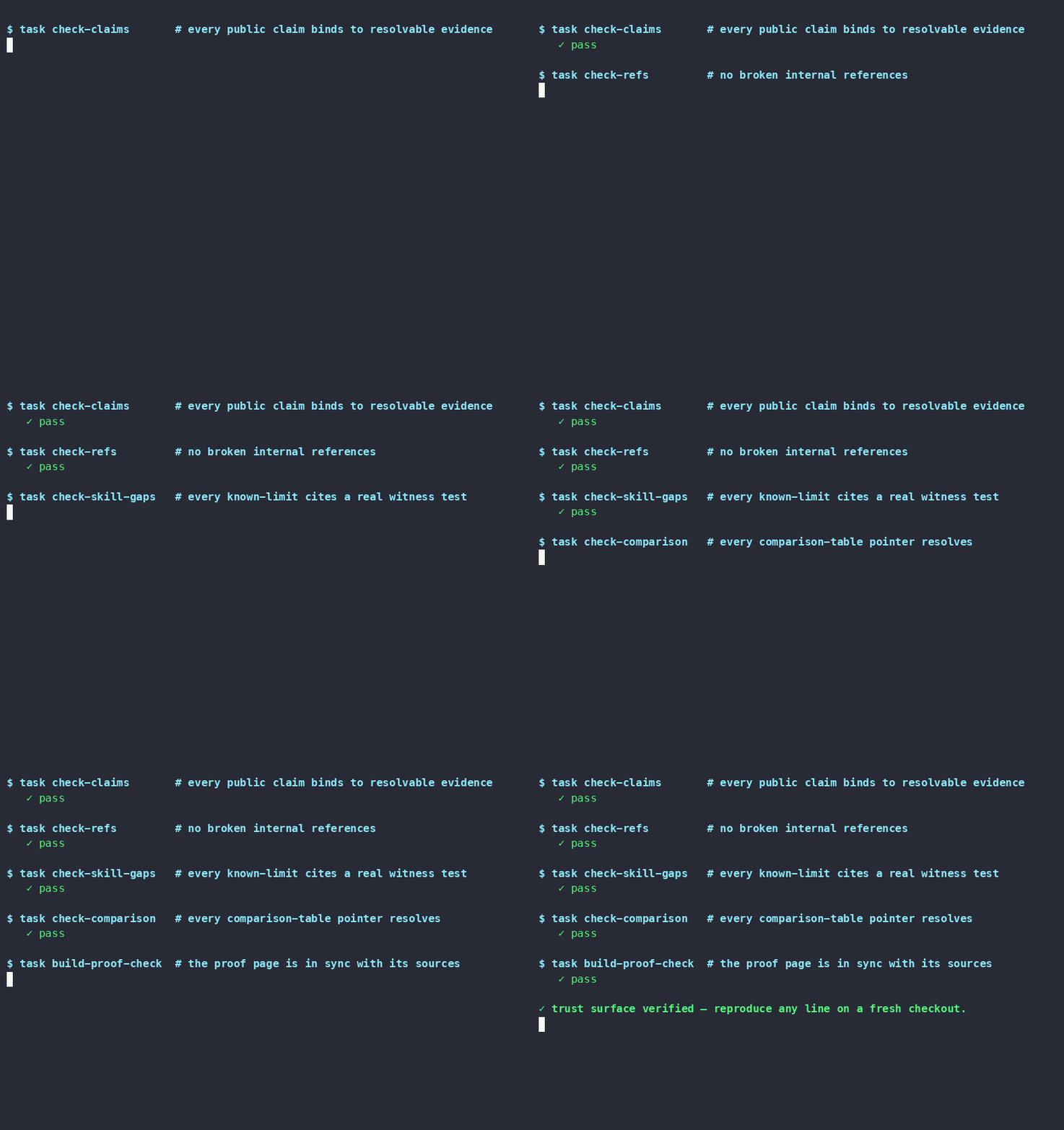
Every public claim in this README is machine-checked — verify it yourself. In a market that runs on unbacked headline numbers, this one binds each claim to resolvable evidence or fails its own build.
Choose your experience — developer · founder · content · agency · finance · ops. Add packs. Get a focused command set, not a 500-artefact dump. Bring your own AI provider.
A deep library of skills, commands and governed rules — plus a capability router that loads the right skill on intent and multi-agent orchestration with consensus review. The whole layer is compiled into 20 host agents — of 23 detected, 3 being export-only (Claude Code, Cursor, Augment, Cline, Windsurf, Copilot, Gemini CLI, Codex, Continue, Zed, JetBrains, Aider and more) — with zero runtime daemon. Six role-shaped entry paths sit on top, so any host becomes a reliable team member — without locking you to a single model or vendor.
What's different
It is both deep and disciplined — and honest about what it deliberately is not:
- Depth that routes itself — a deep skill and command library, with a capability router that loads the right one on intent, not a 500-artefact context dump.
- Governance on every host — rules compiled into each tool's native format at projection time; deterministic runtime hooks added on hook-capable hosts. This config-space, host-agnostic governance is the moat (the governance advantage · enforcement by host).
- Surgical uninstall — removes only its own keys from a shared host config (matched by JSON-pointer + SHA-256), never a neighbour tool's entries.
- Pack-scoped install — writes the active pack only, not a 500-artefact dump.
What it deliberately is not — the core is a governance layer with optional, individually opt-in embedded engines (code intelligence, gated reach, the setup GUI, the bench lab — ADR-124): no background daemon, no separate state database, no self-rewriting memory, no auto-build pipeline. Engines are never mandatory, never default-on without measured lift, and terminate with the command that invoked them. The host agent runs the loop; every learned change is human-reviewed; the same layer stays portable across tools. Capability without a process to babysit.
Where this comes from (honest provenance). The skills, rules and personas are distilled from real production work on TypeScript and PHP codebases. The governance mechanics are stack-agnostic, but the domain heuristics are richest where they were forged — treat coverage on other stacks as promising, not proven and tell us where it falls short.
See exactly what works on which host or jump to things you can do in a minute.
Pick your profile — six entry paths
agent-config setup writes profile.id to .agent-settings.yml; each
anchor below is the first-screen the wizard sends you to. One README,
six entries, no role-detection guesswork.
Profile (profile.id) |
Audience | First commands | First skills |
|---|---|---|---|
👩💻 developer |
IC engineer | /implement-ticket · /work · /review-changes · /fix · /commit |
developer-like-execution · verify-completion-evidence · minimal-safe-diff · systematic-debugging · test-driven-development |
✍️ content_creator |
Writers, ghostwriters, marketers | /work · /post-as · /ghostwriter · /optimize-prompt · /video:from-script · /video:storyboard |
voice-and-tone-design · messaging-architecture · editorial-calendar · release-comms · character-consistency |
🚀 founder |
Solo / early-stage founder | /work · /feature · /challenge-me · /council |
refine-prompt · rice-prioritization · vision-articulation · fundraising-narrative · runway-cognition |
🏛 agency |
Multi-client delivery shop | /work · /implement-ticket · /refine-ticket · /feature · /roadmap |
doc-coauthoring · decision-record · refine-ticket · estimate-ticket · perf-feedback-craft |
💼 finance |
CFO / fractional finance / FP&A | /work · /council · /challenge-me |
dcf-modeling · forecasting · scenario-modeling · unit-economics-modeling · runway-cognition |
🛡 ops |
RevOps, support, SRE-adjacent | /work · /threat-model · /review-changes · /fix |
incident-commander · dashboard-design · logging-monitoring · threat-modeling · launch-readiness |
Not sure which one? Run npx @event4u/agent-config init then
agent-config setup — the browser wizard asks a single 8-option role
question and maps to the closest profile. Source-of-truth:
src/agent-src/profiles/ ·
schema: docs/contracts/profile-system.md.
Beyond software: user-types/
(galabau · metalworking · truck — see Beyond software.
Per-profile experience pages (who it's for · first tasks · packs + flows · what is not loaded · examples): developer · content_creator · founder · agency · finance · ops.
Workflows, not raw commands
You don't memorize every command — you run a work journey. Four flows span the developer story end-to-end; each names the command you TYPE to start and the skills it composes:
| Flow | Start with | The journey |
|---|---|---|
| 🔍 Discovery | /feature:plan · /research |
explore → plan → estimate → refine, before building |
| 🔨 Implementation | /work · /implement-ticket |
plan → implement → verify → commit |
| 🔎 Review | /review-changes · /judge |
self-review → judge → quality-fix → threat-model |
| 🚢 Delivery | /commit · /pr:create |
commit in chunks → open PR → answer review |
Full detail — entry commands, canonical path, composed skills per flow:
docs/flows.md. (agent-admin — memory / analytics / config —
is platform operation, not a user-work flow.)
Creative Pack — cinematic AI video. script → character-locked image → motion+audio prompt → provider render → stitched clip, with
AIV_DRYRUN=trueas the cost-safety default. A first-class capability inside the content / creator experience — no longer the package's headline. See/video:from-script.
Legal Pack — not legal advice. The EU/DE legal pack (contract/NDA/DPA review, triage) is a research-and-drafting aid only — it does not provide legal advice, does not replace a qualified lawyer and must not be relied on for any concrete matter. It produces general information and general templates, never individual-case examination. Read
LEGAL_NOTICE.mdbefore use.
Full catalog — every skill, rule, command, guideline:
docs/catalog.md. The headline is the experience (profile + packs) and the depth behind it.
Use it in your project
Run from a consumer repo — bootstrap via npx, the agent picks up
your stack and you ship work end-to-end. New install? Start with the
Quickstart. Already installed? Supported tools
shows the wired AIs; docs/featured-commands.md
lists the end-to-end workflows (/implement-ticket, /work,
/commit, /pr:create). Deeper tour: 2-minute demo.
Install scope. Pick one scope per machine — project-local (default, recommended for application repos) or user-global (recommended for tooling repos / dotfiles). The installer refuses a second, conflicting scope via the scope_guard pre-flight. Details: docs/contracts/install-scopes.md. Cleanup when needed: bash src/scripts/cleanup_other_scope.sh --confirm.
Prove it
Don't take the claims on trust — verify them. docs/proof.md
is generated from source: a claim→evidence table (every public claim binds to a
resolvable pointer or CI fails), honest-null benchmarks including the runs where
the package changed nothing and a "verify it yourself" block you run on a fresh
checkout. The proof page fails CI if it drifts from its sources — reproducibility
is the proof. Browse it on the deployed docs site — the proof page is the primary entry:
event4u-app.github.io/agent-config/proof/.
The honest comparison frame lives at
docs/us-vs-the-category.md.
Freshest measured row: in one post-fix session, advisory context injection cut language-mirror violations 555 → 19 while the two blocking guards went 8 → 0 and 1 → 0 — advisory reduced massively, only blocking eliminated. One session and a post-hoc reading, so a recorded prior rather than a law.
Maintaining a skills catalog yourself? The anti-reskin gate that blocks
find-replace re-skin PRs here runs on your catalog too —
docs/anti-reskin-gate.md.
Audit-disciplined by construction — every memory consult, decision
key and hook concern lands in agents/runtime/state/ so you can replay it.
Core principles names the four invariants;
What agent-config is — and what it isn't
draws the scope boundary.
Contribute
Working on the package itself? Development covers the
task ci pipeline, Requirements the toolchain,
Maintainer telemetry the
opt-in measurement loop. Source-of-truth tree is
src/ (src/skills, src/rules, src/agent-src/); never hand-edit .augment/ or dist/agent-src/.
Security. Disclosure policy: SECURITY.md. Threat model: docs/threat-model.md.
Quickstart
Try one thing in 30 seconds — before the full suite, drop in a single self-contained subagent and see the discipline on your own repo:
mkdir -p .claude/agents
curl -fsSL https://raw.githubusercontent.com/event4u-app/agent-config/main/docs/wedge/production-validator/production-validator.md \
  -o .claude/agents/production-validator.md
# then in Claude Code:  @production-validator check this branch is actually done
production-validator is read-only and installs nothing else — it gates "done"
by hunting mocks/stubs on the shipped path and demanding real-system evidence
(what it does). Like it? Install the
full suite:
One command. Detection-driven — your installed AI tools are found and pre-selected. Nothing is written until you click Finish. No YAML by hand.
Those four are structural: they hold on every run, because they are properties
of the code path rather than of your machine. How long it takes is not one of
them — that is dominated by network and registry latency, which we do not
control. The install → doctor wall-clock is measured by CI on every umbrella
run and published with its conditions, as evidence; it is never a promised
number.
# 1. Install — on a terminal with a display, the browser wizard launches
#    automatically; the same TypeScript installer runs the real install behind it.
npx -y @event4u/agent-config init

# 2. Pick your profile + tools in the wizard, click Finish.
#    (Writes ~/.event4u/agent-config/, ~/.claude/, ~/.cursor/, …)

# 3. First real task — agent refines, plans, verifies.
/work "your first real task"
Headless / CI: init skips the GUI automatically on CI, on a non-TTY, on a headless host, and whenever any CLI-mode flag is present — it then runs the non-interactive installer directly. The full opt-out set is listed once, against the code, in gui-wizard § When the GUI is skipped. Pass flags (--profile=balanced --tools=claude-code,cursor); add --dry-run to preview writes. The GUI and the CLI share one installer (src/scripts/install.ts), so both produce identical results. Reference: docs/wizard.md.
Pick specific AIs: --tools=claude-code,cursor,augment,windsurf,cline,gemini-cli,copilot,roocode,aider,codex,claude-desktop,continue (any subset). Visual picker: add --gui (loopback-bound, CSRF-gated; contract gui-wizard). --gui is an opt-in that forces the wizard past the TTY and headless checks — it does not override CI, AGENT_CONFIG_NO_UI, or a CLI-mode flag; combining it with one of those exits non-zero rather than quietly running the CLI install. On a headless host add --allow-headless and connect a browser to the printed URL.
Verify hook coverage: npx @event4u/agent-config hooks:status prints the per-platform matrix (--strict for CI, --format json for tooling).
Scope (v2.5+):
initwrites global only —~/.event4u/agent-config/,~/.claude/,~/.cursor/, …. The project tree getsagents/overrides/only (the bridge marker was retired — ADR-020 amendment 2026-07-13; the global root resolves from~/.event4u/agent-config).--projectis maintainer-only behindAGENT_CONFIG_DEV_MODE=1(ADR-020, dev-mode).
Migrating from a v1.x install? npx @event4u/agent-config migrate — full notes in docs/migration/v1-to-v2.md.
What agent-config is — and what it isn't
A content layer — skills, rules, commands, guidelines, personas — distributed via npm and projected into every supported AI tool's native config format. It follows the Agent Skills open standard.
It is not an agent runtime. The agent loop, the LLM dispatcher and tool orchestration stay with the host tool (Claude Code, Augment, Cursor, Cline, Windsurf, Gemini CLI, Copilot). Think of it as a playbook and style guide for those tools — not a replacement.
| In scope | Out of scope |
|---|---|
| Skills, rules, commands, guidelines, personas | Agent loop / LLM dispatcher |
| Multi-tool projection + condensation pipeline | Execution engine inside the package |
Memory helpers (memory-add, memory-promote) |
Cross-tool observability dashboard |
| Linters, CI, frontmatter validation against JSON-Schema (contract) | Runtime GUI / web dashboard |
| Skill orchestration via citations + deterministic helpers | Opinionated automatic skill-resolver (ML / relevance ranking that decides for you) |
| User-driven projection-time filtering by profile + packs (ADR-040) | A runtime resolver / daemon (mid-session switching — conditional, post-6.0.0) |
What your agent is asked to do
| Default behavior | With agent-config |
|---|---|
| Guess and edit blindly | Analyze code before changing it |
| Drift from project conventions | Follow detected stack conventions |
| Skip or invent tests | Write tests in the project's framework |
| Generic commit messages | Conventional Commits with scope + ticket links |
| Skip quality checks | Run the project's quality pipeline and fix reported errors |
| Open PRs without context | Structured PR descriptions from Jira / Linear / GitHub |
| Claim "done" without proof | Verify with real execution before claiming done |
2-minute demo — /implement-ticket
The flagship command. Drives a ticket end-to-end through a fixed linear flow — and blocks on ambiguity instead of guessing.
/implement-ticket PROJ-123
The agent runs this sequence:
refine → memory → analyze → plan → implement → test → verify → report
- Refines the ticket if acceptance criteria are vague.
- Queries memory for past decisions, invariants, incidents.
- Plans the change; you confirm before any file is touched.
- Implements under
minimal-safe-diff+scope-control— no drive-by edits. - Tests (targeted first, full suite on success).
- Reviews the diff through four judges (bugs, security, tests, code quality).
- Reports changes, verdicts, follow-ups — then stops.
/commitand/pr:createare suggestions, never auto-run.
Any ambiguity halts the flow with numbered options — never a silent guess. Persona comes from .agent-settings.yml (roles.active_role): senior-engineer (default), qa or advisory (plan-only).
→ Command reference · Flow contract
Sibling — /work (free-form prompt)
Same engine, no ticket required:
/work add a CSV export endpoint to the audit-log controller
The first pass scores the prompt on five dimensions and routes on the band:
| Band | Score | Action |
|---|---|---|
| high | ≥ 0.8 |
Silent proceed — AC + assumptions in the report |
| medium | 0.5–0.79 |
Halts with assumptions report; confirm or edit |
| low | < 0.5 |
Halts with one clarifying question on the weakest dimension |
After the band gate, the flow is identical to /implement-ticket. Free-form goal → /work; ticket payload → /implement-ticket.
→ Command reference · refine-prompt skill
After the run: agent-config explain last reconstructs the trace (route · memory · council · halts · provider) — read-only, PII-scrubbed, offline. Docs
Product UI track
UI-shaped work routes to one of three directive sets — ui (full audit→design→apply→review→polish→report), ui-trivial (≤ 1 file, ≤ 5 lines: apply→test→report), mixed (backend + UI: contract→ui→stitch). Existing-UI audit is a hard gate (ui-audit-gate); polish has a 2-round ceiling with a11y precedence. Stack detection → blade-livewire-flux / react-shadcn / vue / plain.
→ Mental model (1 page) · Flow contract
Customize
Profiles — how much governance gets loaded
Safety floor (non-destructive defaults · ask-before-guessing · mirror-the-user's-language) ships in every profile. What changes is how much extra coaching gets pulled in.
| Profile | What you get | When to pick it |
|---|---|---|
minimal |
Non-negotiable safety floor only. Cheapest, fastest. | Quick questions · throw-away scripts · CI · tight token budgets |
balanced (default) |
Safety floor + everyday coaching (sensible defaults, review nudges, common pitfalls). | Day-to-day work |
full |
Everything, including long-tail rules normally only maintainers need. | Working on agent-config itself · audits · max-fidelity demos |
Under the hood: kernel-only · kernel + tier-1 · kernel + tier-1 + tier-2. Details: rule-router · kernel-membership · Configure →.
Stability:
STABILITY.mdfor the full matrix. Work Engine (/work+/implement-ticket): beta. Runtime Dispatcher: stable. Tool Adapters: experimental (fullprofile only).
.agent-user.md and Ghostwriter — voice primitives
| Primitive | Voice | Disclosure |
|---|---|---|
personas/*.md |
Review-lens (internal critique) | n/a |
.agent-user.md (project root, gitignored) |
The maintainer's own voice — /post-as:me |
None (you are the author) |
agents/reference/ghostwriter/<slug>.md (gitignored) |
Documented public figure — /post-as:ghostwriter |
Mandatory, non-removable footer |
Create the user file interactively: /agents user init (schema). Ghostwriter cluster: /ghostwriter:fetch <url-or-name> runs an attestation gate; private individuals rejected; paywalled / leaked / DM content banned at the schema level.
Self-hosted MCP on Cloudflare — zero local install
Skills, commands, rules and guidelines can be served as an MCP endpoint from your own Cloudflare Worker — any MCP client (Claude Desktop, Claude Code, Cursor, Zed, Continue, hosted agents) talks to it over HTTP. Two auth modes: public (default, OSS read-only deploys) and bearer-auth (operator opt-in, MCP-Token Wrangler secret).
task mcp:cloud:login         # one-time, opens browser
task mcp:cloud:setup         # check → r2-create → r2-verify → whoami
task mcp:cloud:secret-put    # opt in to bearer-auth (recommended for private deploys)
→ Operator walkthrough: mcp-cloud-setup · Per-client config: mcp-client-config · Endpoints: mcp-cloud-endpoints.
Scope — Lite, not Full. The Worker serves read-only governance (skills · commands · rules · guidelines · contexts) as MCP prompts and resources, plus small read-only tools (
memory_lookup,chat_history_read,list_*). It does not execute the ~112 Python scripts (linters, audits,task ci, work-engine hooks) — those require local install per Quickstart.
The built-in local stdio server is listed for discovery in the Glama MCP Registry (agent developers / contributors; requires a local checkout, not a turnkey install — see ADR-067).
Deployment posture
| Shape | Status | Path |
|---|---|---|
| Single-user workspace | ✅ today | npx @event4u/agent-config init — single machine, single user; no remote sync |
| Small team (3–10 people) | ✅ today | Shared agents/overrides/ Git repo + shared NAS for knowledge — no code change, no new server. Recipe: docs/deploy/small-team-recipe.md |
| Organization mode (SSO · central policy · team context · internal connectors) | ⏸ not started | Each shape gated on a recruited customer + funded audit + maintainer ADR. Posture rationale: docs/deploy/team-deployment-posture.md |
The Hard Floor on organization-mode features (SSO, central policy, OAuth connectors, team-context) is preserved by design — they stay cancelled until a real first customer + funded security audit lifts them. The small-team recipe is the supported path in the meantime.
The 9.3/10 feedback round (2026-05-25) re-asked for OAuth knowledge connectors, IAM / org governance and organization-shared memory. Each is a stable cancellation row in
team-deployment-postureunder the same three release gates — recruited team customer · funded audit · maintainer ADR.
Harness expectations
Three classes of install/runtime behaviour look like package bugs but are host-harness behaviour the package cannot control — sibling-plugin namespaces (codex:*, cc-gemini-plugin:*), deferred tools surfaced via ToolSearch and cross-scope skill drift (real bug, fixed in the distribution-channels track). Diagnostics + the package's response: docs/contracts/harness-expectations.md. First step when a skill appears twice: task probe:skills.
Supported tools
Project-installed (npx)
| Tool | Rules | Skills | Commands | How it works |
|---|---|---|---|---|
| Claude Code | ✅ | ✅ | ✅ | Reads .claude/ |
| Cursor | ✅ | — | ☑️ | Reads .cursor/rules/ + commands via AGENTS.md |
| Cline | ✅ | — | ☑️ | Reads .clinerules/ + commands via AGENTS.md |
| Windsurf | ✅ | — | ☑️ | Reads .windsurfrules + commands via AGENTS.md |
| Gemini CLI | ✅ | — | ☑️ | Reads GEMINI.md |
| GitHub Copilot | ✅ | — | ☑️ | Reads .github/copilot-instructions.md |
| Roo Code | ✅ | — | ☑️ | Auto-discovers .roo/rules/*.md + AGENTS.md |
| Codex CLI | ✅ | — | ☑️ | Auto-discovers AGENTS.md |
| Continue.dev | ✅ | — | ☑️ | Auto-discovers .continue/rules/*.md + AGENTS.md |
| Aider | 📌 | — | — | Manual read: in .aider.conf.yml |
| Augment (VSCode/IntelliJ) | 📌 | — | — | Global-only; project writes marker |
| Claude Desktop | 📌 | — | — | Global-only |
✅ native ☑️ text reference (in AGENTS.md, not invokable as native slash-command) 📌 marker only — not available
Team reproducibility: every tool you
initis recorded inagents/installed-tools.lock(committed, machine-managed). New team members runnpx @event4u/agent-config syncafter cloning; CI gates drift withagent-config validate. Schema:installed-tools-manifest.
Plugin-installed (optional, global)
| Tool | Install |
|---|---|
| Augment CLI · Copilot CLI | Install → — rules + skills + commands, marketplace-updated |
Claude Code: the marketplace plugin is deprecated (single-surface model). The npx/npm file projection now carries content and the deterministic hooks (registered in a managed
~/.claude/settings.jsonblock byagent-config global/upgrade), so the plugin only duplicates skill/command listings while its git-SHA snapshot rots silently. Existing installs:claude plugin uninstall agent-config@event4u-agent-config—agent-config doctorflags the duplicate surface.
Keep the global install current with agent-config upgrade (latest) or
agent-config refresh --global (same-version re-install); agent-config doctor
flags a missing-from-PATH binary or broken hook wiring. See
getting-started § Keeping current ·
Troubleshooting.
The command surface at a glance
| Command | What it does |
|---|---|
agent-config init |
One-shot install — opens the browser wizard (recommended path or step-by-step) |
agent-config init --project |
Initialize a project: minimal agents/ bridge + managed .gitignore block |
agent-config config |
Open the configuration GUI — global settings hub (simple + advanced tiers, search, reset-to-default) |
agent-config config --project |
Open the project configuration surface |
agent-config setup |
Re-run the guided onboarding wizard (prefilled from your current state) |
agent-config upgrade |
Update the global install to the latest release + additively sync settings |
agent-config doctor |
Read-only health/drift report |
Cloud / Hosted-agent surfaces
For platforms where the package's scripts cannot run, artefacts are built for paste-in or upload:
- Linear AI (Codegen, Charlie, …) —
dist/linear/{workspace,team,personal}.md - Claude.ai Web Skills —
dist/cloud/<skill>.zip
Works with agent-switch
agent-switch is the companion
CLI for running several agent accounts on one machine: it isolates each account
in its own profile (CLAUDE_CONFIG_DIR per profile), so switching accounts
never means logging out and back in. The two compose — agent-switch isolates
the accounts, agent-config governs what the agents do inside them. When
agent-config runs under an agent-switch profile it says so in the settings hub,
warns before writes that would land in a shared (cross-profile) tree, and
accepts a host-supplied config root so its own settings stay profile-scoped.
Who this is for
Stack-agnostic governance core (orchestration · role modes · command clusters · quality gates · audit-discipline) plus parallel stack-specific skill sets:
| Stack | Coverage |
|---|---|
| Laravel · modern PHP (deepest) | Pest · PHPStan · Rector · ECS · Eloquent · Livewire/Flux · Horizon · Pulse · Reverb · Pennant |
| Symfony | symfony-workflow (DI · Doctrine · Messenger · voters · Twig) + project-analysis |
| Next.js App Router | nextjs-patterns (RSC · Server Actions · caching · route handlers) + UI react-shadcn |
| Zend / Laminas | project-analysis + shared PHP coder/quality skills |
| React · Node / Express | project-analysis + UI react-shadcn |
| Vue · plain HTML | UI directive set (vue / plain) |
| Cross-stack | API design · testing · security · database · Docker · Git · CI · review · threat modeling · observability |
Beyond software
The same orchestration core drives non-software trades via user-types/: galabau-field-crew · metalworking-shop · truck-driver. Contribute your own — 5-minute scaffold.
Data governance & domain safety
Three domain-safety rules (domain-safety-pii, domain-safety-disclaimer, domain-safety-retention) act as per-domain output floors across ~12 areas — PII redaction (support / finance / recruiting / marketing), advice disclaimers (legal / financial / medical / consulting), retention guidance (finance / support), ops floors (logging / export). Full surface → rule → floor matrix: docs/safety.md. Beta contracts: memory-visibility-v1 · decision-trace-v1.
Code provenance & license governance
Every diff is checked against a license policy derived from the target repo's own detected license (LICENSE/package.json/composer.json, precedence-ordered; sources disagree → escalate, never guess) and a strict linter over our own borrow ledger (provenance/borrows.jsonl → docs/THIRD-PARTY-NOTICES.md) that fails a deny-class license, an unknown license, a missing transformation note or a rename-only-phrased one — wired into ci/ci-strict from day one. A third piece, license-compliance-audit, runs an offline/online similarity scan on demand — a human invokes it deliberately, never a pipeline. This is provenance-governed, license-policy-enforced borrow discipline backed by an audited borrow trail — not a copy detector.
Scope & limits
- Unconscious training-data reproduction is not detectable at this layer. No tool here — or anywhere — can see what a model's training data contained; this system governs what gets consciously borrowed and recorded, never what a model silently recalls.
- Detection, where it exists, covers a knowledge base of known OSS only — a subset of all code that has ever existed, never a model's training corpus.
- No CI-facing detection gate exists. A deterministic scanner (jscpd offline + SCANOSS online) was built and measured against a frozen synthetic corpus, but missed its own pre-registered thresholds (measured: recall 12/16, false positives 2/12, SCANOSS rename-only recall 0/8) — see
docs/CLAIMS.md. It ships in no form in CI, not even advisory — only as the on-demand skill above. - Rename-only laundering is not detected by anything we ship or evaluated. The ledger's transformation-note check rejects a rename-only-phrased note, but it cannot catch an undisclosed rename-only copy that was never logged.
Reduces and doc
No comments yet
Be the first to share your take.