
Language: English | Português (Brasil) | 简体中文 | 繁體中文 | 日本語 | 한국어 | Türkçe | Русский | Tiếng Việt | ไทย | Deutsch | Español












[!WARNING] Official sources only. Install ECC only from verified channels: the GitHub repository github.com/affaan-m/ECC, the npm packages
ecc-universalandecc-agentshield, the GitHub App, the plugin slugecc@ecc, and the project website ecc.tools. Third-party re-uploads and unofficial mirrors are not maintained or reviewed by the project and may contain malware.
211.9K+ stars | 32.5K+ forks | 230+ contributors | 12+ language ecosystems | Cross-harness agent workflows
Language / 语言 / 語言 / Dil / Язык / Ngôn ngữ / Idioma
English | Português (Brasil) | 简体中文 | 繁體中文 | 日本語 | 한국어 | Türkçe | Русский | Tiếng Việt | ไทย | Deutsch | Español
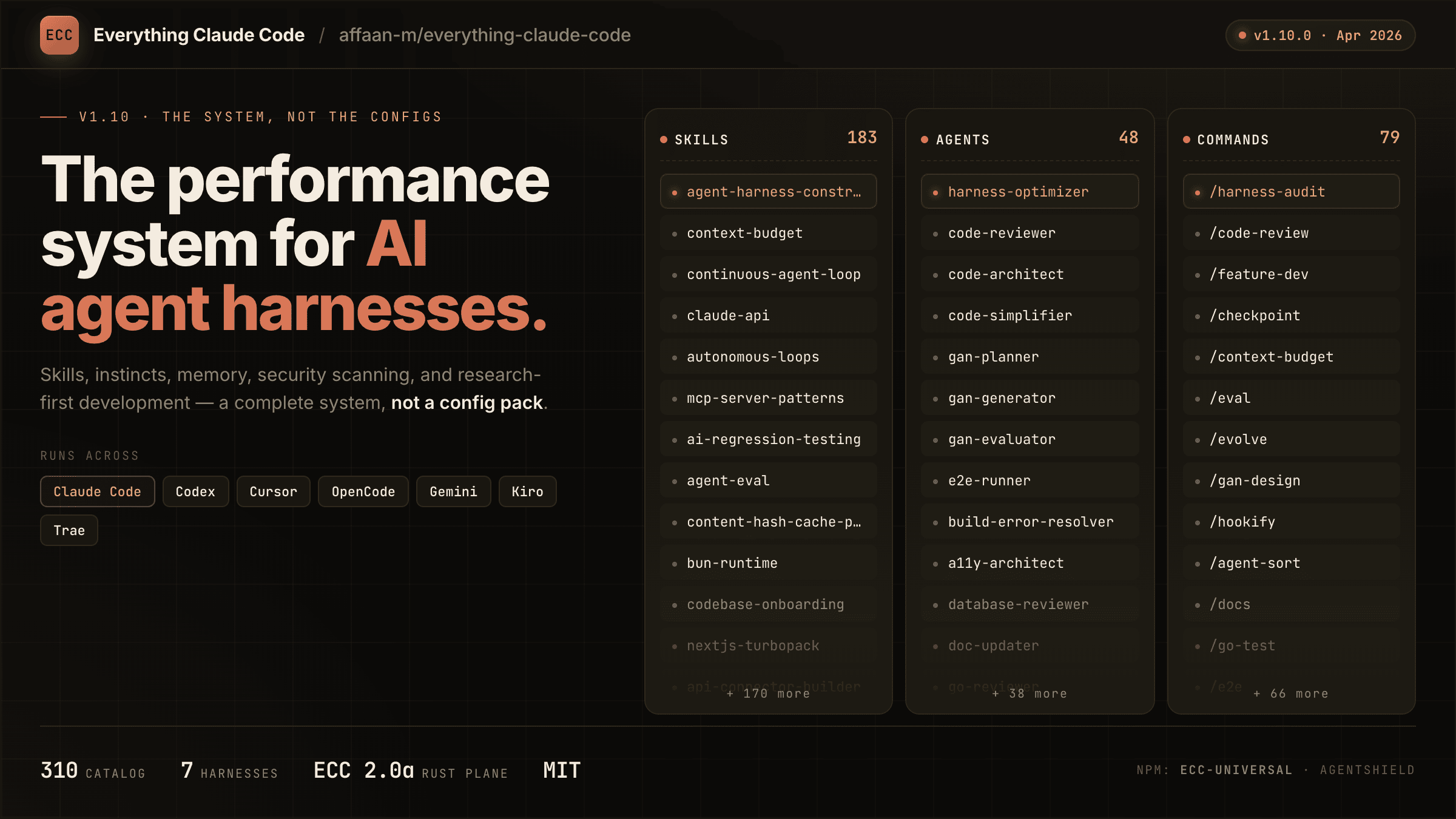
The harness-native operator system for agentic work. Built from real-world multi-harness engineering workflows.
Not just configs. A complete system: skills, instincts, memory optimization, continuous learning, security scanning, and research-first development. Production-ready agents, skills, hooks, rules, MCP configurations, and legacy command shims evolved over 10+ months of intensive daily use building real products.
Works across Codex, Claude Code, Cursor, OpenCode, Gemini, Zed, GitHub Copilot, and other AI agent harnesses.
ECC v2.0.0 adds the public Hermes operator story on top of that reusable layer: start with the Hermes setup guide, then review the 2.0.0 release notes and cross-harness architecture.
OSS stays free. This repo is MIT-licensed forever. ECC Pro is the hosted GitHub App for private repos. Sponsors and Pro subscribers fund the work — that's why a single maintainer ships weekly across 7 harnesses.
Business sponsors
Community sponsors: Mike Morgan · @jasonwu513 · @1anter · @massimotodaro · @meadmccabe
Become a Sponsor · Sponsor Tiers · Sponsorship Program
The Guides
This repo is the raw code only. The guides explain everything.
| Topic | What You'll Learn |
|---|---|
| Token Optimization | Model selection, system prompt slimming, background processes |
| Memory Persistence | Hooks that save/load context across sessions automatically |
| Continuous Learning | Auto-extract patterns from sessions into reusable skills |
| Verification Loops | Checkpoint vs continuous evals, grader types, pass@k metrics |
| Parallelization | Git worktrees, cascade method, when to scale instances |
| Subagent Orchestration | The context problem, iterative retrieval pattern |
What's New
v2.0.0 — The Agent Harness Operating System (Jun 2026)
Stable graduation of the 2.0 line: 261 skills, the control-pane substrate (session adapters + MCP inventory), the worktree-lifecycle service, the orch-* orchestrator family, and the launch of the ECC Discord community. Full notes: docs/releases/2.0.0/release-notes.md.
v2.0.0-rc.1 — Surface Refresh, Operator Workflows, and ECC 2.0 Alpha (Apr 2026)
- Dashboard GUI — New Tkinter-based desktop application (
ecc_dashboard.pyornpm run dashboard) with dark/light theme toggle, font customization, and project logo in header and taskbar. - Public surface synced to the live repo — metadata, catalog counts, plugin manifests, and install-facing docs now match the actual OSS surface: 66 agents, 268 skills, and 84 legacy command shims.
- Operator and outbound workflow expansion —
brand-voice,social-graph-ranker,connections-optimizer,customer-billing-ops,ecc-tools-cost-audit,google-workspace-ops,project-flow-ops, andworkspace-surface-auditround out the operator lane. - Media and launch tooling —
manim-video,remotion-video-creation, and upgraded social publishing surfaces make technical explainers and launch content part of the same system. - Framework and product surface growth —
nestjs-patterns, richer Codex/OpenCode install surfaces, and expanded cross-harness packaging keep the repo usable beyond Claude Code alone. - Itô prediction-market skill pack —
ito-market-intelligence,ito-basket-compare,ito-trade-planner,ito-data-atlas-agent,prediction-market-oracle-research, andprediction-market-risk-reviewadd public, non-advisory market/basket workflows while keeping live Itô API access gated and separate from ECC Tools billing. - Optimization skill pack —
parallel-execution-optimizer,benchmark-optimization-loop,data-throughput-accelerator,latency-critical-systems, andrecursive-decision-ledgerturn repeated speed/recursion prompts into bounded benchmark, throughput, and decision-ledger workflows. - ECC 2.0 alpha is in-tree — the Rust control-plane prototype in
ecc2/now builds locally and exposesdashboard,start,sessions,status,stop,resume, anddaemoncommands. It is usable as an alpha, not yet a general release. - Operator status snapshots —
ecc status --markdown --write status.mdturns the local state store into a portable handoff covering readiness, active sessions, skill-run health, install health, pending governance events, and linked work items from Linear/GitHub/handoffs. Useecc work-items upsert ...for manual entries,ecc work-items sync-github --repo owner/repofor PR/issue queue state, andecc status --exit-codeto fail automation when readiness needs attention. - Ecosystem hardening — AgentShield, ECC Tools cost controls, billing portal work, and website refreshes continue to ship around the core plugin instead of drifting into separate silos.
v1.9.0 — Selective Install & Language Expansion (Mar 2026)
- Selective install architecture — Manifest-driven install pipeline with
install-plan.jsandinstall-apply.jsfor targeted component installation. State store tracks what's installed and enables incremental updates. - 6 new agents —
typescript-reviewer,pytorch-build-resolver,java-build-resolver,java-reviewer,kotlin-reviewer,kotlin-build-resolverexpand language coverage to 10 languages. - New skills —
pytorch-patternsfor deep learning workflows,documentation-lookupfor API reference research,bun-runtimeandnextjs-turbopackfor modern JS toolchains, plus 8 operational domain skills andmcp-server-patterns. - Session & state infrastructure — SQLite state store with query CLI, session adapters for structured recording, skill evolution foundation for self-improving skills.
- Orchestration overhaul — Harness audit scoring made deterministic, orchestration status and launcher compatibility hardened, observer loop prevention with 5-layer guard.
- Observer reliability — Memory explosion fix with throttling and tail sampling, sandbox access fix, lazy-start logic, and re-entrancy guard.
- 12 language ecosystems — New rules for Java, PHP, Perl, Kotlin/Android/KMP, C++, and Rust join existing TypeScript, Python, Go, and common rules.
- Community contributions — Korean and Chinese translations, biome hook optimization, video processing skills, operational skills, PowerShell installer, Antigravity IDE support.
- CI hardening — 19 test failure fixes, catalog count enforcement, install manifest validation, and full test suite green.
v1.8.0 — Harness Performance System (Mar 2026)
- Harness-first release — ECC is now explicitly framed as an agent harness performance system, not just a config pack.
- Hook reliability overhaul — SessionStart root fallback, Stop-phase session summaries, and script-based hooks replacing fragile inline one-liners.
- Hook runtime controls —
ECC_HOOK_PROFILE=minimal|standard|strictandECC_DISABLED_HOOKS=...for runtime gating without editing hook files. - New harness commands —
/harness-audit,/loop-start,/loop-status,/quality-gate,/model-route. - NanoClaw v2 — model routing, skill hot-load, session branch/search/export/compact/metrics.
- Cross-harness parity — behavior tightened across Claude Code, Cursor, OpenCode, and Codex app/CLI.
- 997 internal tests passing — full suite green after hook/runtime refactor and compatibility updates.
v1.7.0 — Cross-Platform Expansion & Presentation Builder (Feb 2026)
- Codex app + CLI support — Direct
AGENTS.md-based Codex support, installer targeting, and Codex docs frontend-slidesskill — Zero-dependency HTML presentation builder with PPTX conversion guidance and strict viewport-fit rules- 5 new generic business/content skills —
article-writing,content-engine,market-research,investor-materials,investor-outreach - Broader tool coverage — Cursor, Codex, and OpenCode support tightened so the same repo ships cleanly across all major harnesses
- 992 internal tests — Expanded validation and regression coverage across plugin, hooks, skills, and packaging
v1.6.0 — Codex CLI, AgentShield & Marketplace (Feb 2026)
- Codex CLI support — New
/codex-setupcommand generatescodex.mdfor OpenAI Codex CLI compatibility - 7 new skills —
search-first,swift-actor-persistence,swift-protocol-di-testing,regex-vs-llm-structured-text,content-hash-cache-pattern,cost-aware-llm-pipeline,skill-stocktake - AgentShield integration —
/security-scanskill runs AgentShield directly from Claude Code; 1282 tests, 102 rules - GitHub Marketplace — ECC Tools GitHub App live at github.com/marketplace/ecc-tools with free/pro/enterprise tiers
- 30+ community PRs merged — Contributions from 30 contributors across 6 languages
- 978 internal tests — Expanded validation suite across agents, skills, commands, hooks, and rules
v1.4.1 — Bug Fix (Feb 2026)
- Fixed instinct import content loss —
parse_instinct_file()was silently dropping all content after frontmatter (Action, Evidence, Examples sections) during/instinct-import. (#148, #161)
v1.4.0 — Multi-Language Rules, Installation Wizard & PM2 (Feb 2026)
- Interactive installation wizard — New
configure-eccskill provides guided setup with merge/overwrite detection - PM2 & multi-agent orchestration — 6 new commands (
/pm2,/multi-plan,/multi-execute,/multi-backend,/multi-frontend,/multi-workflow) for managing complex multi-service workflows - Multi-language rules architecture — Rules restructured from flat files into
common/+typescript/+python/+golang/directories. Install only the languages you need - Chinese (zh-CN) translations — Complete translation of all agents, commands, skills, and rules (80+ files)
- GitHub Sponsors support — Sponsor the project via GitHub Sponsors
- Enhanced CONTRIBUTING.md — Detailed PR templates for each contribution type
v1.3.0 — OpenCode Plugin Support (Feb 2026)
- Full OpenCode integration — 12 agents, 24 commands, 16 skills with hook support via OpenCode's plugin system (20+ event types)
- 3 native custom tools — run-tests, check-coverage, security-audit
- LLM documentation —
llms.txtfor comprehensive OpenCode docs
v1.2.0 — Unified Commands & Skills (Feb 2026)
- Python/Django support — Django patterns, security, TDD, and verification skills
- Java Spring Boot skills — Patterns, security, TDD, and verification for Spring Boot
- Session management —
/sessionscommand for session history - Continuous learning v2 — Instinct-based learning with confidence scoring, import/export, evolution
See the full changelog in Releases.
Quick Start
Get up and running in under 2 minutes:
Pick one path only
Most Claude Code users should use exactly one install path:
- Recommended default: install the Claude Code plugin, then copy only the rule folders you actually want.
- Use the manual installer only if you want finer-grained control, want to avoid the plugin path entirely, or your Claude Code build has trouble resolving the self-hosted marketplace entry.
- Do not stack install methods. The most common broken setup is:
/plugin installfirst, theninstall.sh --profile fullornpx ecc-install --profile fullafterward.
If you already layered multiple installs and things look duplicated, skip straight to Reset / Uninstall ECC.
Low-context / no-hooks path
If hooks feel too global or you only want ECC's rules, agents, commands, and core workflow skills, skip the plugin and use the minimal manual profile:
./install.sh --profile minimal --target claude
.\install.ps1 --profile minimal --target claude
# or
npx ecc-install --profile minimal --target claude
This profile intentionally excludes hooks-runtime.
If you want the normal core profile but need hooks off, use:
./install.sh --profile core --without baseline:hooks --target claude
Add hooks later only if you want runtime enforcement:
./install.sh --target claude --modules hooks-runtime
Find the right components first
If you are not sure which ECC profile or component to install, ask the packaged advisor from any project:
npx ecc consult "security reviews" --target claude
It returns matching components, related profiles, and preview/install commands. Use the preview command before installing if you want to inspect the exact file plan.
For production ML/MLOps workflows, keep the install opt-in and component-scoped:
npx ecc consult "mlops training model deployment" --target claude
npx ecc install --profile minimal --target claude --with capability:machine-learning
Step 1: Install the Plugin (Recommended)
NOTE: The plugin is convenient, but the OSS installer below is still the most reliable path if your Claude Code build has trouble resolving self-hosted marketplace entries.
# Add marketplace
/plugin marketplace add https://github.com/affaan-m/ECC

# Install plugin
/plugin install ecc@ecc
Naming + Migration Note
ECC now has three public identifiers, and they are not interchangeable:
- GitHub source repo:
affaan-m/ECC - Claude marketplace/plugin identifier:
ecc@ecc - npm package:
ecc-universal
This is intentional. Anthropic marketplace/plugin installs are keyed by a canonical plugin identifier, so ECC uses ecc@ecc to keep tool names and slash-command namespaces short enough for strict Desktop/API validators. Older posts may still show the former long marketplace identifier; treat that as a legacy alias only. Separately, the npm package stayed on ecc-universal, so npm installs and marketplace installs intentionally use different names.
Step 2: Install Rules Only If You Need Them
WARNING: Important: Claude Code plugins cannot distribute
rulesautomatically.If you already installed ECC via
/plugin install, do not run./install.sh --profile full,.\install.ps1 --profile full, ornpx ecc-install --profile fullafterward. The plugin already loads ECC skills, commands, and hooks. Running the full installer after a plugin install copies those same surfaces into your user directories and can create duplicate skills plus duplicate runtime behavior.For plugin installs, manually copy only the
rules/directories you want under~/.claude/rules/ecc/. Start withrules/commonplus one language or framework pack you actually use. Do not copy every rules directory unless you explicitly want all of that context in Claude.Use the full installer only when you are doing a fully manual ECC install instead of the plugin path.
If your local Claude setup was wiped or reset, that does not mean you need to repurchase ECC. Start with
node scripts/ecc.js list-installed, then runnode scripts/ecc.js doctorandnode scripts/ecc.js repairbefore reinstalling anything. That usually restores ECC-managed files without rebuilding your setup. If the problem is account or marketplace access for ECC Tools, handle billing/account recovery separately.
# Clone the repo first
git clone https://github.com/affaan-m/ECC.git
cd ECC

# Install dependencies (pick your package manager)
npm install        # or: pnpm install | yarn install | bun install

# Plugin install path: copy only ECC rules into an ECC-owned namespace
mkdir -p ~/.claude/rules/ecc
cp -R rules/common ~/.claude/rules/ecc/
cp -R rules/typescript ~/.claude/rules/ecc/

# Fully manual ECC install path (use this instead of /plugin install)
# ./install.sh --profile full
# Windows PowerShell

# Plugin install path: copy only ECC rules into an ECC-owned namespace
New-Item -ItemType Directory -Force -Path "$HOME/.claude/rules/ecc" | Out-Null
Copy-Item -Recurse rules/common "$HOME/.claude/rules/ecc/"
Copy-Item -Recurse rules/typescript "$HOME/.claude/rules/ecc/"

# Fully manual ECC install path (use this instead of /plugin install)
# .\install.ps1 --profile full
# npx ecc-install --profile full
For manual install instructions see the README in the rules/ folder. When copying rules manually, copy the whole language directory (for example rules/common or rules/golang), not the files inside it, so relative references keep working and filenames do not collide.
Fully manual install (Fallback)
Use this only if you are intentionally skipping the plugin path:
./install.sh --profile full
.\install.ps1 --profile full
# or
npx ecc-install --profile full
If you choose this path, stop there. Do not also run /plugin install.
Reset / Uninstall ECC
If ECC feels duplicated, intrusive, or broken, do not keep reinstalling it on top of itself.
- Plugin path: remove the plugin from Claude Code, then delete the specific rule folders you manually copied under
~/.claude/rules/ecc/. - Manual installer / CLI path: from the repo root, preview removal first:
node scripts/uninstall.js --dry-run
Then remove ECC-managed files:
node scripts/uninstall.js
You can also use the lifecycle wrapper:
node scripts/ecc.js list-installed
node scripts/ecc.js doctor
node scripts/ecc.js repair
node scripts/ecc.js uninstall --dry-run
ECC only removes files recorded in its install-state. It will not delete unrelated files it did not install.
If you stacked methods, clean up in this order:
- Remove the Claude Code plugin install.
- Run the ECC uninstall command from the repo root to remove install-state-managed files.
- Delete any extra rule folders you copied manually and no longer want.
- Reinstall once, using a single path.
Step 3: Start Using
# Skills are the primary workflow surface.
# Existing slash-style command names still work while ECC migrates off commands/.

# Plugin install uses the canonical namespaced form
/ecc:plan "Add user authentication"

# Manual install keeps the shorter slash form:
# /plan "Add user authentication"

# Check available commands
/plugin list ecc@ecc
That's it! You now have access to 67 agents, 278 skills, and 94 legacy command shims.
Dashboard GUI
Launch the desktop dashboard to visually explore ECC components:
npm run dashboard
# or
python3 ./ecc_dashboard.py
Features:
- Tabbed interface: Agents, Skills, Commands, Rules, Settings
- Dark/Light theme toggle
- Font customization (family & size)
- Project logo in header and taskbar
- Search and filter across all components
Multi-model commands require additional setup
WARNING:
multi-*commands are not covered by the base plugin/rules install above.To use
/multi-plan,/multi-execute,/multi-backend,/multi-frontend, and/multi-workflow, you must also install theccg-workflowruntime.Initialize it with
npx ccg-workflow.That runtime provides the external dependencies these commands expect, including:
~/.claude/bin/codeagent-wrapper~/.claude/.ccg/prompts/*Without
ccg-workflow, thesemulti-*commands will not run correctly.
Cross-Platform Support
This plugin now fully supports Windows, macOS, and Linux, alongside tight integration across major IDEs (Cursor, Zed, OpenCode, Antigravity) and CLI harnesses. All hooks and scripts have been rewritten in Node.js for maximum compatibility.
Package Manager Detection
The plugin automatically detects your preferred package manager (npm, pnpm, yarn, or bun) with the following priority:
- Environment variable:
CLAUDE_PACKAGE_MANAGER - Project config:
.claude/package-manager.json - package.json:
packageManagerfield - Lock file: Detection from package-lock.json, yarn.lock, pnpm-lock.yaml, or bun.lockb
- Global config:
~/.claude/package-manager.json - Fallback: First available package manager
To set your preferred package manager:
# Via environment variable
export CLAUDE_PACKAGE_MANAGER=pnpm

# Via global config
node scripts/setup-package-manager.js --global pnpm

# Via project config
node scripts/setup-package-manager.js --project bun

# Detect current setting
node scripts/setup-package-manager.js --detect
Or use the /setup-pm command in Claude Code.
Hook Runtime Controls
Use runtime flags to tune strictness or disable specific hooks temporarily:
# Hook strictness profile (default: standard)
export ECC_HOOK_PROFILE=standard

# Comma-separated hook IDs to disable
export ECC_DISABLED_HOOKS="pre:bash:tmux-reminder,post:edit:typecheck"

# Cap SessionStart additional context (default: 8000 chars)
export ECC_SESSION_START_MAX_CHARS=4000

# Disable SessionStart additional context entirely for low-context/local-model setups
export ECC_SESSION_START_CONTEXT=off

# Session-tmp retention window in days (default: 30).
# Set to 0, off, false, disabled, never, or none to keep all sessions (disable pruning).
export ECC_SESSION_RETENTION_DAYS=14

# Cap how many learned instincts SessionStart injects into context (default: 6)
export ECC_MAX_INJECTED_INSTINCTS=6

# Minimum confidence an instinct needs to be injected, 0-1 (default: 0.7)
export ECC_INSTINCT_CONFIDENCE_THRESHOLD=0.7

# Keep context/scope/loop warnings but suppress API-rate cost estimates
export ECC_CONTEXT_MONITOR_COST_WARNINGS=off
Windows PowerShell:
[Environment]::SetEnvironmentVariable('ECC_CONTEXT_MONITOR_COST_WARNINGS', 'off', 'User')
[Environment]::SetEnvironmentVariable('ECC_SESSION_RETENTION_DAYS', '14', 'User')
Agent data home (multi-harness isolation)
Memory persistence hooks (session summaries, learned skills, session aliases, metrics) store data under a single agent data root. By default that root is ~/.claude. When you use ECC in both Claude Code and Cursor on the same machine, set a separate root for Cursor so the two environments do not overwrite each other's session files:
# Cursor-only boundary (Claude Code keeps the default ~/.claude)
export ECC_AGENT_DATA_HOME="$HOME/.cursor/ecc"
Paths resolved under that root include:
$ECC_AGENT_DATA_HOME/session-data/— session summaries$ECC_AGENT_DATA_HOME/skills/learned/— learned skills from evaluate-session$ECC_AGENT_DATA_HOME/session-aliases.json— session aliases$ECC_AGENT_DATA_HOME/metrics/— cost and activity metrics
See affaan-m/ECC#2065.
What's Inside
This repo is a Claude Code plugin - install it directly or copy components manually.
ECC/
|-- .claude-plugin/   # Plugin and marketplace manifests
|   |-- plugin.json         # Plugin metadata and component paths
|   |-- marketplace.json    # Marketplace catalog for /plugin marketplace add
|
|-- agents/           # 67 specialized subagents for delegation
|   |-- planner.md           # Feature implementation planning
|   |-- architect.md         # System design decisions
|   |-- tdd-guide.md         # Test-driven development
|   |-- code-reviewer.md     # Quality and security review
|   |-- security-reviewer.md # Vulnerability analysis
|   |-- build-error-resolver.md
|   |-- e2e-runner.md        # Playwright E2E testing
|   |-- refactor-cleaner.md  # Dead code cleanup
|   |-- doc-updater.md       # Documentation sync
|   |-- docs-lookup.md       # Documentation/API lookup
|   |-- chief-of-staff.md    # Communication triage and drafts
|   |-- loop-operator.md     # Autonomous loop execution
|   |-- harness-optimizer.md # Harness config tuning
|   |-- cpp-reviewer.md      # C++ code review
|   |-- cpp-build-resolver.md # C++ build error resolution
|   |-- fsharp-reviewer.md   # F# functional code review
|   |-- go-reviewer.md       # Go code review
|   |-- go-build-resolver.md # Go build error resolution
|   |-- python-reviewer.md   # Python code review
|   |-- database-reviewer.md # Database/Supabase review
|   |-- typescript-reviewer.md # TypeScript/JavaScript code review
|   |-- java-reviewer.md     # Java/Spring Boot code review
|   |-- java-build-resolver.md # Java/Maven/Gradle build errors
|   |-- kotlin-reviewer.md   # Kotlin/Android/KMP code review
|   |-- kotlin-build-resolver.md # Kotlin/Gradle build errors
|   |-- harmonyos-app-resolver.md # HarmonyOS/ArkTS app development
|   |-- rust-reviewer.md     # Rust code review
|   |-- rust-build-resolver.md # Rust build error resolution
|   |-- pytorch-build-resolver.md # PyTorch/CUDA training errors
|   |-- mle-reviewer.md      # Production ML pipeline, eval, serving, and monitoring review
|
|-- skills/           # Workflow definitions and domain knowledge
|   |-- coding-standards/           # Language best practices
|   |-- clickhouse-io/              # ClickHouse analytics, queries, data engineering
|   |-- backend-patterns/           # API, database, caching patterns
|   |-- frontend-patterns/          # React, Next.js patterns
|   |-- frontend-slides/            # HTML slide decks and PPTX-to-web presentation workflows (NEW)
|   |-- article-writing/            # Long-form writing in a supplied voice without generic AI tone (NEW)
|   |-- content-engine/             # Multi-platform social content and repurposing workflows (NEW)
|   |-- market-research/            # Source-attributed market, competitor, and investor research (NEW)
|   |-- investor-materials/         # Pitch decks, one-pagers, memos, and financial models (NEW)
|   |-- investor-outreach/          # Personalized fundraising outreach and follow-up (NEW)
|   |-- continuous-learning/        # Legacy v1 Stop-hook pattern extraction
|   |-- continuous-learning-v2/     # Instinct-based learning with confidence scoring
|   |-- iterative-retrieval/        # Progressive context refinement for subagents
|   |-- strategic-compact/          # Manual compaction suggestions (Longform Guide)
|   |-- tdd-workflow/               # TDD methodology
|   |-- security-review/            # Security checklist
|   |-- eval-harness/               # Verification loop evaluation (Longform Guide)
|   |-- verification-loop/          # Continuous verification (Longform Guide)
|   |-- videodb/                   # Video and audio: ingest, search, edit, generate, stream (NEW)
|   |-- golang-patterns/            # Go idioms and best practices
|   |-- golang-testing/             # Go testing patterns, TDD, benchmarks
|   |-- cpp-coding-standards/         # C++ coding standards from C++ Core Guidelines (NEW)
|   |-- cpp-testing/                # C++ testing with GoogleTest, CMake/CTest (NEW)
|   |-- django-patterns/            # Django patterns, models, views (NEW)
|   |-- django-security/            # Django security best practices (NEW)
|   |-- django-tdd/                 # Django TDD workflow (NEW)
|   |-- django-verification/        # Django verification loops (NEW)
|   |-- laravel-patterns/           # Laravel architecture patterns (NEW)
|   |-- laravel-security/           # Laravel security best practices (NEW)
|   |-- laravel-tdd/                # Laravel TDD workflow (NEW)
|   |-- laravel-verification/       # Laravel verification loops (NEW)
|   |-- python-patterns/            # Python idioms and best practices (NEW)
|   |-- python-testing/             # Python testing with pytest (NEW)
|   |-- quarkus-patterns/            # Java Quarkus patterns (NEW)
|   |-- quarkus-security/            # Quarkus security (NEW)
|   |-- quarkus-tdd/                 # Quarkus TDD (NEW)
|   |-- quarkus-verification/        # Quarkus verification (NEW)
|   |-- springboot-patterns/        # Java Spring Boot patterns (NEW)
|   |-- springboot-security/        # Spring Boot security (NEW)
|   |-- springboot-tdd/             # Spring Boot TDD (NEW)
|   |-- springboot-verification/    # Spring Boot verification (NEW)
|   |-- configure-ecc/              # Interactive installation wizard (NEW)
|   |-- security-scan/              # AgentShield security auditor integration (NEW)
|   |-- java-coding-standards/     # Java coding standards (NEW)
|   |-- jpa-patterns/              # JPA/Hibernate patterns (NEW)
|   |-- postgres-patterns/         # PostgreSQL optimization patterns (NEW)
|   |-- nutrient-document-processing/ # Document processing with Nutrient API (NEW)
|   |-- docs/examples/project-guidelines-template.md  # Template for project-specific skills
|   |-- database-migrations/         # Migration patterns (Prisma, Drizzle, Django, Go) (NEW)
|   |-- api-design/                  # REST API design, pagination, error responses (NEW)
|   |-- deployment-patterns/         # CI/CD, Docker, health checks, rollbacks (NEW)
|   |-- docker-patterns/            # Docker Compose, networking, volumes, container security (NEW)
|   |-- e2e-testing/                 # Playwright E2E patterns and Page Object Model (NEW)
|   |-- content-hash-cache-pattern/  # SHA-256 content hash caching for file processing (NEW)
|   |-- cost-aware-llm-pipeline/     # LLM cost optimization, model routing, budget tracking (NEW)
|   |-- regex-vs-llm-structured-text/ # Decision framework: regex vs LLM for text parsing (NEW)
|   |-- swift-actor-persistence/     # Thread-safe Swift data persistence with actors (NEW)
|   |-- swift-protocol-di-testing/   # Protocol-based DI for testable Swift code (NEW)
|   |-- search-first/               # Research-before-coding workflow (NEW)
|   |-- skill-stocktake/            # Audit skills and commands for quality (NEW)
|   |-- liquid-glass-design/         # iOS 26 Liquid Glass design system (NEW)
|   |-- foundation-models-on-device/ # Apple on-device LLM with FoundationModels (NEW)
|   |-- swift-concurrency-6-2/       # Swift 6.2 Approachable Concurrency (NEW)
|   |-- mle-workflow/               # Production ML data contracts, evals, deployment, monitoring (NEW)
|   |-- perl-patterns/             # Modern Perl 5.36+ idioms and best practices (NEW)
|   |-- perl-security/             # Perl security patterns, taint mode, safe I/O (NEW)
|   |-- perl-testing/              # Perl TDD with Test2::V0, prove, Devel::Cover (NEW)
|   |-- autonomous-loops/           # Autonomous loop patterns: sequential pipelines, PR loops, DAG orchestration (NEW)
|   |-- plankton-code-quality/      # Write-time code quality enforcement with Plankton hooks (NEW)
|   |-- codehealth-mcp/             # Optional CodeScene Code Health MCP skill (opt-in; not enabled by default) (NEW)
|
|-- commands/         # Maintained slash-entry compatibility; prefer skills/
|   |-- plan.md             # /plan - Implementation planning
|   |-- code-review.md      # /code-review - Quality review
|   |-- build-fix.md        # /build-fix - Fix build errors
|   |-- refactor-clean.md   # /refactor-clean - Dead code removal
|   |-- quality-gate.md     # /quality-gate - Verification gate
|   |-- learn.md            # /learn - Extract patterns mid-session (Longform Guide)
|   |-- learn-eval.md       # /learn-eval - Extract, evaluate, and save patterns (NEW)
|   |-- checkpoint.md       # /checkpoint - Save verification state (Longform Guide)
|   |-- setup-pm.md         # /setup-pm - Configure package manager
|   |-- go-review.md        # /go-review - Go code review (NEW)
|   |-- go-test.md          # /go-test - Go TDD workflow (NEW)
|   |-- go-build.md         # /go-build - Fix Go build errors (NEW)
|   |-- skill-create.md     # /skill-create - Generate skills from git history (NEW)
|   |-- instinct-status.md  # /instinct-status - View learned instincts (NEW)
|   |-- instinct-import.md  # /instinct-import - Import instincts (NEW)
|   |-- instinct-export.md  # /instinct-export
No comments yet
Be the first to share your take.